Art! Art! Art! › Works
Madame Georges Charpentier and her Children
 Pierre-Auguste Renoir, 1878
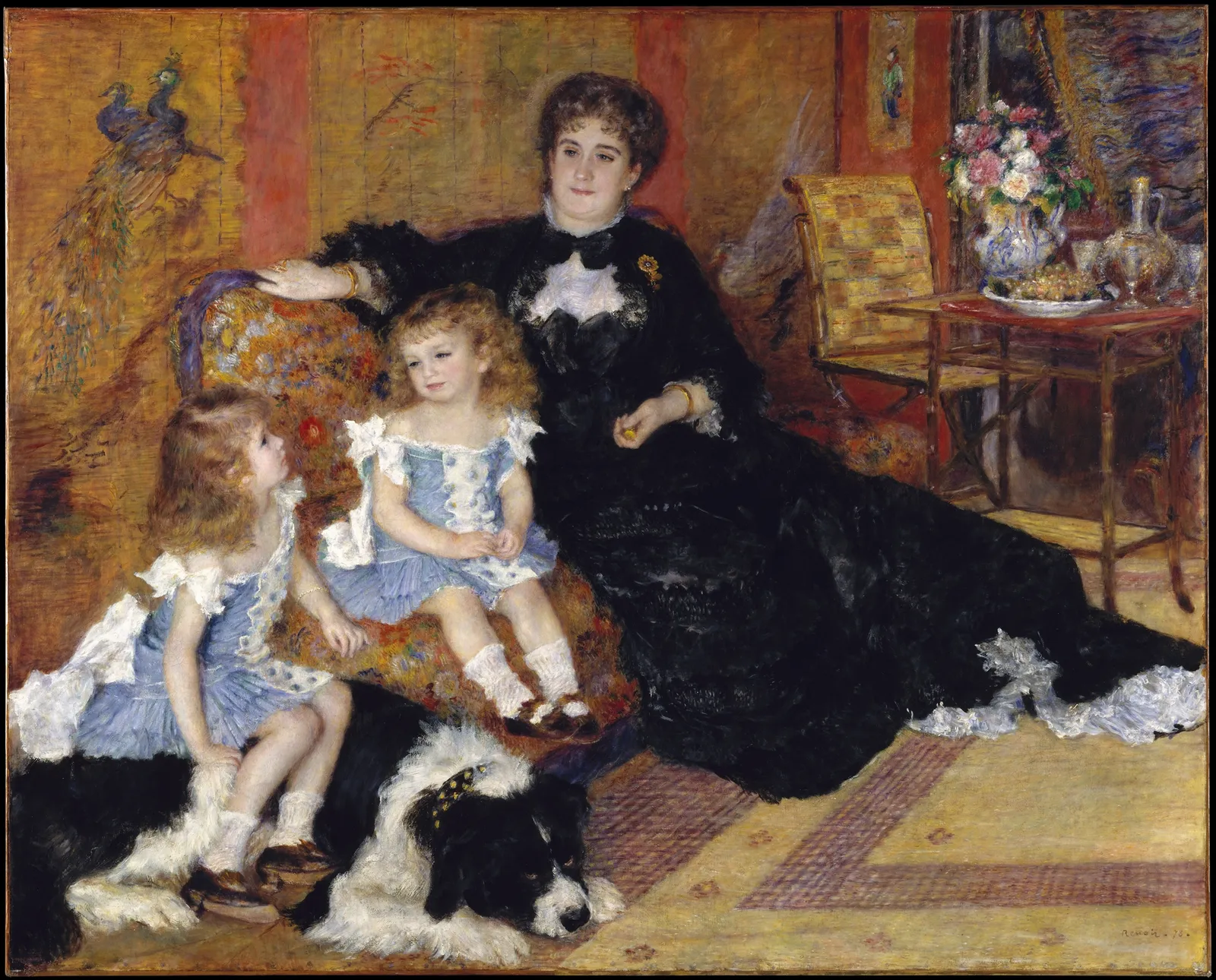
Pierre-Auguste Renoir's Madame Georges Charpentier and her Children, dated 1878, is a large family portrait set in a fashionable Parisian interior. It is in the collection of the Metropolitan Museum of Art, where visitors can study how Renoir combined a formal commissioned portrait with the loose, lively brushwork associated with Impressionism.
Where to see it
The painting belongs to the Metropolitan Museum of Art, which is also listed as its location. Works in large museum collections can be moved, rotated off view or lent to other institutions, so check the Metropolitan Museum of Art's official website for current display status before you visit. The museum's online collection page and visitor information are the most reliable sources for planning your trip.
What to look for in person
The girl and the dog
Start in the lower left corner. The elder child, Georgette, sits on the back of a large black-and-white dog that lies calmly across the carpet. The dog's dark, heavy body anchors that side of the composition and contrasts with the light blue of the child's clothing. Look at how Renoir paints the fur with broad, soft strokes rather than sharp detail, and notice the child's relaxed pose. The grouping gives the portrait a domestic, informal feeling, even though the scene was carefully arranged.
Two children dressed alike
Beside their mother on the sofa sits the younger child, Paul. Many visitors assume both children are girls, because they wear matching outfits and similar long hair. In the period, it was common for young boys of well-off families to be dressed this way before they were old enough for boys' clothing. Compare the two children's faces and the way Renoir uses touches of white and blue to tie them together visually. Their matching dress also links them to each other and to the mother's protective presence.
Madame Charpentier and her room
Madame Charpentier, in a dark dress, forms the strong vertical center of the group. Her black clothing sets off the pale tones of the children and the warm colors of the room around them. Step back and look at the interior: the decor reflects the Japanese-inspired taste, often called Japonisme, that was fashionable in Paris at the time. Notice the diagonal arrangement of the figures from upper right to lower left, which leads your eye across the wide canvas and into the setting.
About the painting
The painting shows Marguerite Charpentier, wife of the Paris publisher Georges Charpentier, with their two children, Georgette and Paul. Georges Charpentier published writers associated with literary Naturalism, including Emile Zola, and the couple were supporters of artists in their circle, among them Renoir. Madame Charpentier hosted a well-known salon where writers, artists and politicians met, and a portrait of her family was a public statement of the household's taste and social standing.
Renoir dated the work 1878. It measures 153.7 by 190.2 centimeters, so it is a large, horizontal canvas, closer in scale to an exhibition painting than to an intimate likeness. That size matters when you stand in front of it: the figures are presented at a scale that invites you into the room, and the wide format gives space to the furnishings and decor as well as the sitters.
The portrait was shown at the Paris Salon of 1879, and its reception there is widely regarded as an important moment in Renoir's career. It demonstrated that a painter connected with the Impressionists could deliver a polished, ambitious portrait suitable for the official exhibition while keeping a soft, broken touch in the handling of fabrics, fur, flowers and skin.
When viewing it, look for the balance between those two qualities. The faces are carefully modeled, but much of the surrounding detail dissolves into flickering strokes of color. The picture is both a record of a particular Parisian family and an example of how Renoir adapted his manner to the demands of a prestigious commission.
Key facts
| Artist | Pierre-Auguste Renoir |
|---|---|
| Date | 1878 |
| Size | 153.7 × 190.2 cm |
| Medium | oil paint, canvas |
| Collection | Metropolitan Museum of Art |
| Gallery | Gallery 824 Checked in the museum's open data on 2026-11-12 (galleries can change) Source |
How to visit: Metropolitan Museum of Art
New York City, United States · Museum guide
| Opening hours | Sun, Mon, Tue, Thu 10:00–17:00 Fri, Sat 10:00–21:00 |
|---|---|
| Closed | Wednesdays; Thanksgiving Day, 25 December, 1 January and the first Monday in May |
| Admission | Adults USD 30 Seniors (65 and over) USD 22 Visitors with a disability (in person only) USD 22 Students USD 17 Children (12 and under) free Care partners of visitors with a disability (in person only) free New York State residents; NY, NJ and CT students: pay what you wish (minimum USD 0.01). Online requires a NY State billing address; NJ/CT students in person with student ID |
| Free entry | Free for children 12 and under, Members and Patrons, and care partners of visitors with a disability. Pay what you wish for New York State residents and NY/NJ/CT students. |
| Booking | No reservation is required and there is no timed entry. |
The Cantor Roof Garden, the Modern and Contemporary Galleries, and the Ancient West Asia and Ancient Cyprus Galleries are closed for renovation.
Official ticket page
Official website
View on map
Hours and prices can change. Please check the official website before you go. (Checked on: 2026-11-09)
More by Pierre-Auguste Renoir
 La Balançoire — Musée d'Orsay
 Jean Renoir sewing
 Luncheon of the Boating Party
 The Great Bathers — Philadelphia Museum of Art
 Dance in the City — Musée d'Orsay
 Girls at the Piano — Musée d'Orsay
 La Liseuse — Musée d'Orsay
 Torse, effet de soleil — Musée d'Orsay
 Mlle Irene Cahen d'Anvers
 Dance at Bougival — Museum of Fine Arts Boston
 Bather with a Griffon Dog
 Two Sisters — Art Institute of Chicago