Adolph Menzel
1815–1905 · realism
Adolph Menzel (1815–1905) was a realist painter of the Kingdom of Prussia who could move from grand royal history to an empty room with a breeze in its curtains. This gallery gathers seven of his best-known works, from intimate early studies to his crowded scenes of modern life and industry.
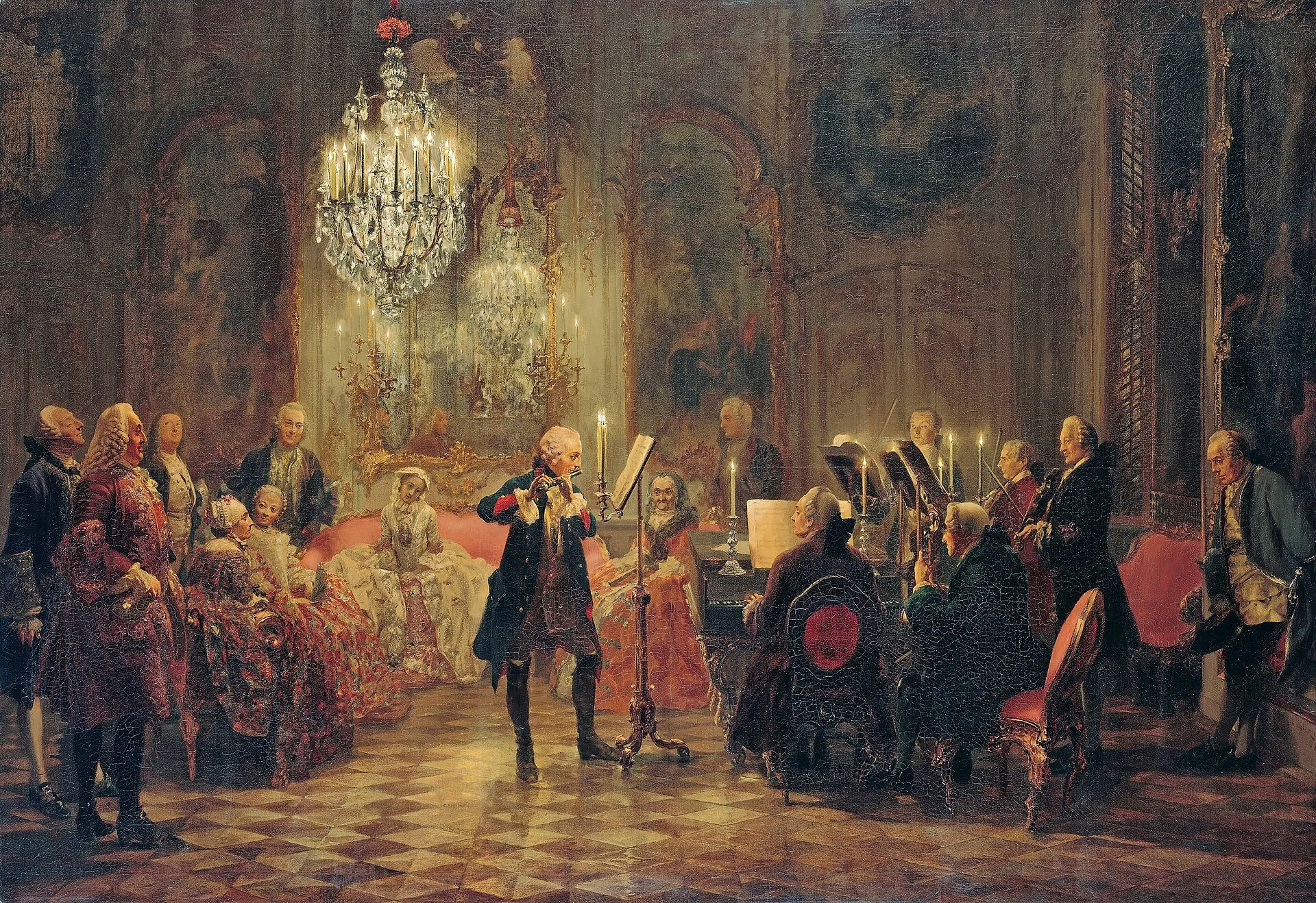 Frederick the Great Playing the Flute at Sanssouci1850–1852
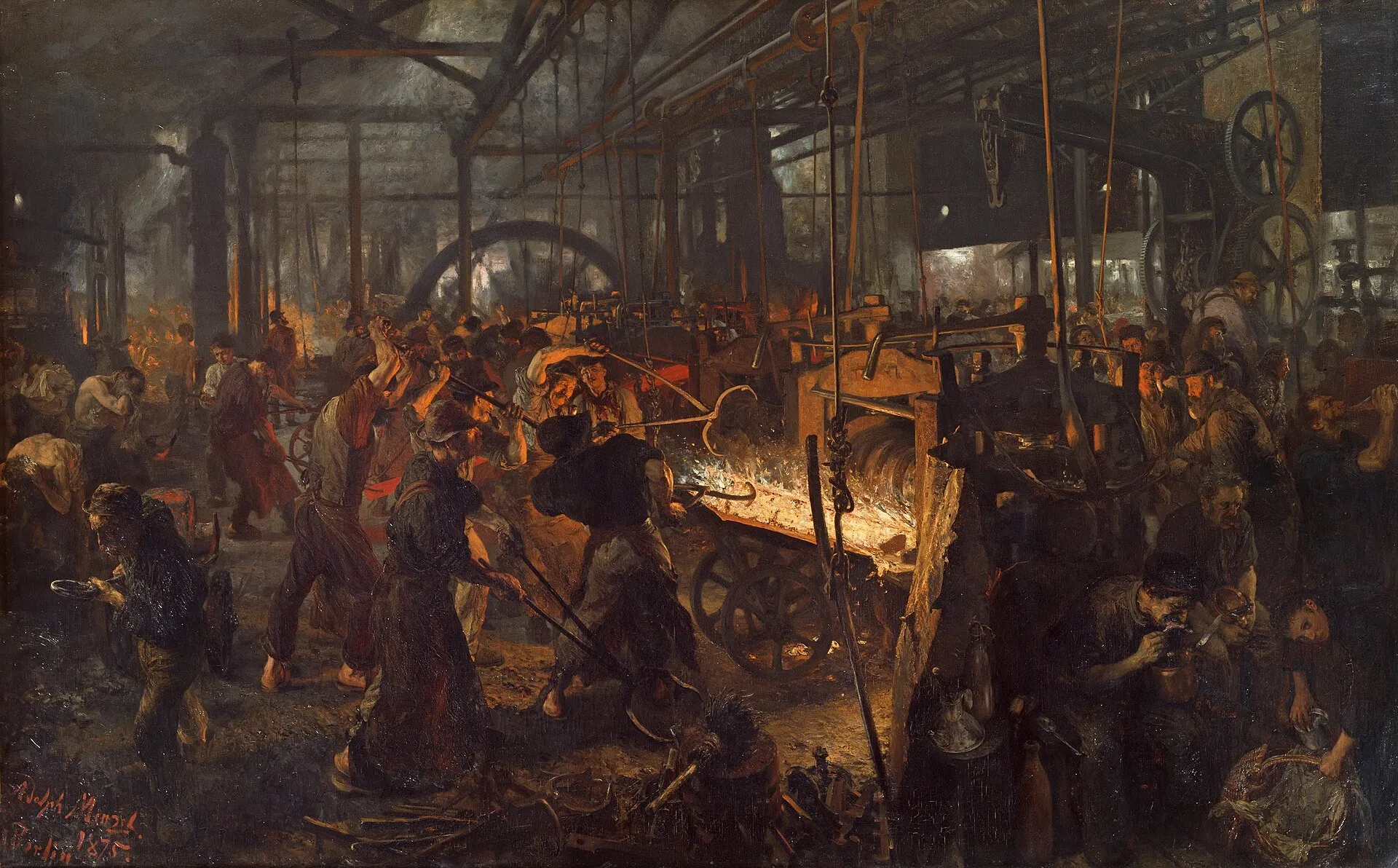 The Iron Rolling Mill (Modern Cyclopes)1872–1875
 Weekday in Paris1869
 The Dinner at the Ball1878
 The Berlin-Potsdam Railway1847
 Coronation of Wilhelm I., King of Prussia, Königsberg1861
 The Balcony Room1845
Life and work
Adolph Menzel was born in Wrocław in 1815 and died in Berlin in 1905. He is counted among the leading realists of the Kingdom of Prussia, and his long career is unusual for its range. On one side stands the public history painter. His scenes from the reign of Frederick the Great, such as Frederick the Great Playing the Flute at Sanssouci (1850–1852), and the official Coronation of Wilhelm I., King of Prussia, Königsberg (1861), present Prussian history and ceremony with careful attention to costume, light and setting. On the other side is the private observer. Small, informal pictures like The Balcony Room (1845) and The Berlin-Potsdam Railway (1847) record an ordinary interior and a landscape cut through by a train. They are painted with a freshness that later viewers often found ahead of its time. In later decades he turned to crowded contemporary life: the street bustle of Weekday in Paris (1869), the glittering, jostling society of The Dinner at the Ball (1878), and the factory floor of The Iron Rolling Mill (1872–1875). That last work is widely regarded as one of the most ambitious depictions of industrial labour in nineteenth-century art. What connects all of these is close looking. Menzel was a tireless draughtsman, and his paintings reward viewers who take time over small details.
The Balcony Room (1845): a painting about light and air
There is almost nothing here: two chairs, a mirror, a bare floor and a curtain lifting at an open balcony door. Look at how the light does the work. Sunlight dissolves the edges of the curtain, and the mirror shows a blurred glimpse of a room we cannot otherwise see. Notice the loose, quick brushwork on the walls, where some areas look barely finished. Menzel treats an everyday corner as worthy of a picture, with no story and no people. Stand back to feel the breeze, then move close to see how few strokes create it.
The Iron Rolling Mill (1872–1875): industry as spectacle and labour
This large canvas places you on a factory floor. At the centre, workers guide a glowing bar of red-hot iron into the rollers, and the fiery light picks out straining arms and faces. Then let your eye wander to the edges. Some men are washing or eating, others rest while the machinery keeps running. Menzel shows the whole working day, not just a heroic moment. Look for the contrast between the furnace glow and the smoky gloom of the hall, and for how the crowded composition makes the space feel hot, loud and dangerous.
Sources
- Wikidata Q164961
- Images: Wikimedia Commons (public domain / CC0); sources on each painting’s page