Art! Art! Art! › Works
Portrait of Margaret Stonborough-Wittgenstein
 Gustav Klimt, 1905
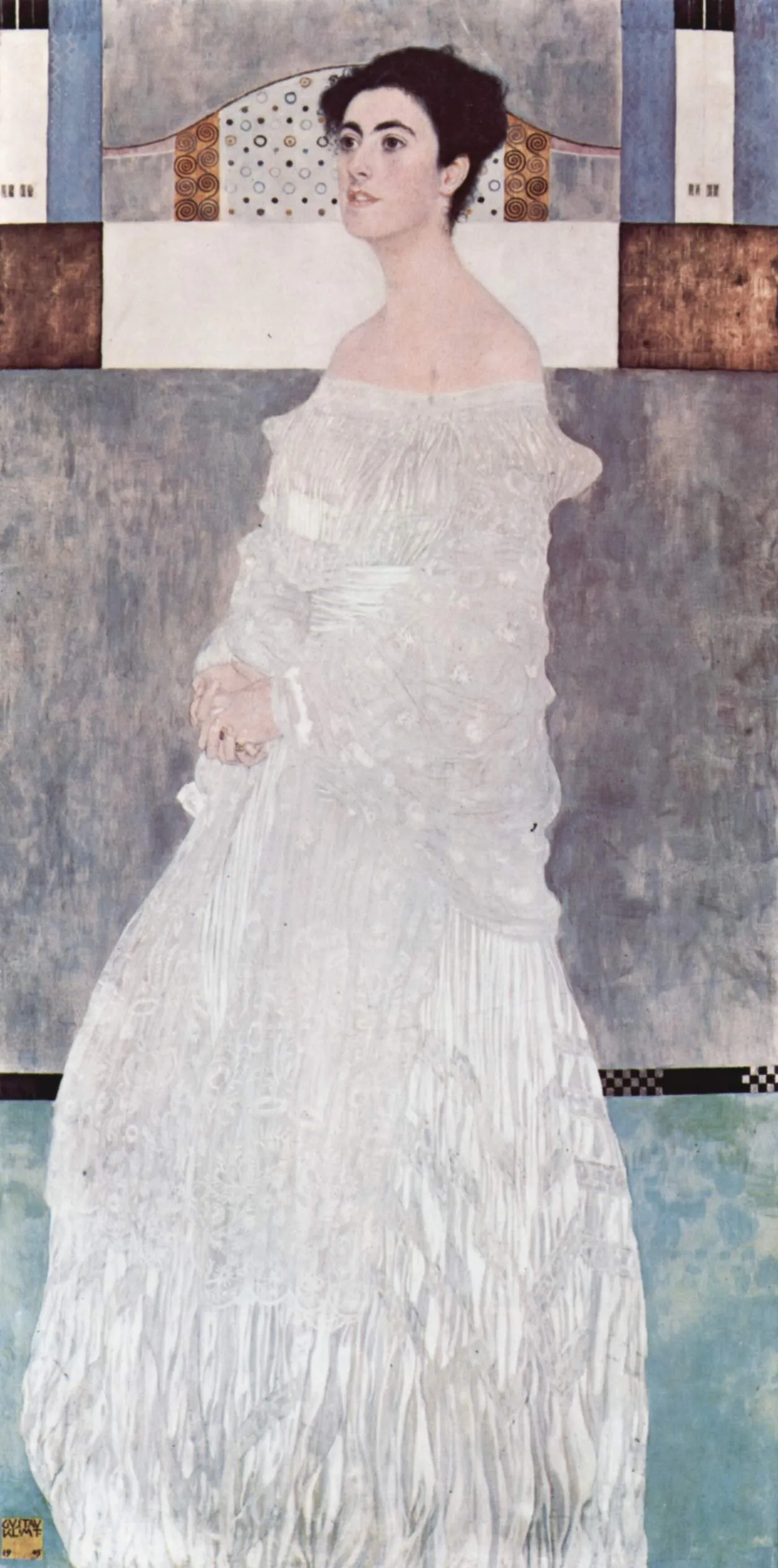
Gustav Klimt's Portrait of Margaret Stonborough-Wittgenstein, dated 1905, is a tall, full-length portrait of a young Viennese woman in a pale gown set against a field of flat geometric shapes. The painting belongs to the Bavarian State Painting Collections and is associated with the Neue Pinakothek. Standing in front of it, you can see how Klimt balanced lifelike portraiture with decorative design.
Where to see it
The painting is in the collection of the Bavarian State Painting Collections, and its listed location is the Neue Pinakothek. Display arrangements at museums can change because of renovations, rehangs or loans, so check the official website of the Bavarian State Painting Collections for the painting's current display status before you plan your visit.
What to look for in person
A dress built from loose brushwork
Look closely at the white gown. Instead of describing every fold, Klimt builds the fabric from quick, feathery strokes of white, cream and grey, so the dress seems light and almost transparent in places. Compare this with the face and hands, which are painted with much more control and smooth modelling. Stepping back and then moving in close shows the contrast clearly: from a distance the dress reads as soft, flowing cloth, while up close it breaks into lively, open marks of paint.
The geometric background
Behind the sitter, the space is not a room in any realistic sense. Klimt arranges rectangles, squares and patterned panels into a flat design, including shapes placed around the area of her head. These forms reflect the interest in geometric ornament shared by artists and designers of the Vienna Secession around 1905. Notice how the flat pattern pushes the softly modelled figure forward, so she seems to stand in front of a decorative screen rather than inside a three-dimensional space.
Scale and the narrow upright format
The canvas measures 179.8 by 90.5 centimetres, so the figure appears at roughly life size, and the tall, narrow format stretches her silhouette from head to hem. Stand at a normal viewing distance and the portrait meets you nearly at eye level, which gives it a formal, ceremonial presence. Pay attention to the quiet pose and restrained expression: the painting relies on posture, proportion and the play of light colours against darker shapes rather than on dramatic gesture or setting.
About the painting
Gustav Klimt painted this portrait in 1905, when he was one of the leading figures in Viennese art and a founding member of the Vienna Secession. In these years he produced a series of full-length portraits of women from Vienna's wealthy and cultured families, and this picture belongs to that group. The sitter, Margaret Stonborough-Wittgenstein, came from the Wittgenstein family, one of the most prominent industrial families in Vienna; her father, Karl Wittgenstein, was a supporter of the Secession, and her younger brother was the philosopher Ludwig Wittgenstein. She married Jerome Stonborough in 1905, the same year as the portrait, and the painting is generally linked to that occasion. Compared with the gold-heavy works Klimt painted a little later, this portrait is restrained in colour, dominated by whites, greys and darker accents. Its main interest lies in the way Klimt joins two different ways of painting on one canvas: a naturalistically rendered face and hands, a loosely brushed dress, and a background of flat, abstract geometry. That combination shows the direction his portraiture was taking in the mid-1900s, as decorative pattern became an increasingly important part of how he presented his sitters. Margaret Stonborough-Wittgenstein remained an important figure in Viennese cultural life; she is also known as the patron of the modernist house in Vienna designed in the 1920s with the involvement of her brother Ludwig. Today the portrait forms part of the Bavarian State Painting Collections, where it offers visitors a chance to see Klimt's portrait style in a single, carefully balanced full-length work.
Key facts
| Artist | Gustav Klimt |
|---|---|
| Date | 1905 |
| Size | 179.8 × 90.5 cm |
| Medium | oil paint, canvas |
| Collection | Bavarian State Painting Collections |
How to visit: Bavarian State Painting Collections
Munich, Germany
Hours and prices can change. Please check the official website before you go.
More by Gustav Klimt
 Danaë
 Death and Life
 Judith I — Belvedere
 Portrait of Adele Bloch-Bauer I
 Beethoven Frieze — Belvedere
 The Kiss — Belvedere