Art! Art! Art! › Works
Death and Life
 Gustav Klimt, 1910
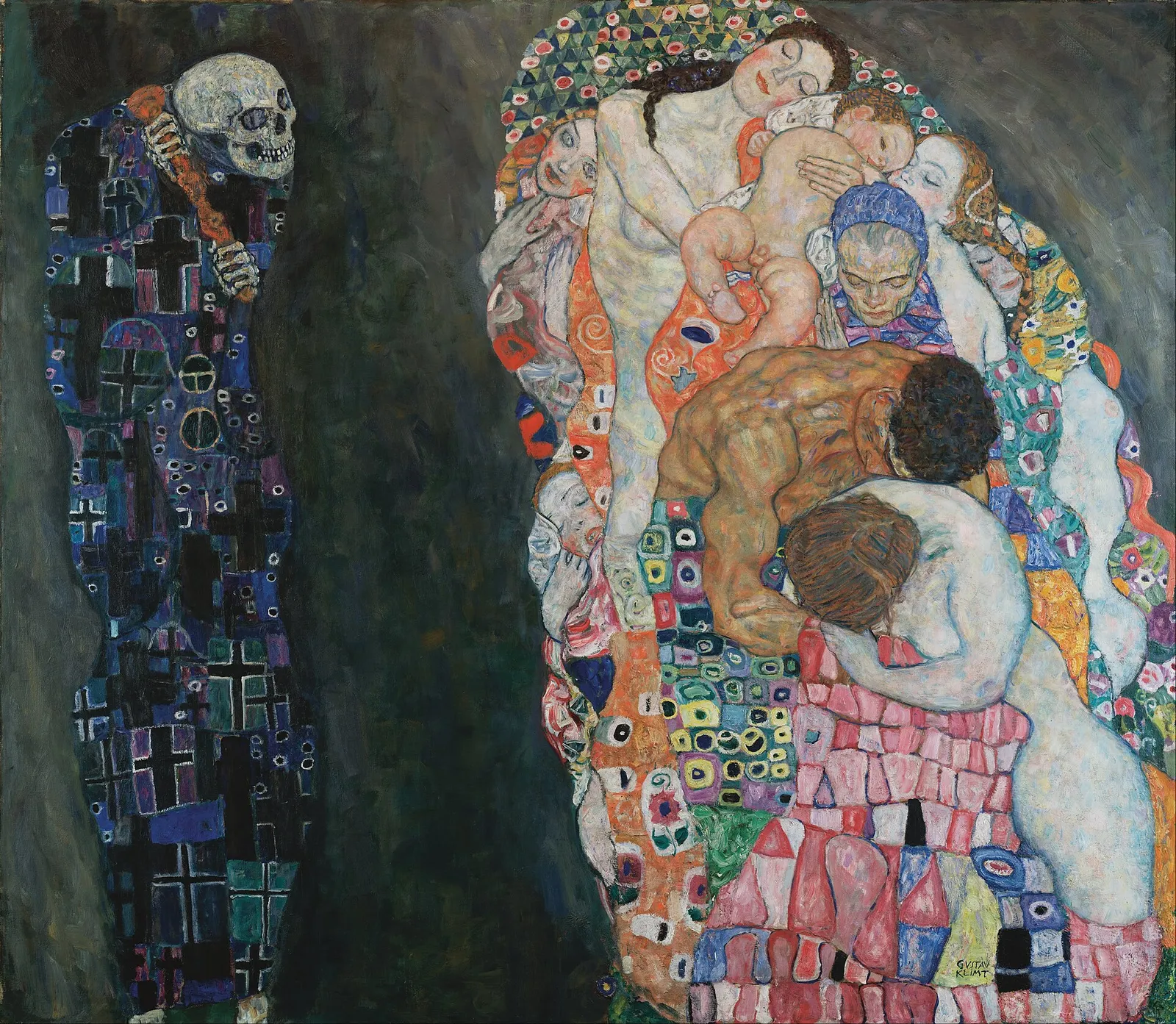
Gustav Klimt's Death and Life, dated 1910, belongs to the collection of the Leopold Museum. The large canvas sets a lone figure of Death against a crowded, tightly woven group of the living, and it rewards slow looking from both near and far.
Where to see it
Death and Life is held by the Leopold Museum, which is also the location recorded for the work. Display arrangements can change because of rehanging, conservation or exhibitions, so check the Leopold Museum's official website for current display status, opening hours and ticketing before you visit.
What to look for in person
The divide down the middle
Start by standing back. The composition splits into two unequal parts with an open, dark field between them. On one side stands Death; on the other, the living cluster together. Nothing physically bridges the gap, yet Death leans toward the group, and the tension of that empty space is the heart of the picture. Notice how the living seem unaware of the figure watching them, which gives the scene its quiet, unsettling mood rather than a dramatic confrontation.
Death's patterned robe
Move closer to the figure of Death. Klimt shows a skull-headed figure wrapped in a dark cloak, and the cloak is not plain: it is covered with small decorative motifs, including crosses, that echo the ornamental language Klimt used throughout his work. Compare this surface with the living group opposite. The contrast between the dark, closed silhouette of Death and the bright, varied patterns of the living is one of the clearest ways the painting carries its theme without any text or narrative.
The tangle of the living
Now spend time with the group on the other side. Look for figures of different ages: infants, mothers, couples and older people, folded together in a single mass. Many faces appear restful, with eyes closed, as though sleeping or dreaming. Their bodies are wrapped in fabrics of circles, flowers and colour blocks, so that skin and ornament merge. Try to trace individual figures through the pattern; working out where one body ends and another begins is part of the experience the painting offers.
About the painting
Death and Life is an allegorical painting by the Austrian artist Gustav Klimt, recorded with a date of 1910 and now in the collection of the Leopold Museum. Its subject is one of the oldest in European art: the presence of death alongside human life. Klimt, however, avoids a moral sermon or a dramatic scene. Instead, he places the two ideas side by side and lets the viewer feel the distance and closeness between them.
The painting reflects Klimt's long interest in the human life cycle, a theme he returned to in several works. Here the cycle is shown as a single, interlocking group of people at different stages of life, from babies to the elderly. Their closeness suggests shared experience and continuity, while the solitary figure of Death stands apart, patient and watchful.
Visitors familiar with Klimt's better-known golden paintings may be surprised by the palette. Rather than a shimmering gold ground, the figures sit against a darker, more muted background, which makes the colourful patterns of the living stand out even more. Klimt is known to have reworked the canvas after first completing it, and this later intervention is part of the work's history.
When you visit, it helps to look in two stages. From a distance, read the overall structure: two groups, one gap, one leaning figure. Up close, explore the surface: the ornament on Death's robe, the floral and circular motifs around the living, and the calm expressions on many of the faces. The painting holds both readings at once, which is why it repays a return visit.
Key facts
| Artist | Gustav Klimt |
|---|---|
| Date | 1910 |
| Size | 1805 × 2005 cm |
| Medium | oil paint, canvas |
| Collection | Leopold Museum |
How to visit: Leopold Museum
Vienna, Austria
Hours and prices can change. Please check the official website before you go.
More by Gustav Klimt
 Danaë
 Judith I — Belvedere
 Portrait of Margaret Stonborough-Wittgenstein
 Portrait of Adele Bloch-Bauer I
 Beethoven Frieze — Belvedere
 The Kiss — Belvedere