Art! Art! Art! › Works
Judith I
 Gustav Klimt, 1901
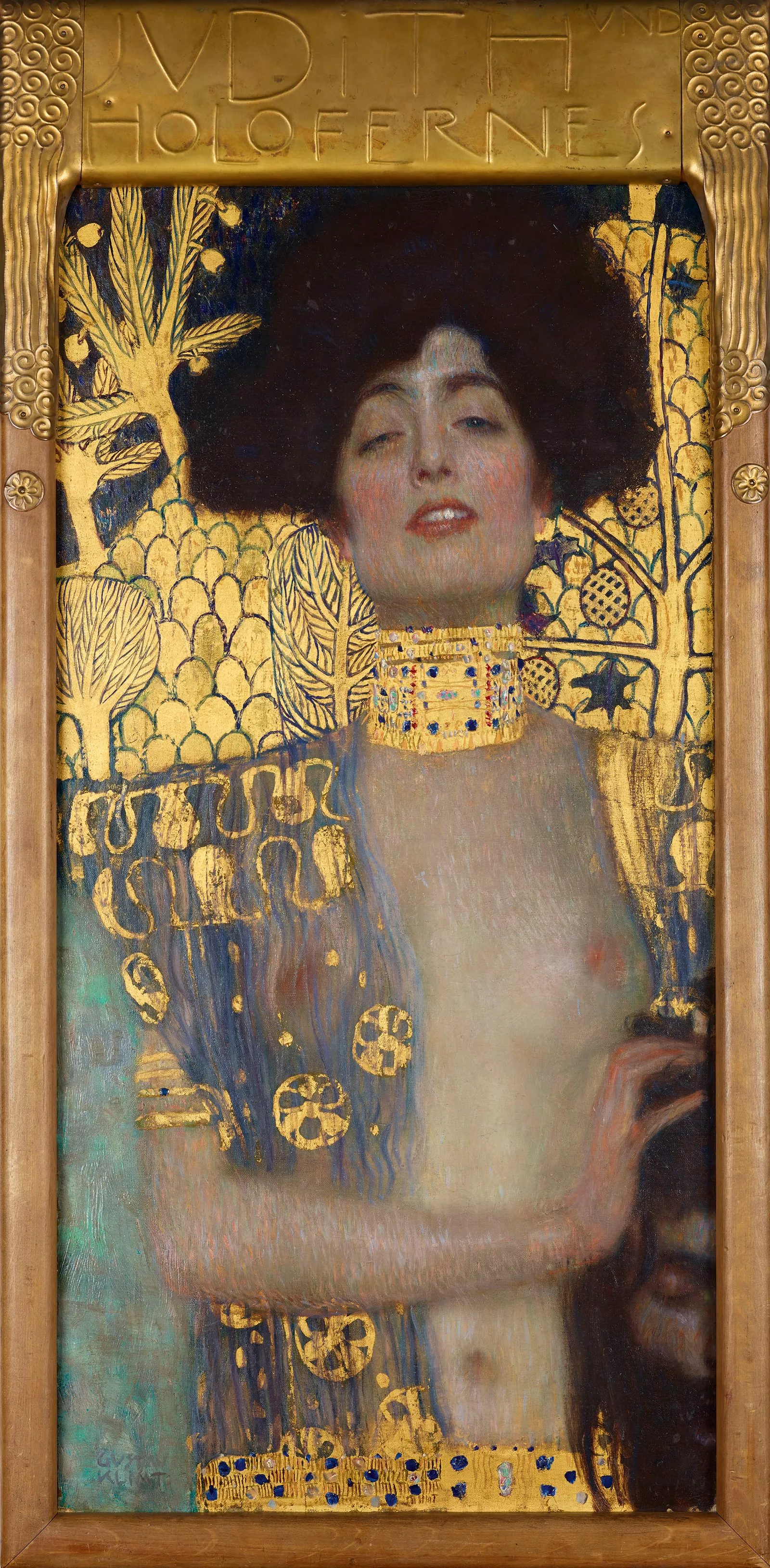
Gustav Klimt's Judith I, dated 1901, belongs to the collection of the Belvedere. The painting shows the biblical heroine Judith holding the severed head of the Assyrian general Holofernes, and it is often seen as an early landmark of Klimt's use of gold. At 84 by 42 cm, it is a compact, upright canvas that rewards close, unhurried looking.
Where to see it
Judith I is held by the Belvedere, which lists the painting in its collection. Works can be moved, rehung, lent or temporarily removed for conservation, so check the Belvedere's official website for current display status, opening hours and ticket information before you visit.
What to look for in person
Judith's face and gaze
Start with the face. Judith's head is tilted slightly back, her eyes half-closed and her lips parted, an expression that viewers have long found ambiguous, somewhere between triumph, calm and sensual absorption. She looks down toward the viewer rather than at the deed she has just done. Notice how softly and realistically Klimt models the skin compared with the flat, ornamental gold around it. That contrast between a lifelike body and a decorative surface is one of the defining features of his work from this period.
The head of Holofernes at the edge
Look to the lower right corner. The head of Holofernes is easy to miss at first, because Klimt cuts it off at the edge of the canvas, so only part of the face is visible beneath Judith's hand. Pushing the story's violent climax to the margin keeps attention on Judith herself. This understated treatment is one reason the painting has sometimes been mistaken for an image of Salome, another biblical woman linked to a severed head, even though the subject is Judith.
Gold, ornament and the frame
Step closer to see how gold is used across the picture: in the wide jeweled choker around Judith's neck, in her garments and in the stylized background of tree-like forms. Klimt applied gold leaf, which catches the light differently as you move. Then step back and include the frame in your view. It is a metal frame made by Klimt's brother Georg, a goldsmith and engraver, and it carries the inscription 'Judith und Holofernes', naming the subject directly.
About the painting
Gustav Klimt painted Judith I in 1901, during the years when he was a leading figure of the Vienna Secession, the group of artists who broke away from the academic establishment to promote new forms of art and design. The picture is often placed at the beginning of what is commonly called his 'golden phase', a period in which he combined oil painting with gold leaf and dense ornament, culminating in works such as The Kiss. The subject comes from the Book of Judith, in which a Jewish widow saves her town by entering the camp of the Assyrian general Holofernes and beheading him. Earlier European artists usually showed Judith as a virtuous heroine, often with a sword and a servant beside her. Klimt removes the sword and the narrative setting and concentrates on a single, close-up figure whose bare skin, jewelry and expression dominate the canvas. The result is closer to a portrait of a modern woman than a history painting, and the work is frequently discussed in connection with the femme fatale theme that was widespread in art and literature around 1900. The tall, narrow format, 84 cm high and 42 cm wide, presses the figure close to the picture surface and gives the composition a vertical, almost icon-like quality, reinforced by the flat gold areas. Klimt returned to the subject in a later painting known as Judith II, which is why this work carries the numeral I. When you visit, allow time to view it both from a distance, to take in the overall design, and up close, to see the texture of the gold.
Key facts
| Artist | Gustav Klimt |
|---|---|
| Date | 1901 |
| Size | 84 × 42 cm |
| Medium | gold, oil paint, canvas |
| Collection | Belvedere |
How to visit: Belvedere
Vienna, Austria · Museum guide
| Opening hours | Upper Belvedere (Klimt's The Kiss): Mon–Sun 09:00–18:00 Lower Belvedere: Mon–Sun 10:00–18:00 Belvedere 21: Tue–Sun 11:00–18:00 (Thu until 21:00; open on public-holiday Mondays) |
|---|---|
| Closed | Upper and Lower Belvedere are open daily. Belvedere 21 is closed on Mondays, except public holidays. |
| Last entry | 30 minutes before closing |
| Admission | Upper Belvedere, adult EUR 23 Upper Belvedere, seniors 65+ / students under 26 EUR 19 Upper Belvedere, Vienna City Card EUR 21.5 Upper Belvedere, Disability Card EUR 8 Lower Belvedere, adult EUR 20 (reduced EUR 16.00; Vienna City Card EUR 18.50; Disability Card EUR 8.00) Belvedere 21, adult EUR 12 (reduced EUR 8.00; Vienna City Card EUR 10.50; Disability Card EUR 5.00) 2-in-1 day ticket (Upper + Lower), adult EUR 32 (reduced EUR 25.00; Vienna City Card EUR 29.50; Disability Card EUR 10.00; includes an Upper Belvedere time slot) 3-in-1 day ticket (Upper + Lower + Belvedere 21), adult EUR 34 (reduced EUR 27.00; Disability Card EUR 12.00) Under 19 free Gold Pass (annual) EUR 49 (Gold Pass +1 EUR 69.00; Gold Pass U26 EUR 29.00) |
| Free entry | Free for under-19s, companions of Disability Card holders (where the need is noted), Kulturpass holders and IAA Card holders (free ticket from the museum ticket offices). |
| Booking | Booking is required, with timed entry. |
Official ticket page
Official website
View on map
Hours and prices can change. Please check the official website before you go. (Checked on: 2026-11-09)
More by Gustav Klimt
 Danaë
 Death and Life
 Portrait of Margaret Stonborough-Wittgenstein
 Portrait of Adele Bloch-Bauer I
 Beethoven Frieze — Belvedere
 The Kiss — Belvedere