Art! Art! Art! › Works
Portrait of Adele Bloch-Bauer I
 Gustav Klimt, 1907
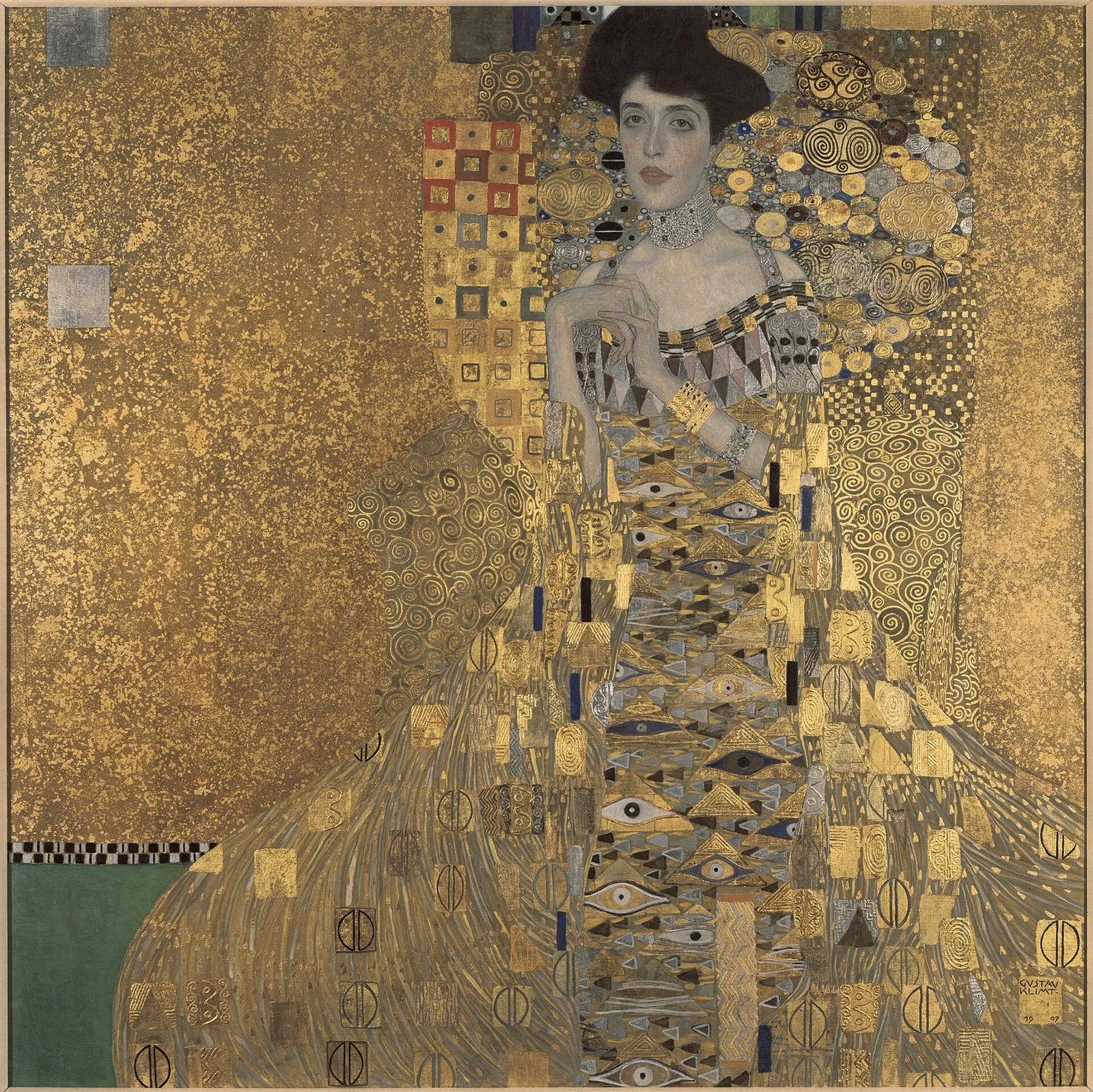
Gustav Klimt's Portrait of Adele Bloch-Bauer I, dated 1907, is held by the Neue Galerie. It is one of the defining works of Klimt's so-called Golden Phase, in which a carefully painted face and hands emerge from a shimmering field of metal leaf and ornament. Seeing it in person shows things a reproduction cannot, especially how the gold responds to light as you move.
Where to see it
Portrait of Adele Bloch-Bauer I is in the collection of the Neue Galerie. Before you visit, check the Neue Galerie's official website for current display status, opening hours, ticketing and visitor guidelines, since arrangements can change and works may occasionally be off view.
What to look for in person
A living face inside a field of gold
Start with Adele's face, shoulders and hands. These are painted in oil with soft modelling and naturalistic skin tones, while almost everything around them is flat, patterned and metallic. The contrast is the core of the picture: a recognisable individual appears to float within, or be absorbed by, an abstract surface. Look at the hands, held together near her chest at an angled, slightly tense position. They are among the few modelled forms in the composition, and they draw the eye back toward the sitter amid the ornament.
Metal leaf that changes as you move
Klimt used gold and silver leaf alongside oil paint, and parts of the surface are built up so the decoration has slight physical relief. Standing in front of the canvas, take a few steps to the left and right. The metal catches and releases the light, so areas that look bright from one angle turn darker or warmer from another. This quality is almost entirely lost in photographs and printed reproductions, and it is the strongest reason to see the work in person rather than on a screen.
Reading the ornament up close
The dress and background are filled with a dense vocabulary of motifs. Look for eye-like shapes, often linked by scholars to ancient Egyptian imagery, along with spirals, swirling lines, squares and small rectangular blocks. Klimt's interest in Byzantine mosaics is widely cited as an influence on this flat, glittering treatment of space. Notice how hard it is to tell where the chair ends and the dress begins: the boundaries between figure, furniture and background deliberately dissolve into pattern, giving the composition its distinctive, icon-like stillness.
About the painting
Portrait of Adele Bloch-Bauer I is a portrait by the Viennese painter Gustav Klimt, dated 1907. The sitter, Adele Bloch-Bauer, was a member of Vienna's cultivated, wealthy society around 1900, and the painting was commissioned by her husband, the industrialist Ferdinand Bloch-Bauer. Klimt worked on the portrait over several years, and it is closely associated with his Golden Phase, the period in which he combined oil paint with gold and silver leaf to create decorative, shimmering surfaces.
The painting reflects the ideals of the Vienna Secession, the artists' movement Klimt helped lead, which sought to break down barriers between fine art and decorative design. Rather than placing the sitter in a realistic room, Klimt surrounds her with ornament, so that the portrait functions as both a likeness and a richly patterned object.
The work also has a much-discussed modern history. After the annexation of Austria in 1938, the Bloch-Bauer family's property was seized by the Nazi regime, and the portrait later hung in Vienna's Austrian state collection for decades. Following a long legal dispute, it was restituted in 2006 to Adele's niece, Maria Altmann, and other heirs. That same year it was acquired for the Neue Galerie, where it has become central to the museum's identity.
Klimt painted Adele again in a second, stylistically different portrait, which is why this work carries the numeral I. When visiting, allow time to view the painting both from a distance, to take in the overall composition, and up close, to study the surface and ornament.
Key facts
| Artist | Gustav Klimt |
|---|---|
| Date | 1907 |
| Size | 138 × 162 cm |
| Medium | gold, silver, oil paint, gold leaf, canvas |
| Collection | Neue Galerie |
How to visit: Neue Galerie
New York City, United States
Hours and prices can change. Please check the official website before you go.
More by Gustav Klimt
 Danaë
 Death and Life
 Judith I — Belvedere
 Portrait of Margaret Stonborough-Wittgenstein
 Beethoven Frieze — Belvedere
 The Kiss — Belvedere