Art! Art! Art! › Works
Beethoven Frieze
 Gustav Klimt, 1902
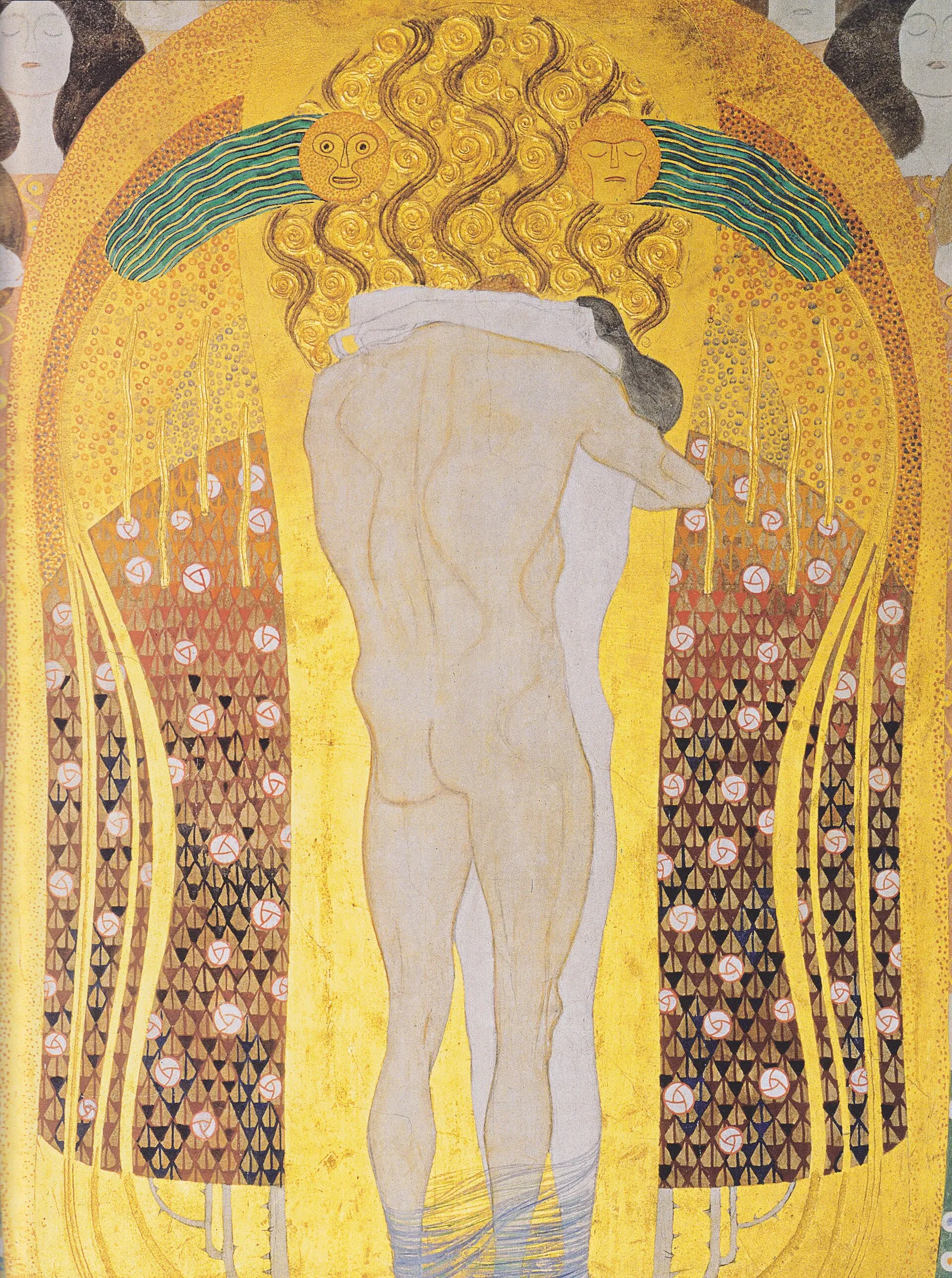
Image:Gustav Klimt — Public domain(Wikimedia Commons)
Gustav Klimt's Beethoven Frieze, made in 1902, is a mural cycle 215 cm high and 3414 cm long that runs around the upper walls of a room. It belongs to the Belvedere and is located in the Secession Building in Austria, the building for which it was conceived. Reading it means walking it, wall by wall, as a story told in line, pattern and gold.
Where to see it
The Beethoven Frieze is in the collection of the Belvedere and is located in the Secession Building, Austria. Because the work is owned by one institution and sited in another building, check the official websites of the Belvedere and the Secession for current display status, opening hours and ticketing before you plan your visit.
What to look for in person
The Longing for Happiness
The frieze opens with floating, elongated female figures drifting along the wall like a slow current. They embody humanity's longing for happiness. Look for the small group of kneeling, naked figures representing suffering humanity, who appeal to a knight in golden armour. He stands for the strong, well-armed hero who takes up the struggle for happiness on their behalf. Notice how Klimt leaves large stretches of the wall almost bare, so the figures read as a line of movement rather than a crowded scene, and your eye is pulled forward along the room.
The Hostile Forces
The central wall turns dark and dense. A huge ape-like giant, Typhoeus, fills the space with coiling, serpentine forms, flanked by his daughters, the three Gorgons. Around them are figures personifying Sickness, Madness and Death, as well as Lust, Wantonness and Excess, along with a hunched figure of Gnawing Grief. Above them, the longings of humanity float past. Compare the heavy patterning, gold and ornamental detail here with the sparser walls on either side; the sudden change in density is a key part of how the story is told.
The Kiss to the Whole World
The final wall resolves the struggle. The longing for happiness finds fulfilment in poetry and the arts, represented by a female figure playing a lyre, leading towards a choir of angels. At the end, a couple embraces in front of the choir, a reference to the line 'This kiss to the whole world' from Schiller's Ode to Joy, which Beethoven set in the finale of his Ninth Symphony. Look closely at the surface here: gilded and applied elements catch the light differently from the painted areas as you move.
About the painting
Gustav Klimt created the Beethoven Frieze in 1902 for an exhibition of the Vienna Secession, the association of artists he had helped to found. The exhibition was devoted to Ludwig van Beethoven and was conceived as a total work of art, in which architecture, painting and sculpture would combine around a central sculpture of the composer by Max Klinger. Klimt's contribution was a painted cycle running around the upper part of the walls of one room, which visitors passed through on their way through the show. The programme of the frieze follows an interpretation of Beethoven's Ninth Symphony associated with Richard Wagner: humanity longs for happiness, a hero confronts hostile forces, and longing is finally fulfilled in the arts and in an embrace that echoes Schiller's Ode to Joy. Klimt worked directly on the wall surface, combining painting with gilding and applied ornamental materials, and he deliberately left areas of the ground unpainted. The result is a work that is as much about rhythm and empty space as about its figures. The frieze was intended for a temporary exhibition, and it drew sharp criticism from some contemporaries, particularly for its frank treatment of the nude body in the Hostile Forces section. It was nonetheless preserved rather than destroyed, later removed from its original setting, and eventually restored. Today it belongs to the Belvedere and is located in the Secession Building in Austria. At 215 cm high and 3414 cm wide, it is best experienced by walking slowly along its full length.
Key facts
| Artist | Gustav Klimt |
|---|---|
| Date | 1902 |
| Size | 215 × 3414 cm |
| Medium | graphite, paint, chalk, casein paint, plaster |
| Collection | Belvedere |
How to visit: Belvedere
Vienna, Austria · Museum guide
| Opening hours | Upper Belvedere (Klimt's The Kiss): Mon–Sun 09:00–18:00 Lower Belvedere: Mon–Sun 10:00–18:00 Belvedere 21: Tue–Sun 11:00–18:00 (Thu until 21:00; open on public-holiday Mondays) |
|---|---|
| Closed | Upper and Lower Belvedere are open daily. Belvedere 21 is closed on Mondays, except public holidays. |
| Last entry | 30 minutes before closing |
| Admission | Upper Belvedere, adult EUR 23 Upper Belvedere, seniors 65+ / students under 26 EUR 19 Upper Belvedere, Vienna City Card EUR 21.5 Upper Belvedere, Disability Card EUR 8 Lower Belvedere, adult EUR 20 (reduced EUR 16.00; Vienna City Card EUR 18.50; Disability Card EUR 8.00) Belvedere 21, adult EUR 12 (reduced EUR 8.00; Vienna City Card EUR 10.50; Disability Card EUR 5.00) 2-in-1 day ticket (Upper + Lower), adult EUR 32 (reduced EUR 25.00; Vienna City Card EUR 29.50; Disability Card EUR 10.00; includes an Upper Belvedere time slot) 3-in-1 day ticket (Upper + Lower + Belvedere 21), adult EUR 34 (reduced EUR 27.00; Disability Card EUR 12.00) Under 19 free Gold Pass (annual) EUR 49 (Gold Pass +1 EUR 69.00; Gold Pass U26 EUR 29.00) |
| Free entry | Free for under-19s, companions of Disability Card holders (where the need is noted), Kulturpass holders and IAA Card holders (free ticket from the museum ticket offices). |
| Booking | Booking is required, with timed entry. |
Official ticket page
Official website
View on map
Hours and prices can change. Please check the official website before you go. (Checked on: 2026-11-09)
More by Gustav Klimt
 Danaë
 Death and Life
 Judith I — Belvedere
 Portrait of Margaret Stonborough-Wittgenstein
 Portrait of Adele Bloch-Bauer I
 The Kiss — Belvedere