Art! Art! Art! › Works
Danaë
 Gustav Klimt, 1907
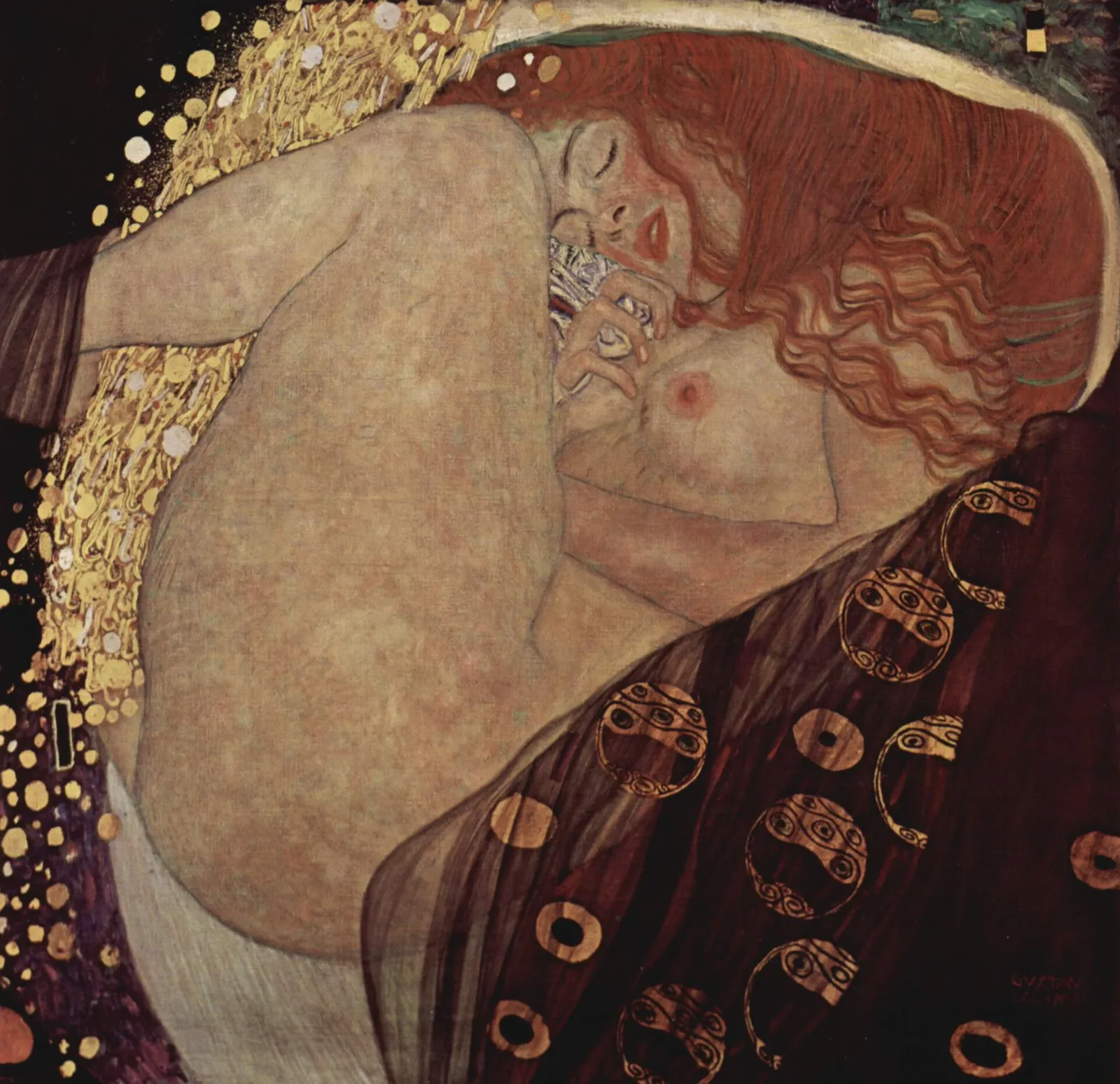
Gustav Klimt's Danaë, dated 1907, is listed in the collection of the Leopold Museum. The canvas measures 77 x 83 cm, so it is slightly wider than it is tall, and the figure fills almost all of it. Seen in person, it rewards close looking at the contrast between soft flesh and flat, glittering ornament.
Where to see it
Danaë (1907) by Gustav Klimt is listed in the collection of the Leopold Museum, which is also given as its location. Works are sometimes taken off view for conservation, rotation or loans, so check the Leopold Museum's official website for current display status, opening hours and ticket information before you plan your visit.
What to look for in person
A body folded into the frame
Start with the pose. Danaë lies curled on her side, knees drawn up toward her chest, so her body becomes a compact, rounded shape pressed into the near-square format. Her thigh sweeps across the foreground and is the largest single form in the picture, while her head is tucked into the upper corner. Her eyes are closed and her expression is inward and dreamlike. Notice how tightly Klimt crops the scene: there is almost no surrounding space, which pulls you very close to the figure.
The shower of gold
In Greek myth, Zeus reaches the imprisoned Danaë as a shower of gold, and Klimt makes that moment the painting's central motif. Look for the stream of golden discs and drops pouring in from the left and flowing between her thighs. Up close, the gold reads as pattern rather than realistic rain, set against the warm tones of her skin. Within the stream you can find a small black rectangle, a hard geometric accent that stands out sharply against all the curves around it.
Hair, veil and ornament
Next, follow the decorative surfaces. Danaë's mass of red hair spills around her face in curling strands, and a dark, translucent veil patterned with gold spirals and circles drapes across her lower body. These areas are treated as flat ornament, while her face, shoulder and leg are softly modeled. That tension between decorative surface and three-dimensional flesh is a hallmark of Klimt's work in these years, and it is easiest to appreciate by stepping back and then moving in close again.
About the painting
Danaë is one of the best-known paintings from the period often called Klimt's golden phase, when he combined gold, intricate pattern and sensual figures in works that defined the look of Viennese modernism. The fact sheet dates it to 1907, and its size, 77 x 83 cm, makes it a fairly intimate picture rather than a large wall painting. In front of it, you can take in the whole composition at once and still examine the details of the gold and the veil from a short distance.
The subject comes from Greek mythology. Danaë was locked away by her father, King Acrisius, after a prophecy that her son would kill him. Zeus came to her as a shower of gold, and she later gave birth to the hero Perseus. Artists from the Renaissance onward painted the story, often showing Danaë reclining on a bed in a room, with attendants or a curtain nearby. Klimt strips away the setting and the supporting characters. Instead of a narrative scene, he gives a single close-up figure absorbed in the moment, with the golden rain reduced to a decorative stream.
When you visit, look at how much of the effect comes from shape and placement: the circular sweep of the body, the diagonal flow of the gold, and the small, sharp black rectangle set against all of it. The painting shows Klimt's interest in eroticism, symbolism and ornament together, and it is often discussed alongside his other works of the same years. Give yourself time to stand at more than one distance, because the picture reads differently as a whole than it does in detail.
Key facts
| Artist | Gustav Klimt |
|---|---|
| Date | 1907 |
| Size | 77 × 83 cm |
| Medium | oil paint, canvas |
| Collection | Leopold Museum |
How to visit: Leopold Museum
Vienna, Austria
Hours and prices can change. Please check the official website before you go.
More by Gustav Klimt
 Death and Life
 Judith I — Belvedere
 Portrait of Margaret Stonborough-Wittgenstein
 Portrait of Adele Bloch-Bauer I
 Beethoven Frieze — Belvedere
 The Kiss — Belvedere