Art! Art! Art! › Works
Tiger in a Tropical Storm
 Henri Rousseau, 1891
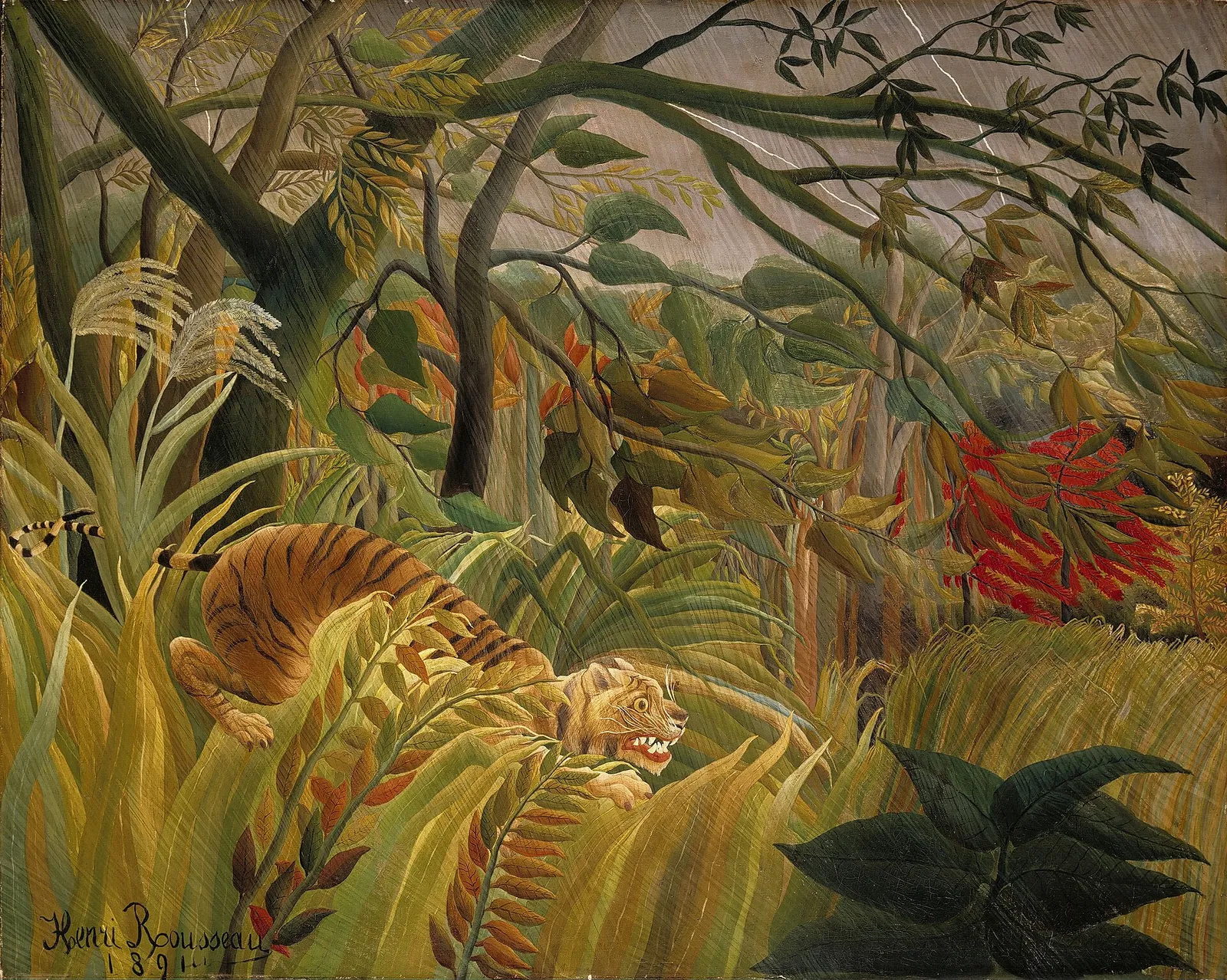
Henri Rousseau's Tiger in a Tropical Storm, dated 1891, shows a crouching tiger caught in wind-driven rain inside a dense, invented jungle. The painting is in the collection of the National Gallery, where visitors can study its layered greens, its streaks of rain and the startled stare of its central animal.
Where to see it
Tiger in a Tropical Storm is held by the National Gallery, and the National Gallery is listed as its location. Displays can change because of rehangs, conservation or loans, so check the National Gallery's official website for current display status, opening hours and ticketing information before you visit. The canvas measures 128.9 cm high by 161.9 cm wide, a size that rewards viewing from a few steps back as well as up close.
What to look for in person
The tiger's stare
Start with the tiger near the centre of the canvas. Its body is pressed low among the plants, its head turned toward the viewer with wide eyes and open jaws. Notice how Rousseau describes the stripes and fur with firm, deliberate outlines rather than soft shading, so the animal reads almost like a pattern. Despite this flatness, the pose carries real tension. Compare the crisp edges of the tiger with the crowded foliage around it, and you will see how carefully the animal has been set apart from its surroundings.
How the storm is painted
Step back to see how the weather works across the whole picture. Fine, pale diagonal streaks run over the surface to suggest driving rain, and a thin, jagged line of lightning crosses the sky. Grasses and leaves bend in the same direction, as though pushed by the wind. Rousseau builds the storm through repeated lines and leaning shapes rather than blurred atmosphere, so the scene feels turbulent yet orderly. Follow the direction of the rain lines and notice how they help unify the composition from one edge to the other.
Layers of green
Move closer to the vegetation. Rousseau used many different greens, from dark, cool tones to lighter, yellowish ones, and gave individual leaves clear outlines. Rather than relying on conventional perspective, he suggests depth by stacking overlapping plant forms one behind another toward the back of the picture. The result is a dense screen of foliage that feels both decorative and enclosing. Look at how the careful, almost botanical treatment of the leaves contrasts with the wild drama of the subject; that contrast is central to the painting's character.
About the painting
Henri Rousseau was a self-taught painter who worked for years in the Paris toll service, which later earned him the nickname Le Douanier, the customs officer. He had no academic training, and critics of his day often mocked his flat forms and unusual proportions. Over time, however, his work came to be valued by younger artists and is now seen as an important example of so-called naive painting. Tiger in a Tropical Storm, dated 1891, is generally regarded as the first of his jungle pictures, a subject he returned to many times in later years. The painting is also known by the title Surprised!, which points to the sudden, startled quality of the scene. Rousseau is not known to have travelled outside France, and his jungles are understood to be imagined. He drew on sources available in Paris, such as the plants and animals at the city's botanical garden and illustrations in books and magazines, combining them into scenes that no real forest would match. For visitors, it helps to approach the picture not as a record of nature but as a constructed world. The sharp outlines, the even, carefully worked surface and the dense repetition of leaves all reveal a painter building an image piece by piece. At 128.9 by 161.9 centimetres, the canvas is large enough that the jungle seems to surround the tiger, and standing in front of it you can sense both the threat of the storm and the patient, methodical way it was painted.
Key facts
| Artist | Henri Rousseau |
|---|---|
| Date | 1891 |
| Size | 128.9 × 161.9 cm |
| Medium | oil paint, canvas |
| Collection | National Gallery |
How to visit: National Gallery
London, United Kingdom · Museum guide
| Opening hours | Mon–Thu, Sat, Sun 10:00–18:00 Fri 10:00–21:00 (Friday late) |
|---|---|
| Closed | 24–26 December and 1 January. |
| Admission | General admission (collection) free; donations invited Some exhibitions are charged (e.g. Renoir and Love, until 31 Jan 2027) |
| Free entry | General admission is always free. |
| Booking | No reservation or timed entry is required. Free timed booking gives fast-track entry. |
Building work and improvements are under way: some rooms are closed and some paintings have moved, so check the floorplans or collection search before visiting. A new Research Centre is due to open in 2028. On 17 November only, some east wing rooms and the Espresso Bar close from 16:00.
Official ticket page
Official website
View on map
Hours and prices can change. Please check the official website before you go. (Checked on: 2026-11-11)
More by Henri Rousseau
 The Sleeping Gypsy — Museum of Modern Art
 The Repast of the Lion — Metropolitan Museum of Art
 La encantadora de serpientes — Musée d'Orsay
 Carnival Evening — Philadelphia Museum of Art
 Boy on the Rocks — National Gallery of Art
 The Dream — Museum of Modern Art
 The Muse Inspiring the Poet
 The Hungry Lion Throws Itself on the Antelope