Art! Art! Art! › Works
The Hungry Lion Throws Itself on the Antelope
 Henri Rousseau, 1905
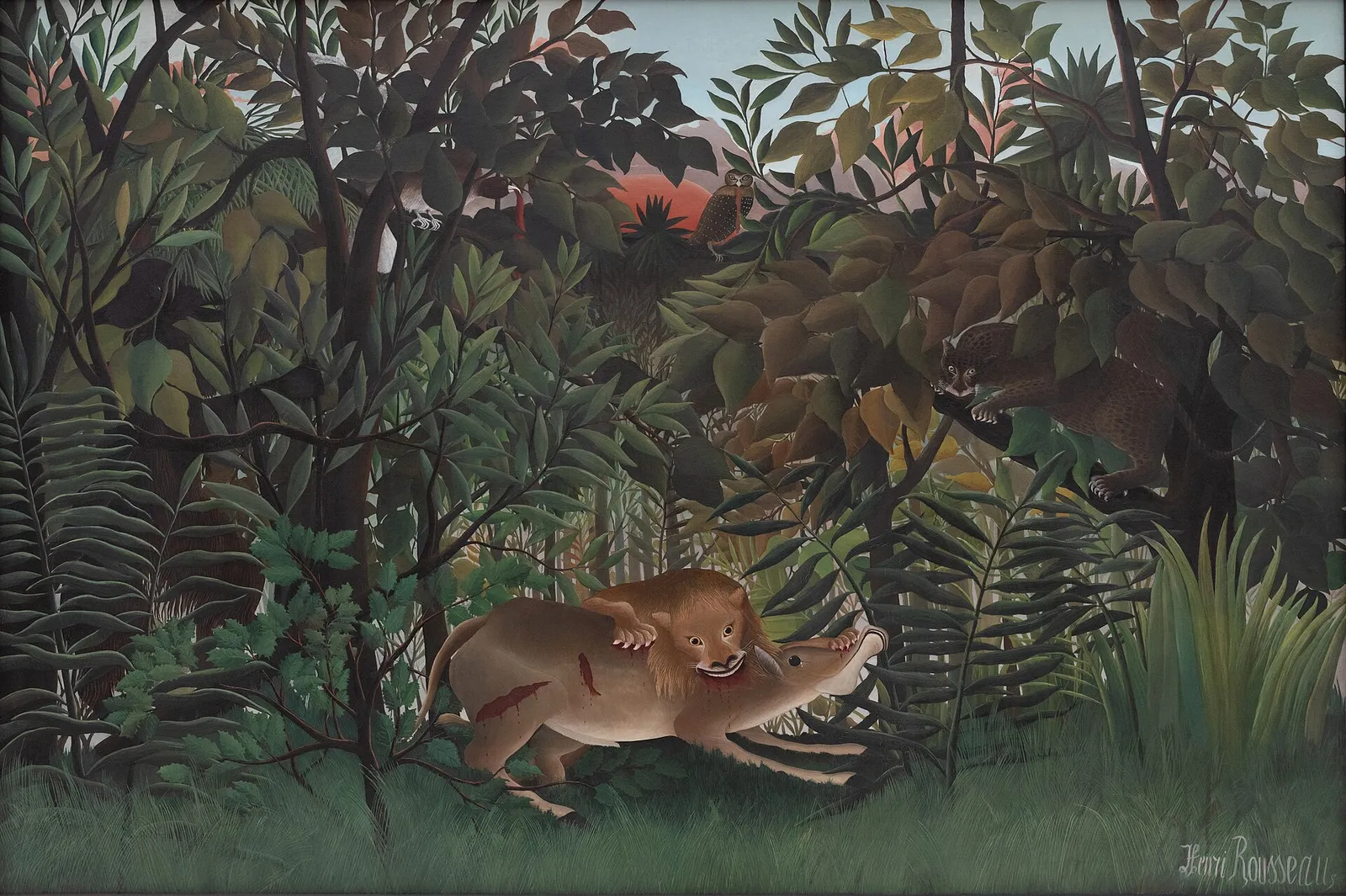
Henri Rousseau's The Hungry Lion Throws Itself on the Antelope, dated 1905, is a large jungle scene in which a moment of violence is set inside a dense, carefully patterned wall of tropical plants. The painting belongs to the Beyeler Foundation, and at 200 × 300 cm it is a picture to experience in person, where its scale and detail become clear.
Where to see it
The Hungry Lion Throws Itself on the Antelope is in the collection of the Beyeler Foundation. Works in museum collections are sometimes rotated, lent to other institutions or taken off view for conservation, so check the Beyeler Foundation's official website for current display status, opening hours and ticket information before you plan your visit.
What to look for in person
A jungle at full scale
The canvas measures 200 × 300 cm, so the scene comes close to filling your field of vision. Start by standing well back to take in the overall arrangement: a central drama framed by layers of vegetation that rise toward the top edge and close in from the sides. Then move closer. At a distance the picture reads as a single image; up close it becomes a sequence of separate, individually painted elements, each leaf and stem given its own outline. Shifting between these two viewing distances is one of the main pleasures of seeing the work in person.
Leaves as pattern
Look at how Rousseau builds the foliage. Leaves are flattened, sharply edged and stacked one over another, with many distinct shades of green set side by side to separate the layers. Rather than blending forms into atmospheric depth, he treats the plants almost like a decorative screen. The vegetation is generally understood to be invented or combined from several sources rather than a record of any real place, which helps explain its dreamlike regularity. Notice how bright flowers or fruit punctuate the greens and guide your eye across the surface.
Stillness inside the struggle
At the centre, the lion seizes the antelope, as the title announces. Yet the scene feels strangely held in place rather than frantic. The animals' bodies are clearly contoured and smoothly painted, and the surrounding plants do not bend or blur with movement. Spend time on the faces and eyes of the animals, and scan the foliage around the main group, where other creatures can be found looking on. This combination of a violent subject with calm, deliberate painting is a key part of the work's distinctive, unsettling mood.
About the painting
Henri Rousseau was a self-taught painter who worked for years at the Paris municipal toll service, which earned him the nickname "Le Douanier" (the customs officer). He took up painting seriously in middle age and developed a style that ignored academic conventions of perspective and modelling, favouring crisp outlines, flattened forms and meticulous detail. For much of his lifetime, critics often mocked his work, though a number of younger avant-garde artists and writers came to admire it.
Rousseau is best known for his jungle pictures, a theme he first explored around the early 1890s and returned to repeatedly in the last years of his life. He is generally understood never to have travelled to the tropics. Instead, his exotic scenes drew on the plants and animals he could study in Paris, notably at the Jardin des Plantes with its glasshouses and menagerie, as well as on illustrated books and popular imagery. The result is a jungle assembled in the imagination: botanically inventive, carefully ordered and slightly unreal.
The Hungry Lion Throws Itself on the Antelope, dated 1905, is one of his largest jungle compositions, at 200 × 300 cm. Its descriptive title is typical of Rousseau, who often gave his paintings long, narrative names. The picture is widely associated with its showing at the Salon d'Automne in Paris in 1905. Today it belongs to the Beyeler Foundation. When you visit, it rewards slow looking: the tension between its dramatic subject and its patient, almost ornamental execution is what gives Rousseau's jungles their lasting appeal to artists and museum-goers alike.
Key facts
| Artist | Henri Rousseau |
|---|---|
| Date | 1905 |
| Size | 200 × 300 cm |
| Medium | oil paint, canvas |
| Collection | Beyeler Foundation |
How to visit: Beyeler Foundation
Canton of Basel-Stadt, Switzerland
Hours and prices can change. Please check the official website before you go.
More by Henri Rousseau
 The Sleeping Gypsy — Museum of Modern Art
 The Repast of the Lion — Metropolitan Museum of Art
 La encantadora de serpientes — Musée d'Orsay
 Carnival Evening — Philadelphia Museum of Art
 Boy on the Rocks — National Gallery of Art
 The Dream — Museum of Modern Art
 The Muse Inspiring the Poet
 Tiger in a Tropical Storm — National Gallery