Art! Art! Art! › Works
The Repast of the Lion
 Henri Rousseau, 20th century
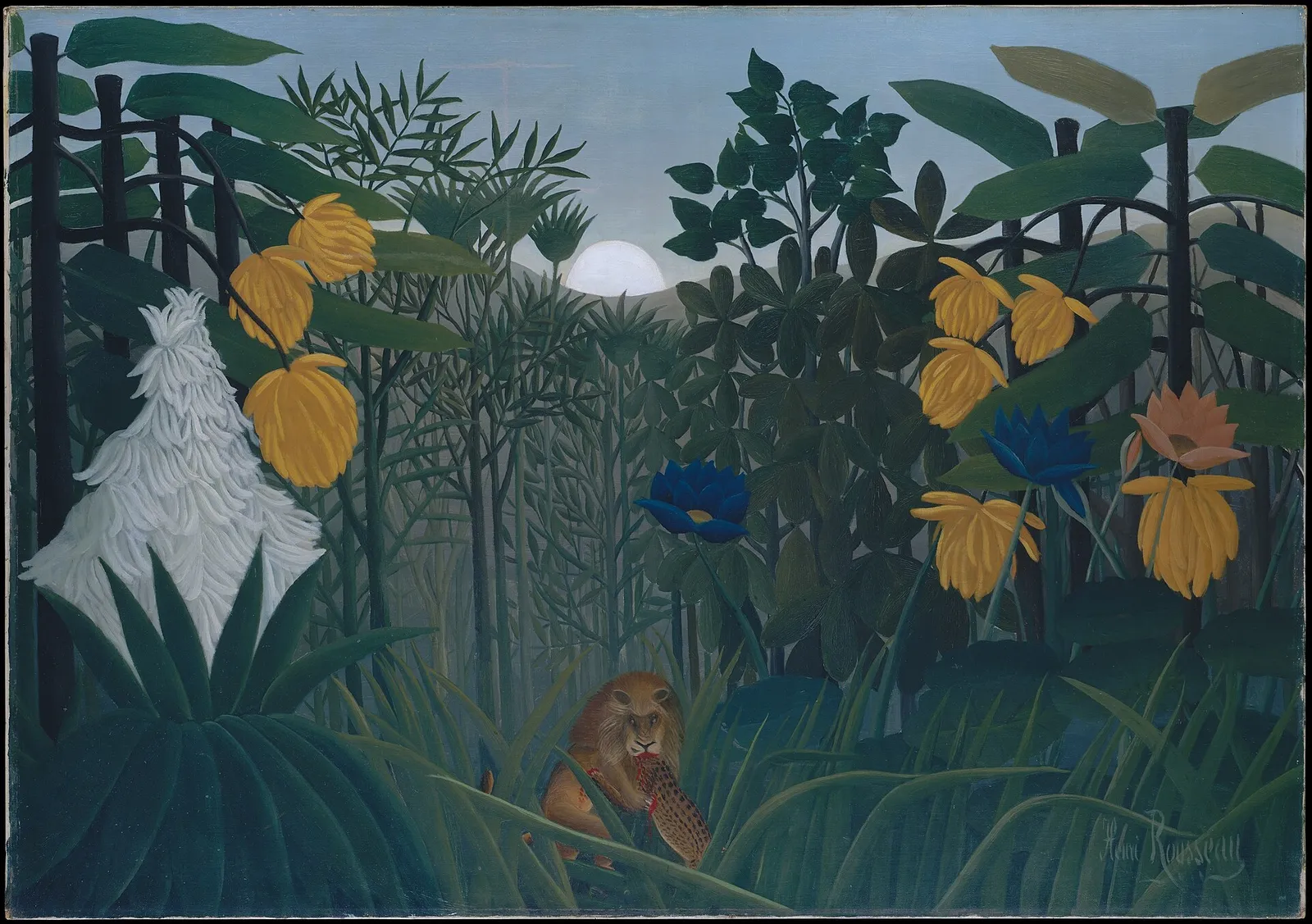
Henri Rousseau's The Repast of the Lion is a 20th-century jungle scene in which a lion feeds on its prey amid towering, carefully layered foliage. The painting belongs to the Metropolitan Museum of Art, and at 113.7 by 160 centimetres it is large enough to draw you into its dense, invented wilderness.
Where to see it
The Repast of the Lion is in the collection of the Metropolitan Museum of Art. Works in any collection can be moved, rotated off view or lent to other institutions, so check the Metropolitan Museum of Art's official website for the painting's current display status before you plan your visit.
What to look for in person
The jungle as a wall of leaves
Step back first and take in the whole canvas. Rousseau builds the jungle from overlapping leaves, stems and fronds, each shape outlined crisply and filled with its own shade of green. Rather than fading into atmospheric distance, the plants stack up like a patterned screen across the picture. Notice how many different greens he uses, and how lighter and darker leaves alternate to keep the shapes distinct. This flattened, decorative treatment of space is one of the clearest signs of his personal style, and it rewards slow looking from left to right.
The lion and its prey
Move closer to the animals in the lower part of the scene. The lion is shown at the moment of feeding, yet the drama feels oddly still and composed rather than violent. Rousseau gives the animals smooth, simplified forms and clear outlines, much like the surrounding plants, so predator, prey and foliage seem to belong to the same carefully arranged world. Look at how the lion's body is framed by vegetation, almost as if the jungle were staging the encounter for the viewer.
Flowers, fruit and precise detail
Scan the canvas for the bright accents that break up the greens: large blossoms and rounded forms that catch the eye like ornaments. Then look closely at the surface. Rousseau's handling is smooth and deliberate, with little visible brushwork, and edges are kept sharp even on small leaves. This painstaking finish is typical of the self-taught artist, who worked slowly to achieve clarity rather than loose effects. Comparing the near-microscopic care of individual leaves with the bold overall design is one of the pleasures of seeing the work in person.
About the painting
Henri Rousseau was a self-taught French painter, often known by the nickname "Le Douanier" because of his years working in the Paris toll and customs service. He came to painting without academic training, and his work was frequently mocked during his lifetime before being championed by avant-garde artists and writers who admired its directness and invention. Today he is regarded as a central figure among painters described as naive or self-taught. Jungle scenes like The Repast of the Lion are among his best-known subjects. Rousseau is generally understood never to have travelled to the tropics. Instead, he drew on what was available to him in Paris: the plants in the city's botanical gardens and glasshouses, animals at the zoo, and images found in books, magazines and other printed sources. The result is not a record of a real place but an imagined wilderness, assembled from observed details and arranged according to his own sense of pattern and order. In front of the painting, this mix of the observed and the invented is what stands out. Individual leaves can look botanically convincing, yet the overall arrangement is theatrical, with foliage stacked in layers and animals placed within it like actors on a stage. The canvas measures 113.7 by 160 centimetres, a scale that lets the greenery fill much of your field of vision when you stand close. The work dates from the 20th century and is held by the Metropolitan Museum of Art. Visitors interested in early modern painting will find it a useful example of how an artist outside the academic system developed a distinctive, highly recognisable approach to composition and colour.
Key facts
| Artist | Henri Rousseau |
|---|---|
| Date | 20th century |
| Size | 113.7 × 160 cm |
| Medium | oil paint, canvas |
| Collection | Metropolitan Museum of Art |
| Gallery | Gallery 825 Checked in the museum's open data on 2026-11-12 (galleries can change) Source |
How to visit: Metropolitan Museum of Art
New York City, United States · Museum guide
| Opening hours | Sun, Mon, Tue, Thu 10:00–17:00 Fri, Sat 10:00–21:00 |
|---|---|
| Closed | Wednesdays; Thanksgiving Day, 25 December, 1 January and the first Monday in May |
| Admission | Adults USD 30 Seniors (65 and over) USD 22 Visitors with a disability (in person only) USD 22 Students USD 17 Children (12 and under) free Care partners of visitors with a disability (in person only) free New York State residents; NY, NJ and CT students: pay what you wish (minimum USD 0.01). Online requires a NY State billing address; NJ/CT students in person with student ID |
| Free entry | Free for children 12 and under, Members and Patrons, and care partners of visitors with a disability. Pay what you wish for New York State residents and NY/NJ/CT students. |
| Booking | No reservation is required and there is no timed entry. |
The Cantor Roof Garden, the Modern and Contemporary Galleries, and the Ancient West Asia and Ancient Cyprus Galleries are closed for renovation.
Official ticket page
Official website
View on map
Hours and prices can change. Please check the official website before you go. (Checked on: 2026-11-09)
More by Henri Rousseau
 The Sleeping Gypsy — Museum of Modern Art
 La encantadora de serpientes — Musée d'Orsay
 Carnival Evening — Philadelphia Museum of Art
 Boy on the Rocks — National Gallery of Art
 The Dream — Museum of Modern Art
 The Muse Inspiring the Poet
 The Hungry Lion Throws Itself on the Antelope
 Tiger in a Tropical Storm — National Gallery