Art! Art! Art! › Works
Carnival Evening
 Henri Rousseau, 1886
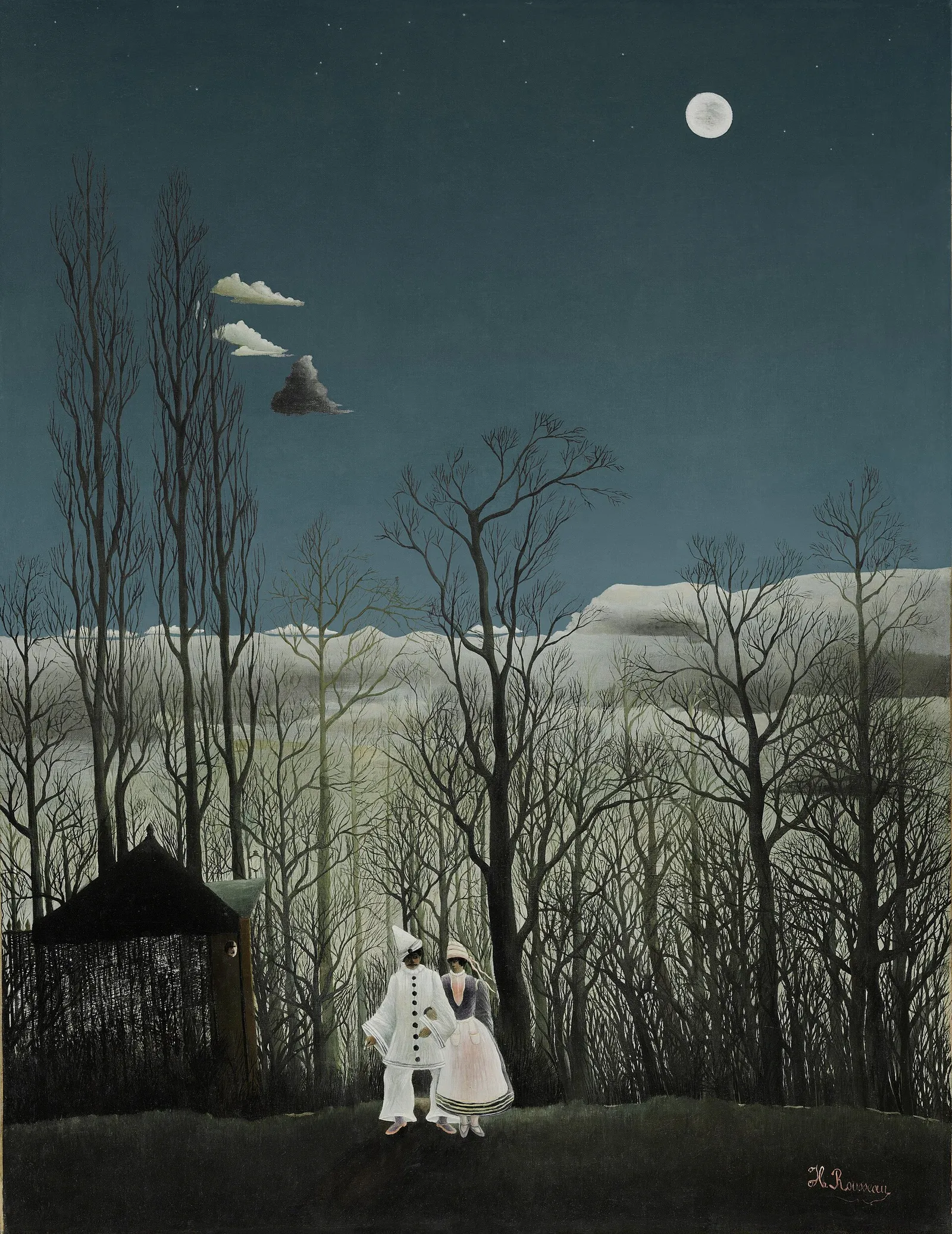
Carnival Evening is an 1886 painting by Henri Rousseau, the self-taught French artist often called Le Douanier. It belongs to the Philadelphia Museum of Art, where visitors can meet one of the key early works by a painter whose untrained, carefully worked style went on to intrigue later generations of artists.
Where to see it
Carnival Evening is in the collection of the Philadelphia Museum of Art, in Philadelphia. Works in museum collections are sometimes moved, rotated off view or lent, so check the Philadelphia Museum of Art's official website for the painting's current display status, opening hours and ticket information before you visit.
What to look for in person
Two small figures in a large night
Start by finding the people. Two figures in pale carnival costume stand near the bottom of the canvas, small against the scene around them. Their bright clothing seems to glow against the darkened woodland, almost as if lit from within. Notice how little they seem to interact with their surroundings: they look placed into the landscape rather than moving through it. That stillness and slight strangeness are typical of Rousseau and give the scene its quiet, dreamlike mood.
Bare branches against a luminous sky
Look up at the trees. Rousseau paints the leafless branches with patient, almost linear care, building a dense lacework of dark shapes against a sky that is noticeably brighter than the ground below. Stand close to see how precisely the branches are drawn, then step back to see them merge into one pattern. This contrast between a dark, detailed foreground and a glowing sky is one of the most striking things to see in person.
A self-taught painter's method
Rousseau had no academic training, and his approach shows it in ways worth looking for. Perspective and scale do not follow conventional rules, forms have firm outlines, and the surface is smoothly and deliberately finished rather than loosely brushed. Instead of reading these as mistakes, notice how they create a flattened, ordered world in which every element feels equally considered. This early canvas offers a chance to see the beginnings of the style he would develop throughout his career.
About the painting
Henri Rousseau came to painting late and without formal instruction. For years he worked for the Paris municipal toll service, a job that later earned him the nickname Le Douanier, the customs officer. He painted in his spare time, teaching himself by looking at art and the world around him, and he exhibited at the Salon des Independants, which had no selection jury and was open to artists outside the academic system. Carnival Evening dates from 1886, near the start of his public career. During his lifetime many critics mocked his work as naive. Over time, however, his directness, his clear outlines and his unusual handling of space attracted the interest of younger avant-garde artists and writers in Paris, and his reputation grew considerably after his death. Today he is regarded as a central figure among painters described as naive or self-taught. In front of this painting, it helps to set aside expectations of realistic perspective. Rousseau builds the picture from distinct parts: costumed figures, dark trees, an open, glowing sky. Each is given careful attention, and together they create an atmosphere that feels both festive and solitary. The theme of carnival costume set in a wintry night landscape gives the image an air of mystery that viewers continue to interpret in different ways. Carnival Evening is part of the collection of the Philadelphia Museum of Art. If seeing it is the main reason for your trip, confirm on the museum's website that it is on view.
Key facts
| Artist | Henri Rousseau |
|---|---|
| Date | 1886 |
| Size | 1173.99 × 896.11 cm |
| Medium | oil paint, canvas |
| Collection | Philadelphia Museum of Art |
How to visit: Philadelphia Museum of Art
Philadelphia, United States · Museum guide
| Opening hours | Mon, Thu, Sat, Sun 10:00–17:00 (Main Building) Fri 10:00–20:45 (Pay What You Wish 17:00–20:45, through June 2027) 24 Dec 2026 (Christmas Eve) 10:00–15:00 |
|---|---|
| Closed | Closed Tuesdays and Wednesdays, as well as 4 July, Thanksgiving (26 Nov 2026) and Christmas Day (25 Dec 2026). |
| Admission | Adult USD 30 (valid two consecutive days, includes the Rodin Museum) Senior (65 and over) USD 28 Student with valid ID USD 14 Youth (18 and under) free (ticket required) Member free Member guest USD 15 (senior guest USD 14) |
| Free entry | Pay What You Wish on the first Sunday of the month and every Friday 17:00–20:45 through June 2027 (suggested donation USD 15). Under-18s are always free. PA ACCESS/EBT cardholders get free general admission for 4 adults. Military personnel and their party are free from Armed Forces Day to Labor Day. |
| Booking | Booking in advance is strongly recommended. There is no timed entry. |
Official ticket page
Official website
View on map
Hours and prices can change. Please check the official website before you go. (Checked on: 2026-11-09)
More by Henri Rousseau
 The Sleeping Gypsy — Museum of Modern Art
 The Repast of the Lion — Metropolitan Museum of Art
 La encantadora de serpientes — Musée d'Orsay
 Boy on the Rocks — National Gallery of Art
 The Dream — Museum of Modern Art
 The Muse Inspiring the Poet
 The Hungry Lion Throws Itself on the Antelope
 Tiger in a Tropical Storm — National Gallery