Art! Art! Art! › Works
Boy on the Rocks
 Henri Rousseau, 1897
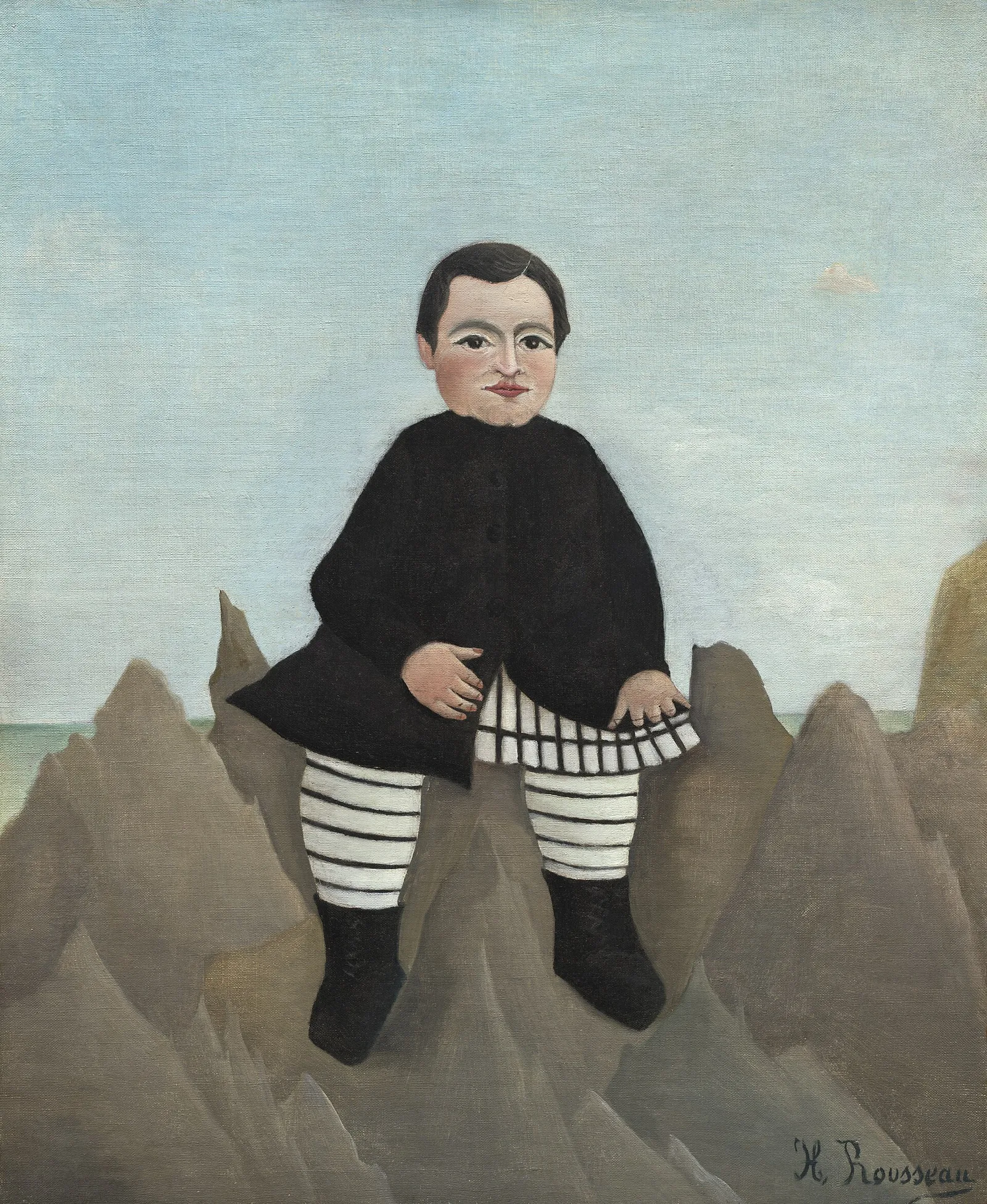
Boy on the Rocks is an 1897 painting by the self-taught French artist Henri Rousseau. It shows a child posed among rocky forms whose scale is hard to pin down, a puzzle typical of Rousseau's approach. At 55.4 by 45.7 cm, it is a modest canvas that rewards close, unhurried looking.
Where to see it
The fact sheet records both the collection and the location of Boy on the Rocks under the Wikidata identifier Q214867, not a written museum name. Before you travel, open the painting's Wikidata entry (https://www.wikidata.org/wiki/Q4952174) to confirm the holding museum, then check that museum's official website for current display status, opening hours and ticketing. Works on canvas can be moved for conservation, rotation or loans, so confirm the painting is on view before planning a trip around it.
What to look for in person
A puzzle of scale
Start by asking how big the boy is. The rocks beneath him read at once as boulders and as distant peaks, so the child can seem either an ordinary sitter or a giant perched above a landscape. Rousseau did not work with conventional academic perspective, and this ambiguity is part of the picture's strange charm. Step back to take in the whole composition, then move closer and notice how the setting shifts in meaning as you change your distance.
The frontal, still figure
Rousseau tended to present people in direct, stiff poses, almost like subjects of a formal photograph. Look at how the boy faces outward and how little movement there is in the figure. Rather than reading this as a lack of skill, many viewers find it gives the image a quiet, timeless gravity. Pay attention to the face and the placement of the limbs, and to how the figure sits firmly against the background instead of melting into it.
Clear outlines and flat colour
Rousseau's surfaces are typically smooth, with forms defined by crisp edges and areas of relatively even colour. In front of the canvas, look for the boundaries where figure, rock and sky meet, and notice how carefully each shape is separated from its neighbour. Because the painting is fairly small, at 55.4 by 45.7 cm, these details are easy to study at a normal viewing distance. The result is a deliberate, almost decorative clarity.
About the painting
Henri Rousseau (1844-1910) is one of the best-known self-taught painters in the history of modern art. He worked for years at the Paris municipal toll service, which earned him the nickname 'Le Douanier' (the customs officer), and he took up painting seriously in middle age. Without academic training, he developed a personal style of firm outlines, flattened space and carefully worked surfaces. He showed regularly at the Salon des Independants in Paris, an exhibition without a selection jury, where his work was often mocked by critics. Later, younger avant-garde artists and writers came to admire him, and his reputation grew considerably after his death.
Boy on the Rocks dates from 1897, the same year Rousseau painted The Sleeping Gypsy, and it belongs to the period in which his distinctive manner was well established. Portraits and figure subjects are an important part of his output alongside the jungle scenes for which he is now most famous. In this canvas, the qualities often discussed in his work are all visible: an unconventional handling of scale, a direct and motionless figure, and a calm, ordered surface.
For visitors, the painting's small size is an advantage. You can take in the whole image at once, then lean in to study the edges, the treatment of the rocks and the expression of the child. Allow a few minutes to let the uncertain proportions do their work; the picture becomes more intriguing the longer you look. Pairing it with other Rousseau works, where available, helps show how consistent his vision was.
Key facts
| Artist | Henri Rousseau |
|---|---|
| Date | 1897 |
| Size | 55.4 × 45.7 cm |
| Medium | oil paint, canvas |
| Collection | Q214867 |
How to visit: National Gallery of Art
Washington, D.C., United States · Museum guide
| Opening hours | Mon–Sun 10:00–17:00 (open daily) |
|---|---|
| Closed | 25 December and 1 January |
| Admission | All visitors: free (including special exhibitions) |
| Free entry | Admission is always free. No passes or tickets are needed for the galleries, exhibitions or guided tours; some events require free registration. |
| Booking | No reservation is required and there is no timed entry. |
Hours and prices can change. Please check the official website before you go. (Checked on: 2026-11-11)
More by Henri Rousseau
 The Sleeping Gypsy — Museum of Modern Art
 The Repast of the Lion — Metropolitan Museum of Art
 La encantadora de serpientes — Musée d'Orsay
 Carnival Evening — Philadelphia Museum of Art
 The Dream — Museum of Modern Art
 The Muse Inspiring the Poet
 The Hungry Lion Throws Itself on the Antelope
 Tiger in a Tropical Storm — National Gallery