Art! Art! Art! › Works
La encantadora de serpientes
 Henri Rousseau, 1907
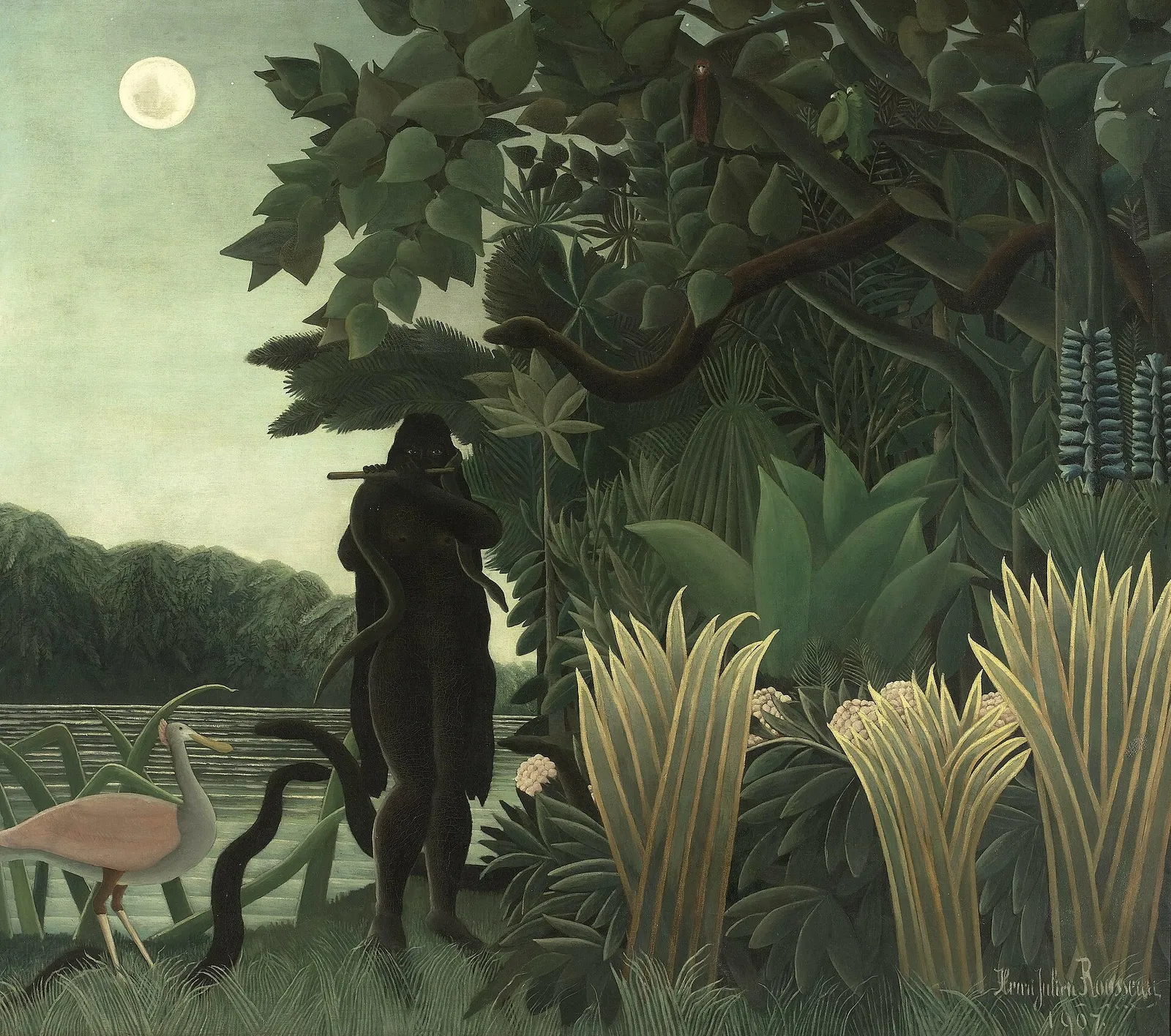
Henri Rousseau's La encantadora de serpientes, better known in English as The Snake Charmer, is a moonlit jungle scene painted in 1907. It belongs to the Musée d'Orsay, and at 167 by 189 centimetres it is large enough to fill your field of view when you stand before it.
Where to see it
The painting is in the collection of the Musée d'Orsay, which is also its listed location. Works in museum collections can be moved, rehung or lent to other institutions, so check the Musée d'Orsay's official website for current display status before you visit. If seeing this particular painting is the main reason for your trip, it is worth confirming shortly before you go.
What to look for in person
The charmer as a silhouette
Start with the central figure. The snake charmer is painted as a dark, almost flat silhouette against the glow of the sky, playing a flute. Very little of her body is modelled; what stands out are her eyes, which catch the light and seem to look straight out at the viewer. Follow the snake draped around her shoulders and notice the other serpents emerging from the foliage, apparently drawn by her music. The stillness of the figure contrasts with the sense that the whole jungle is listening.
Layer upon layer of leaves
Step closer and look at how the vegetation is built. Rousseau painted leaves one by one, in a wide range of greens, stacking them in overlapping bands so the jungle feels dense yet orderly. The plants are not botanically exact; they are invented or combined forms. Rousseau never travelled to the tropics, and his jungles are generally understood as products of imagination, drawing on sources available to him in France. Look at the crisp edges of each leaf and the almost decorative repetition of shapes across the canvas.
Moonlight, water and the bird
Now step back to take in the light. The scene is set at night or dusk, with a pale sky and moonlight reflecting on the water behind the charmer. This light silhouettes the figure and the trees, creating the dreamlike, hushed mood the painting is known for. On the right, find the long-legged pink bird standing among the plants, a spot of warm colour against the cool greens and dark tones. Comparing near and far helps you see how Rousseau stages the picture like a theatre set.
About the painting
Henri Rousseau was a self-taught painter who came to art late and worked outside the academic system of his day. He was sometimes mocked by critics for his flattened figures and unusual perspective, but he was admired by many younger avant-garde artists, and his work is now seen as an important part of the story of modern art. He is often associated with the term 'naive art', although his paintings are carefully composed and painstakingly finished.
La encantadora de serpientes, dated 1907, is one of the best known of his jungle pictures, a group of works he produced mainly in the later part of his career. Like the others, it shows an exotic landscape that Rousseau never saw in person. Instead of recording a real place, he built an imagined world from his own invention and from images and plant forms he could study in France. The result is less a view of nature than a carefully arranged vision.
In front of the painting, the scale matters: at 167 by 189 centimetres, the canvas is roughly the width of a person with arms outstretched, so the foliage surrounds the central figure in a way that small reproductions cannot convey. The balance between the dark figure, the bright sky and the surrounding greens is the key to its quiet, mysterious atmosphere.
The painting is held by the Musée d'Orsay. Give yourself time to view it from a distance first, for the overall composition, and then up close, for the detailed brushwork in the leaves.
Key facts
| Artist | Henri Rousseau |
|---|---|
| Date | 1907 |
| Size | 167 × 189 cm |
| Medium | oil paint, canvas |
| Collection | Musée d'Orsay |
How to visit: Musée d'Orsay
Paris, France · Museum guide
| Opening hours | Tue–Wed, Fri–Sun 09:30–18:00 (galleries close at 17:30) Thu 09:30–21:45 (late opening; galleries close at 21:15) |
|---|---|
| Closed | Every Monday, 1 May and 25 December. |
| Last entry | 17:00 (exhibitions 17:15); Thursdays 21:00 |
| Admission | Full rate, online EUR 16 Full rate, at the museum EUR 14 Reduced rate (on site only) EUR 11 Enfant & Cie, online EUR 13 Enfant & Cie, at the museum EUR 11 Night rate (Thursday), online EUR 12 Night rate (Thursday), at the museum EUR 10 Under 18s; EEA residents under 26 free |
| Free entry | Free for under 18s and residents of the European Economic Area under 26. Free on the first Sunday of the month, with booking required. |
| Booking | Booking is strongly recommended. Entry is by timed slot. |
The museum stays open and all collections and exhibitions remain accessible, but entrances have changed: timed-ticket holders use Entrance 1 (Quay); priority visitors, reseller voucher holders, visitors without tickets and groups use Entrance 2 (Forecourt). Arrive at least 15 minutes before your time slot.
Official ticket page
Official website
View on map
Hours and prices can change. Please check the official website before you go. (Checked on: 2026-11-11)
More by Henri Rousseau
 The Sleeping Gypsy — Museum of Modern Art
 The Repast of the Lion — Metropolitan Museum of Art
 Carnival Evening — Philadelphia Museum of Art
 Boy on the Rocks — National Gallery of Art
 The Dream — Museum of Modern Art
 The Muse Inspiring the Poet
 The Hungry Lion Throws Itself on the Antelope
 Tiger in a Tropical Storm — National Gallery