Art! Art! Art! › Works
The Third of May 1808
 Francisco Goya, 1814
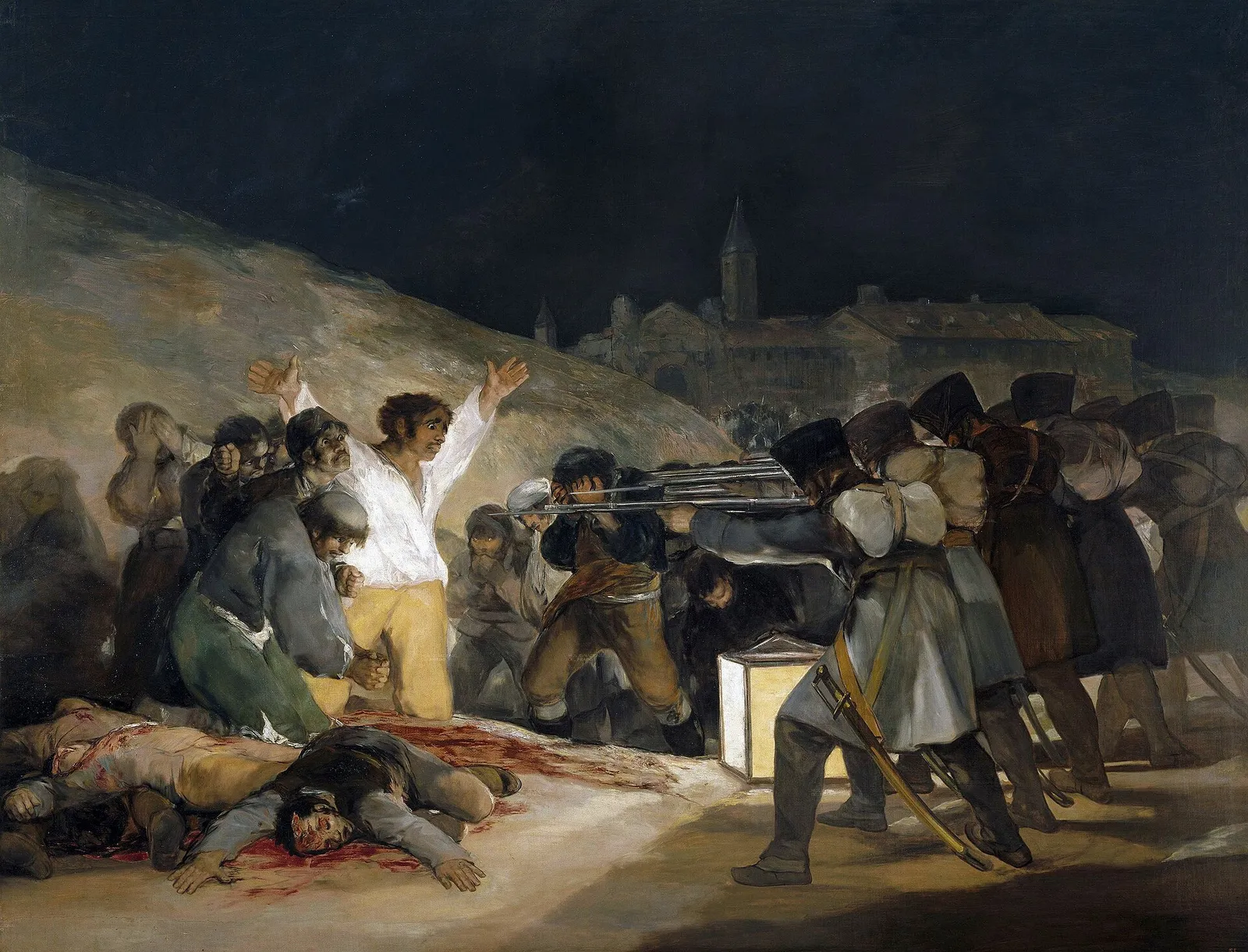
The Third of May 1808 is Francisco Goya's 1814 painting of a night-time execution, made to commemorate Spanish resistance to Napoleon's troops during the occupation of Madrid. The large oil on canvas belongs to the Museo del Prado, where visitors can stand before its lantern-lit confrontation between a firing squad and its victims.
Where to see it
The Third of May 1808 is in the collection of the Museo del Prado, and its location is listed as the Museo del Prado. The canvas measures 268 x 347 cm, so it is a picture to view both from a distance, to take in the whole composition, and up close, for details such as the central figure's hands. Works can be moved, lent or taken off view for conservation, so check the Museo del Prado's official website for current display status, opening hours and ticket information before you visit.
What to look for in person
The lantern and the man in white
Start at the centre, where a square lantern set on the ground throws a hard light across the scene. It falls fully on a man in a white shirt, his arms raised as he faces the guns. Look closely at his right hand: Goya gives it a mark resembling a stigma, a detail often read as linking the victim to Christian images of sacrifice. The white shirt and the lantern's glow make him the brightest area of the canvas, so your eye keeps returning to him wherever else it travels.
The faceless firing squad
Now look to the right. The soldiers of the firing squad are seen almost from behind, so their faces stay hidden from you. Notice how alike they are: a tight row of shakos, coats and bayonet-fixed muskets, repeated in nearly the same pose. Set against the varied, brightly lit figures on the left, they read less as individuals than as a single unit. Standing in front of the painting, you find yourself on their side of the line, looking past their shoulders toward the people about to be shot.
The captives and the dark town
Spend time with the group of captives on the left. Among those caught in the light is a monk or friar, shown with his hands joined in prayer, while others around him hide their faces or stare toward the guns. Then let your eyes adjust to the dark upper part of the canvas. Behind the figures, a townscape with a church steeple emerges faintly from the night. The sky offers no relief, which leaves the lantern on the ground as the only real source of light in the picture.
About the painting
Goya painted The Third of May 1808 in 1814, in oil on canvas, as a memorial to the Spanish uprising against Napoleon's forces in Madrid six years earlier. The idea came from the artist himself. In February 1814, once the French had been driven out, he petitioned Spain's provisional government for permission to commemorate, with his brush, the heroic acts of the insurrection against the man he called the 'Tyrant of Europe'. The government agreed, and the commission covered two canvases of the same size: this one and its companion, The Second of May 1808, which shows the street fighting that came before the executions.
After its completion the painting was kept at the Royal Palace in Madrid. It had passed to the Prado by 1834, although it does not appear in the museum's inventory until 1872, where it is recorded as 'Scene of the 3rd of May 1808'. The picture has not had an easy life. Both it and The Second of May 1808 were damaged in a road accident while being transported from Valencia. A restoration in 2008 brought back much of the brightness of the original paint surface, which helps the contrast between the lantern's glare and the surrounding darkness read clearly today.
The Prado treats the work as central to its collection: in 2009 the museum named it among its 14 most important works. For visitors, its size of 268 x 347 cm means the figures are close to life scale, which is part of why the scene feels so direct when you stand in front of it.
Key facts
| Artist | Francisco Goya |
|---|---|
| Date | 1814 |
| Size | 268 × 347 cm |
| Medium | oil paint, canvas |
| Collection | Museo del Prado |
How to visit: Museo del Prado
Madrid, Spain · Museum guide
| Opening hours | Mon–Sat 10:00–20:00 Sun and public holidays 10:00–19:00 6 Jan, 24 Dec, 31 Dec 10:00–14:00 (limited opening) |
|---|---|
| Closed | Closed on 1 January, 1 May and 25 December. |
| Last entry | Last entry 30 minutes before closing; visitors are asked to leave the galleries 10 minutes before closing. |
| Admission | General EUR 15 (includes the Collection and temporary exhibitions) Reduced (over 65, youth card holders, members of large families) EUR 7.5 Under 18, students aged 18–25, people with a disability of 33% or more, and other listed groups: free (official proof required at the ticket office on the day) Audio guide EUR 5 (added to the ticket; over 250 works in 15 languages) |
| Free entry | The Collection is free during the last two hours before closing (tickets at the ticket office, subject to capacity; 50% off temporary exhibitions). Always free for under-18s, students aged 18–25 and other listed groups with official proof at the ticket office. |
| Booking | Entry is by timed ticket. |
Official ticket page
Official website
View on map
Hours and prices can change. Please check the official website before you go. (Checked on: 2026-11-11)
More by Francisco Goya
 Saturn Devouring His Son — Museo del Prado
 La maja desnuda — Museo del Prado
 The Clothed Maja — Museo del Prado
 Charles IV of Spain and His Family — Museo del Prado
Sources
- Wikidata Q1091086
- Wikipedia (en) (CC BY-SA 4.0)
- Wikipedia (ja) (CC BY-SA 4.0)
- Wikipedia (it) (CC BY-SA 4.0)
- content3.cdnprado.net
- museodelprado.es
- www.museodelprado.es