Art! Art! Art! › Works
La maja desnuda
 Francisco José de Goya y Lucientes, 18th century
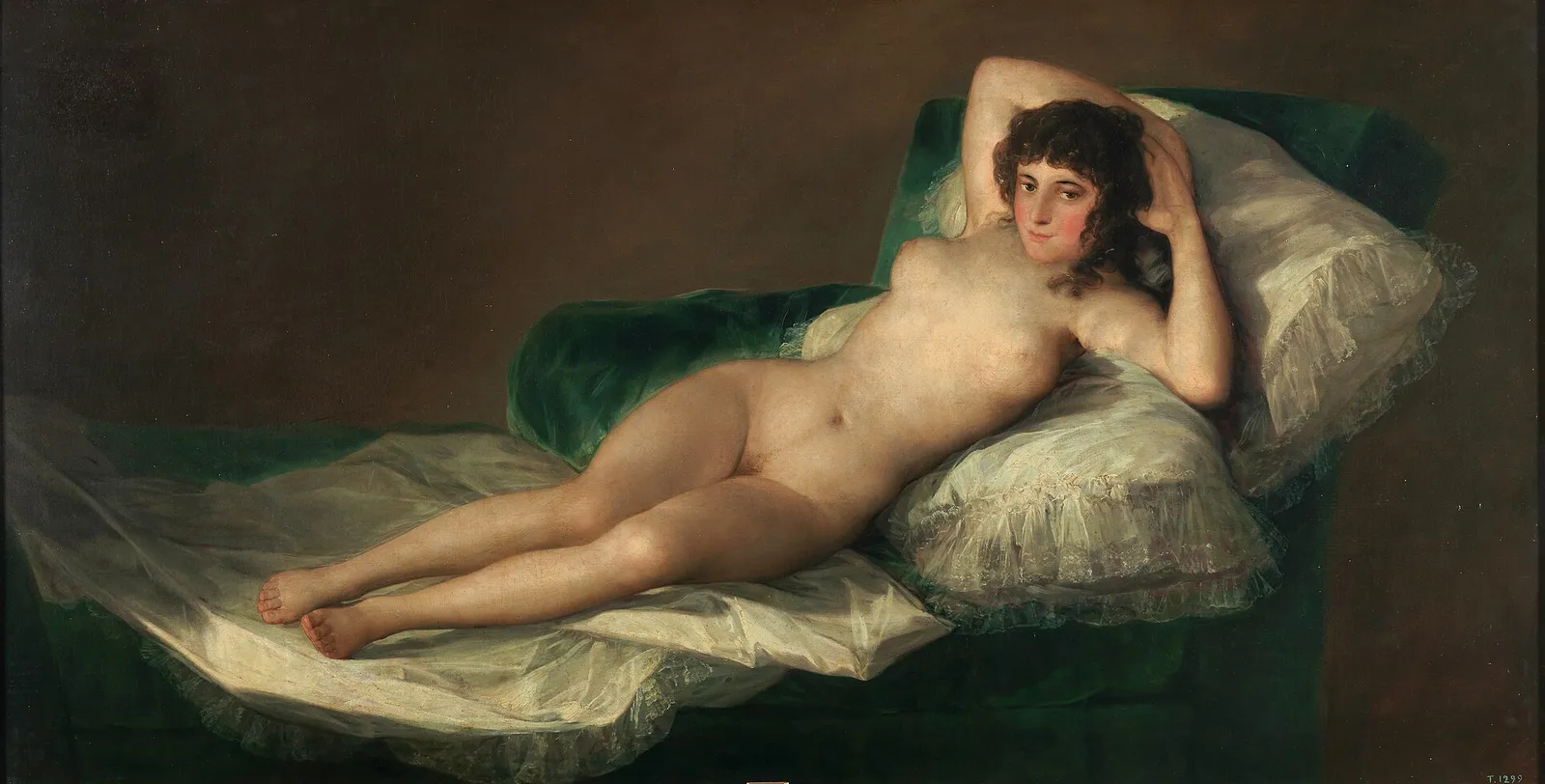
La maja desnuda, by Francisco José de Goya y Lucientes, is in the collection of the Museo del Prado. The painting dates from the 18th century and shows a reclining nude woman who looks directly out at the viewer. It measures 98 by 191 centimetres, so the figure appears close to life-size.
Where to see it
La maja desnuda belongs to the Museo del Prado, which holds it in its collection. Paintings in large collections are sometimes moved, rehung, lent or taken off view for conservation, so check the Museo del Prado's official website for the painting's current display status and for opening hours and ticket information before you visit.
What to look for in person
Meet her gaze
Start with her eyes. The woman lies on her back with both arms folded behind her head and looks straight out at you rather than away or down. That frank, level gaze is what most visitors notice first, and it sets the tone of the picture: she is not presented as a goddess or a figure from mythology, but as a contemporary woman who knows she is being looked at. Step back and see how the raised arms open the upper body, and how the slightly turned head holds your attention at the left end of the long canvas.
Flesh, fabric and a dark ground
Look at how the pale body sits against the bedding. The figure rests on a green divan piled with white pillows and sheets, and the cool, silvery whites set off the warmer tones of the skin. Move closer and compare the handling: the body is smoothly modelled, while the fabrics are painted more loosely, with visible brushwork in the folds. The background is kept dark and plain, so nothing competes with the figure. At 98 by 191 centimetres, the canvas is wide and low, and the body stretches across almost its full length.
What is missing, and its companion
Notice what Goya leaves out. There is no Cupid, no mirror, no classical setting or mythological attribute, the devices earlier painters often used to make a nude acceptable. That absence is central to the painting's reputation. Keep in mind, too, that Goya painted a companion picture, La maja vestida, showing a woman in the same pose and setting but dressed in a close-fitting white costume. The two works are traditionally discussed as a pair, and comparing them in your mind's eye sharpens how direct the nude version is.
About the painting
Francisco José de Goya y Lucientes was one of the leading painters in Spain in the late eighteenth and early nineteenth centuries, working as a portraitist and as a painter to the Spanish court. La maja desnuda dates from the 18th century and is now in the collection of the Museo del Prado. The word maja referred to a type of fashionable, spirited young woman from the popular classes of Madrid, a figure who appears often in Spanish art and literature of the period. The painting stands out in the Spanish tradition because the female nude was rarely painted there; the Church discouraged such subjects, and only a handful of earlier examples are known, such as Velázquez's Rokeby Venus. Goya's picture goes further than most by presenting a real-looking woman without a mythological pretext. The painting and its clothed companion, La maja vestida, are recorded in the possession of Manuel Godoy, the powerful chief minister of King Charles IV. After Godoy fell from power, his collection was seized, and in 1815 the Spanish Inquisition summoned Goya to account for the two pictures, which it considered obscene. The identity of the model has never been established, and theories about her remain speculative. For visitors, the painting rewards slow looking: the relationship between the gaze and the pose, the contrast of skin and fabric, and the plainness of the setting all show how Goya made an old subject feel immediate and modern.
Key facts
| Artist | Francisco José de Goya y Lucientes |
|---|---|
| Date | 18th century |
| Size | 98 × 191 cm |
| Medium | oil paint, canvas |
| Collection | Museo del Prado |
How to visit: Museo del Prado
Madrid, Spain · Museum guide
| Opening hours | Mon–Sat 10:00–20:00 Sun and public holidays 10:00–19:00 6 Jan, 24 Dec, 31 Dec 10:00–14:00 (limited opening) |
|---|---|
| Closed | Closed on 1 January, 1 May and 25 December. |
| Last entry | Last entry 30 minutes before closing; visitors are asked to leave the galleries 10 minutes before closing. |
| Admission | General EUR 15 (includes the Collection and temporary exhibitions) Reduced (over 65, youth card holders, members of large families) EUR 7.5 Under 18, students aged 18–25, people with a disability of 33% or more, and other listed groups: free (official proof required at the ticket office on the day) Audio guide EUR 5 (added to the ticket; over 250 works in 15 languages) |
| Free entry | The Collection is free during the last two hours before closing (tickets at the ticket office, subject to capacity; 50% off temporary exhibitions). Always free for under-18s, students aged 18–25 and other listed groups with official proof at the ticket office. |
| Booking | Entry is by timed ticket. |
Official ticket page
Official website
View on map
Hours and prices can change. Please check the official website before you go. (Checked on: 2026-11-11)
More by Francisco José de Goya y Lucientes
 The Third of May 1808 — Museo del Prado
 Saturn Devouring His Son — Museo del Prado
 The Clothed Maja — Museo del Prado
 Charles IV of Spain and His Family — Museo del Prado