Art! Art! Art! › Works
Saturn Devouring His Son
 Francisco José de Goya y Lucientes, 1819
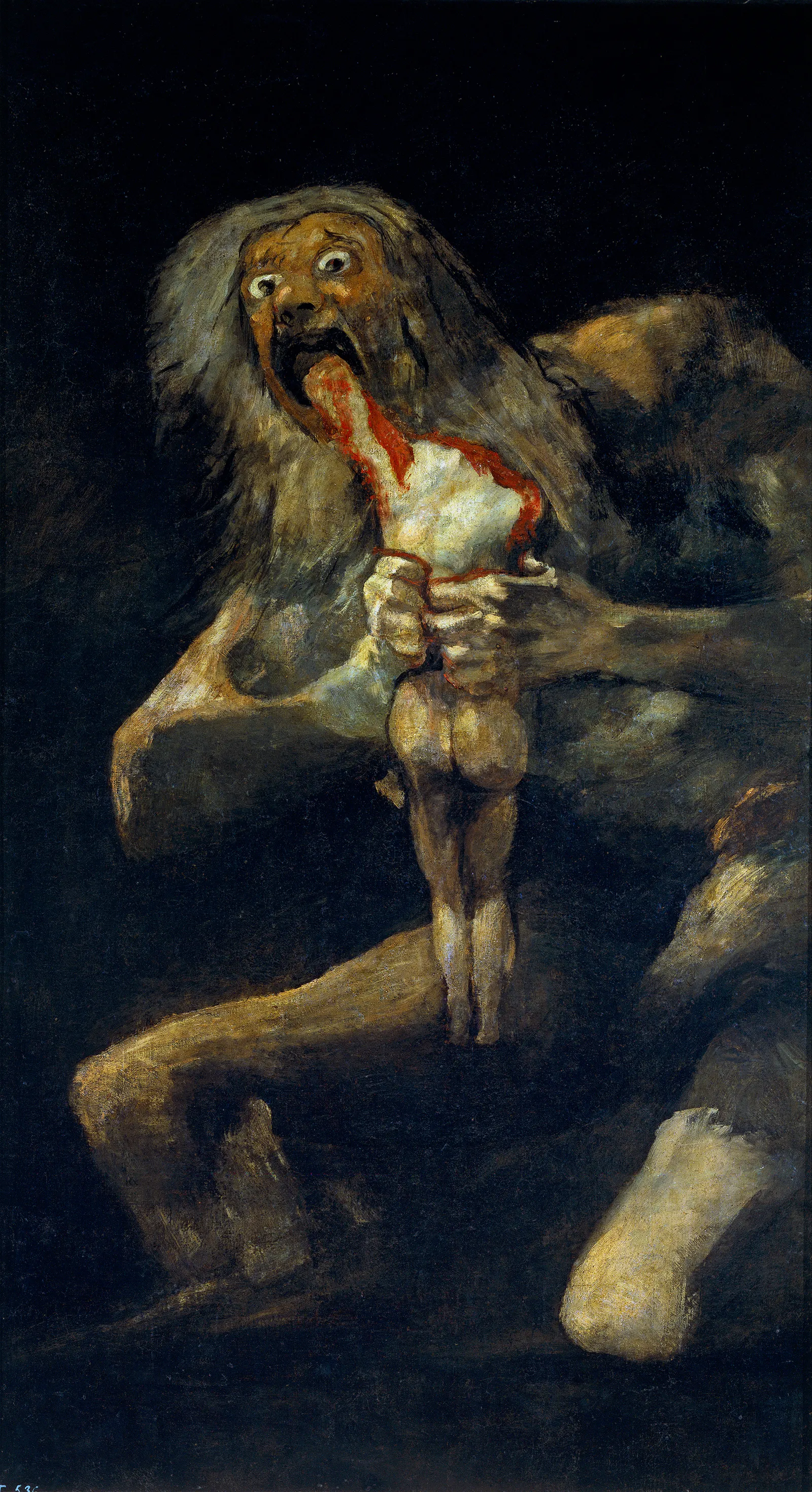
Saturn Devouring His Son is one of the Black Paintings that Francisco José de Goya y Lucientes painted directly onto the walls of his own house, and it now belongs to the Museo del Prado. Dated 1819 in the collection record, the image of a giant figure consuming a human body has become one of the most recognised works in Goya's late output.
Where to see it
The painting is in the collection of the Museo del Prado, and that is where you go to see it. Display arrangements can change because of rehanging, conservation or other museum activity, so check the Museo del Prado's official website for current display status before you visit.
What to look for in person
The figure and what it holds
Stand back first and let the composition register: a large figure looms out of the darkness, gripping a human body in both hands. Then move closer and look at the body itself. Its head and part of its left arm are already gone, so the act of eating is shown as something already under way rather than about to happen. Notice how little setting Goya provides. There is no landscape, no architecture and no supporting cast, only the figure, the body and the surrounding dark, which keeps your attention fixed on the act at the centre of the picture.
A wall painting now on canvas
This was never meant to be an easel picture. Goya painted it in oil directly onto the plaster wall of his house, and it was transferred to canvas only years later. Keep that history in mind as you look at the surface and the edges of the image. The tall, narrow format, 143.5 by 81.4 cm, reflects a section of wall in a domestic room rather than a canvas size chosen in a studio. You are looking at a fragment of an interior that was physically lifted from its original setting and moved into a museum.
One room among several
The painting belongs to a group of 14 works known as the Black Paintings, created for Goya's house, the Quinta del Sordo near Madrid. Saturn was one of six of these images painted in the dining room on the ground floor. Try to picture it as part of a sequence on the walls of a lived-in space, with other dark, enigmatic scenes around it. The Prado holds the Black Paintings, so if others from the group are on view during your visit, look at them together to get a sense of the series as a whole.
About the painting
Goya painted Saturn Devouring His Son on a wall of the Quinta del Sordo, his house near Madrid, as part of the group of fourteen murals now called the Black Paintings. The collection record gives the date as 1819. The artist did not give the picture a title; the name it carries today was assigned by others after his death. The scene is traditionally interpreted as the classical myth of Saturn, the Roman counterpart of the Greek Cronus, who ate his children because he feared that one of them would overthrow him.
Technical study has added another layer to the work's history. X-ray examination suggests that Goya first covered the walls of the house with calm landscapes, which he later painted over with the Black Paintings, so the image visitors see sits on top of a very different earlier decoration.
The murals left the house after it was acquired by Baron Emile d'Erlanger, who arranged for them to be transferred from plaster to canvas. The work was carried out under Salvador Martinez Cubells, a restorer at the Prado. The Black Paintings were then shown in Paris at the Exposition Universelle of 1878. In 1881 d'Erlanger gave them to the Spanish state, and they have been exhibited at the Museo del Prado since 1889.
When you stand in front of the painting, you are therefore seeing a private wall decoration, painted for a room in which its owner lived and ate, that has passed through transfer, international exhibition and donation to become part of a public collection.
Key facts
| Artist | Francisco José de Goya y Lucientes |
|---|---|
| Date | 1819 |
| Size | 143.5 × 81.4 cm |
| Medium | wall, mixed technique, canvas |
| Collection | Museo del Prado |
How to visit: Museo del Prado
Madrid, Spain · Museum guide
| Opening hours | Mon–Sat 10:00–20:00 Sun and public holidays 10:00–19:00 6 Jan, 24 Dec, 31 Dec 10:00–14:00 (limited opening) |
|---|---|
| Closed | Closed on 1 January, 1 May and 25 December. |
| Last entry | Last entry 30 minutes before closing; visitors are asked to leave the galleries 10 minutes before closing. |
| Admission | General EUR 15 (includes the Collection and temporary exhibitions) Reduced (over 65, youth card holders, members of large families) EUR 7.5 Under 18, students aged 18–25, people with a disability of 33% or more, and other listed groups: free (official proof required at the ticket office on the day) Audio guide EUR 5 (added to the ticket; over 250 works in 15 languages) |
| Free entry | The Collection is free during the last two hours before closing (tickets at the ticket office, subject to capacity; 50% off temporary exhibitions). Always free for under-18s, students aged 18–25 and other listed groups with official proof at the ticket office. |
| Booking | Entry is by timed ticket. |
Official ticket page
Official website
View on map
Hours and prices can change. Please check the official website before you go. (Checked on: 2026-11-11)
More by Francisco José de Goya y Lucientes
 The Third of May 1808 — Museo del Prado
 La maja desnuda — Museo del Prado
 The Clothed Maja — Museo del Prado
 Charles IV of Spain and His Family — Museo del Prado
Sources
- Wikidata Q1150997
- Wikipedia (en) (CC BY-SA 4.0)
- Wikipedia (ja) (CC BY-SA 4.0)
- Wikipedia (it) (CC BY-SA 4.0)
- Wikipedia (fr) (CC BY-SA 4.0)
- content3.cdnprado.net
- museodelprado.es
- www.museodelprado.es