Art! Art! Art! › Works
Charles IV of Spain and His Family
 Francisco José de Goya y Lucientes, 1800
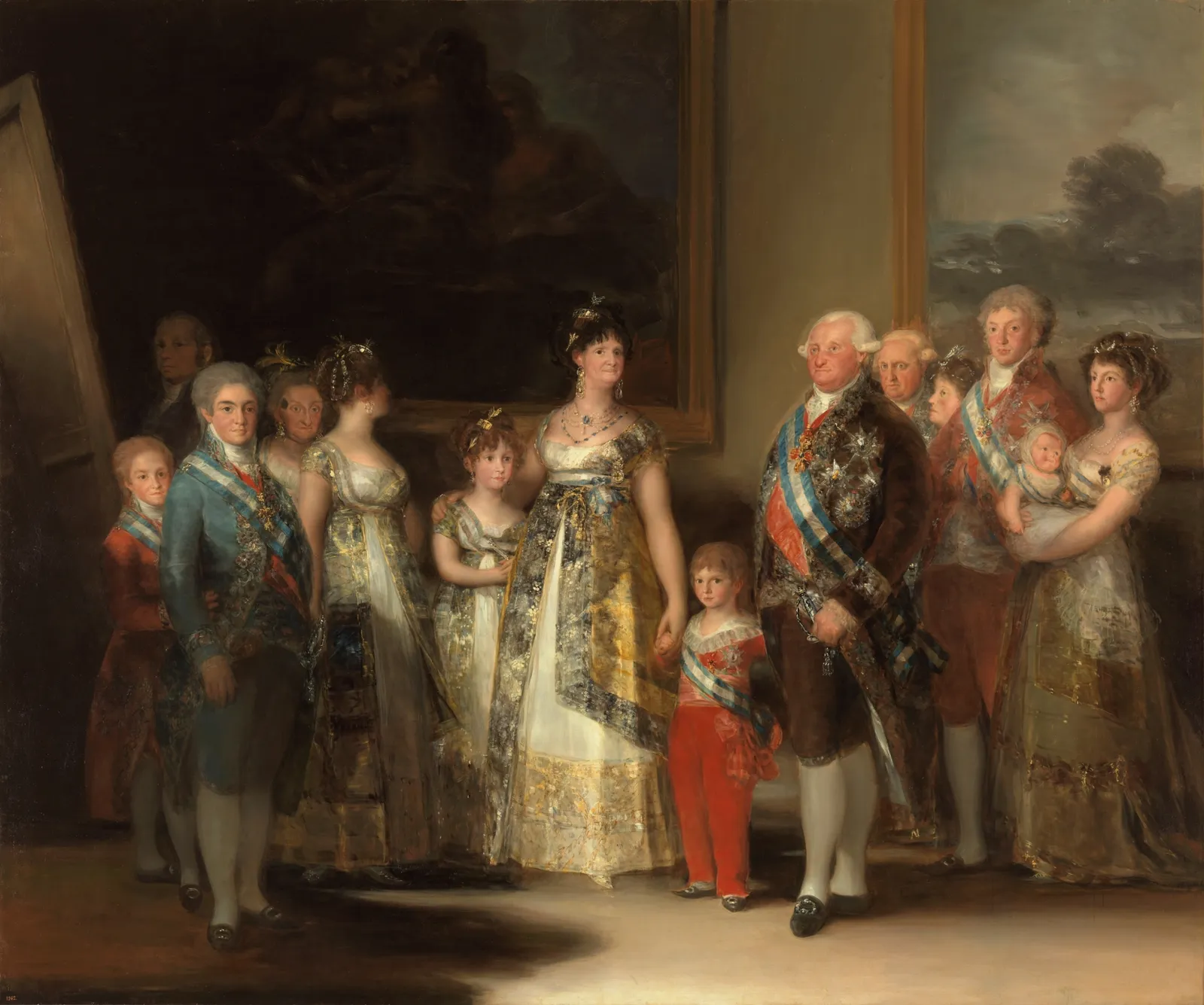
Charles IV of Spain and His Family is Francisco José de Goya y Lucientes's large group portrait of the Spanish royal family, dated 1800 and held by the Museo del Prado. At 280 by 336 cm, it lines the family up almost at life size, so standing in front of it feels like meeting them face to face.
Where to see it
The painting belongs to the collection of the Museo del Prado. The fact sheet lists its location as the Royal Palace of Madrid and the Museo del Prado, so confirm where it is currently shown before you go. Works can be moved, lent or temporarily taken off view, so check the Museo del Prado's official website for current display status, opening hours and ticketing before planning your visit.
What to look for in person
Find the painter in the shadows
Look to the far left, behind the royal figures. In the dim background stands Goya himself, at a large canvas, looking out toward the viewer. Placing the artist at work inside a royal portrait is widely read as a reference to Velázquez's Las Meninas, which Goya knew well from the royal collection. Notice how he keeps himself in the dark while the family steps forward into the light. It is a quiet signature, and it makes you wonder what exactly he is painting and from what point of view.
The queen at the centre
Your eye is drawn to the middle of the row, not to the king. Queen Maria Luisa occupies the centre of the composition, flanked by two of her youngest children, one held by the hand and one by the shoulder. King Charles IV stands slightly forward on the right, his chest covered with sashes and orders. Step back and see how the grouping works: rather than a single ruler at the heart of the picture, the queen anchors the arrangement, and the adults and children spread out from her on either side.
Fabric, jewels and quick brushwork
Move closer to the costumes. From a distance the silks, embroidery, jewels and decorations look precise and glittering. Up close, many of these effects dissolve into loose, rapid strokes and dabs of bright paint laid over darker tones. This contrast between a convincing surface from afar and free handling up close is typical of Goya's mature portraits. Compare the shimmer of the clothing with the faces, which are painted with individual and often unflattering character rather than idealised smoothness.
About the painting
Goya painted this group portrait while serving as First Court Painter to Charles IV, a post he had recently been given. The fact sheet dates the work to 1800, and its size, 280 by 336 cm, reflects its role as an official image of the dynasty, intended to present the royal family together at a moment when Spain's monarchy was facing an unsettled period in Europe. Rather than placing the family in an elaborate allegorical setting, Goya arranges them in a shallow row across a plain interior, with large paintings dimly visible on the wall behind. The figures stand rather than act; there is no single event, only a gathering. This simplicity puts the emphasis on faces, costume and the relationships between the sitters. Among the figures is the heir to the throne, the future Ferdinand VII, shown at the left in blue. Next to him is a young woman who turns her head away from the viewer, a detail often explained as a placeholder for a future bride whose identity was not yet settled. The painting has long prompted discussion about how Goya regarded his patrons. The faces are frank and individual, without the idealisation found in many court portraits, yet the family accepted the work. For visitors, the most rewarding approach is to take time: first view the whole frieze of figures from a distance, then walk along it, reading each face and noticing how light picks out some people and leaves others, including the painter, in shadow.
Key facts
| Artist | Francisco José de Goya y Lucientes |
|---|---|
| Date | 1800 |
| Size | 280 × 336 cm |
| Medium | oil paint, canvas |
| Collection | Museo del Prado |
How to visit: Museo del Prado
Madrid, Spain · Museum guide
| Opening hours | Mon–Sat 10:00–20:00 Sun and public holidays 10:00–19:00 6 Jan, 24 Dec, 31 Dec 10:00–14:00 (limited opening) |
|---|---|
| Closed | Closed on 1 January, 1 May and 25 December. |
| Last entry | Last entry 30 minutes before closing; visitors are asked to leave the galleries 10 minutes before closing. |
| Admission | General EUR 15 (includes the Collection and temporary exhibitions) Reduced (over 65, youth card holders, members of large families) EUR 7.5 Under 18, students aged 18–25, people with a disability of 33% or more, and other listed groups: free (official proof required at the ticket office on the day) Audio guide EUR 5 (added to the ticket; over 250 works in 15 languages) |
| Free entry | The Collection is free during the last two hours before closing (tickets at the ticket office, subject to capacity; 50% off temporary exhibitions). Always free for under-18s, students aged 18–25 and other listed groups with official proof at the ticket office. |
| Booking | Entry is by timed ticket. |
Official ticket page
Official website
View on map
Hours and prices can change. Please check the official website before you go. (Checked on: 2026-11-11)
More by Francisco José de Goya y Lucientes
 The Third of May 1808 — Museo del Prado
 Saturn Devouring His Son — Museo del Prado
 La maja desnuda — Museo del Prado
 The Clothed Maja — Museo del Prado