Art! Art! Art! › Works
The Clothed Maja
 Francisco José de Goya y Lucientes, 1800
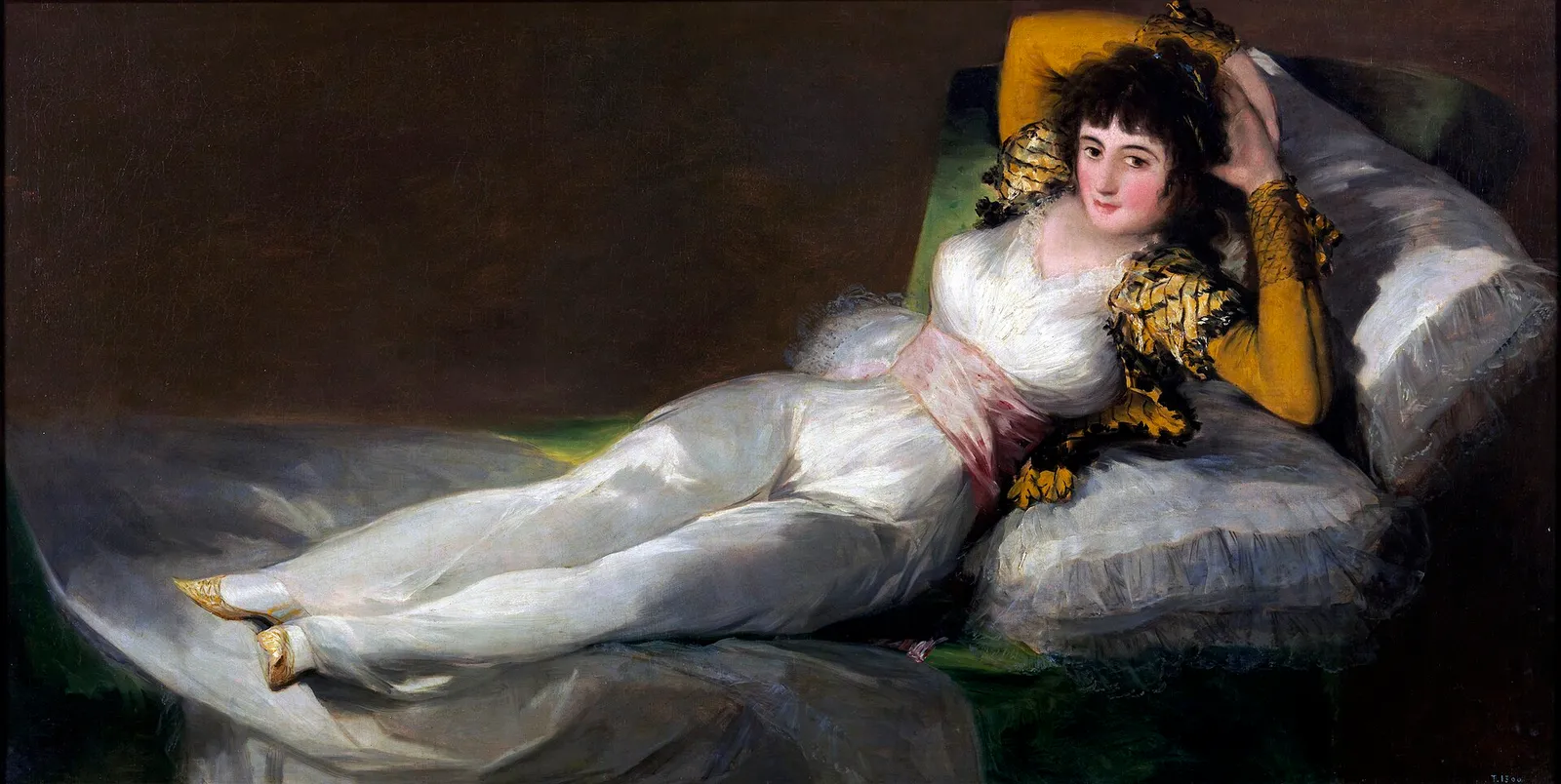
The Clothed Maja by Francisco José de Goya y Lucientes is held by the Museo del Prado. Dated 1800 and measuring 95 x 190 cm, it shows a reclining woman in fashionable dress who meets the viewer's eye with open confidence. It is best known as the companion to Goya's The Nude Maja.
Where to see it
The Clothed Maja is in the collection of the Museo del Prado, which is its listed location. Its collection record also names the Royal Academy of Fine Arts of San Fernando, reflecting the painting's history before it reached the Prado. Paintings can be moved, lent or temporarily taken off view, so check the Museo del Prado's official website for current display status, opening hours and ticket information before you visit.
What to look for in person
The shimmering costume
Look first at the dress. Goya builds the white gown from quick, fluid strokes that follow the curves of the body rather than describing every fold, so the fabric seems both to cling and to shimmer. Over it sits a short jacket trimmed in gold, and a rose-pink sash wraps the waist. Step close and the surface breaks into loose touches of paint; step back and it resolves into silk and gauze. The fashionable outfit identifies the sitter as a maja, a figure associated with Spanish popular style in Goya's time.
A direct, unembarrassed gaze
The woman reclines with her arms folded behind her head and looks straight out at the viewer. That steady gaze is the centre of the picture. Notice the flushed cheeks and made-up face, painted with more finish than the clothing, which keeps pulling your attention back to her expression. Her body stretches across the long horizontal canvas, and the green upholstered couch and plump cushions frame her from shoulder to slippered feet. The pose is relaxed, but nothing about it is passive.
Thinking about the pair
The painting has a famous companion, The Nude Maja, which shows a woman in nearly the same pose without clothing. If both works are on view during your visit, compare them carefully. The couch, the pose and the gaze repeat, but the handling of paint differs, and the clothed version is generally described as freer and more sketch-like in its brushwork. Seen side by side, the two pictures turn a single image into a question about looking, concealment and display, which is a large part of why they remain so discussed.
About the painting
Francisco José de Goya y Lucientes painted The Clothed Maja as one half of a pair, matched with The Nude Maja. The fact sheet dates it to 1800, and the canvas measures 95 x 190 cm, a wide, low format suited to a reclining figure. The title refers to the maja, a type drawn from Spanish popular culture: confident, stylishly dressed and associated with the lively street life that Goya often depicted in his tapestry designs and prints. Both paintings are widely associated with Manuel Godoy, the powerful chief minister to King Charles IV, in whose collection they were recorded. After Godoy's fall, the paintings attracted official attention, and Goya was summoned before the Spanish Inquisition in connection with them, a sign of how provocative the nude in particular was considered at the time. The identity of the model has never been established. A long-repeated popular story links her to the Duchess of Alba, but this is not supported by firm evidence and is generally treated as legend. For visitors, the value of the painting lies less in who she was than in how Goya presents her. The woman is not a goddess or a figure from mythology, the usual justification for a reclining female figure in European painting, but a contemporary woman in fashionable dress who looks back at us. The collection record lists both the Royal Academy of Fine Arts of San Fernando and the Museo del Prado, reflecting the painting's passage through the Academy before it entered the Prado, which is its listed location today.
Key facts
| Artist | Francisco José de Goya y Lucientes |
|---|---|
| Date | 1800 |
| Size | 95 × 190 cm |
| Medium | oil paint, canvas |
| Collection | Royal Academy of Fine Arts of San Fernando / Museo del Prado |
How to visit: Museo del Prado
Madrid, Spain · Museum guide
| Opening hours | Mon–Sat 10:00–20:00 Sun and public holidays 10:00–19:00 6 Jan, 24 Dec, 31 Dec 10:00–14:00 (limited opening) |
|---|---|
| Closed | Closed on 1 January, 1 May and 25 December. |
| Last entry | Last entry 30 minutes before closing; visitors are asked to leave the galleries 10 minutes before closing. |
| Admission | General EUR 15 (includes the Collection and temporary exhibitions) Reduced (over 65, youth card holders, members of large families) EUR 7.5 Under 18, students aged 18–25, people with a disability of 33% or more, and other listed groups: free (official proof required at the ticket office on the day) Audio guide EUR 5 (added to the ticket; over 250 works in 15 languages) |
| Free entry | The Collection is free during the last two hours before closing (tickets at the ticket office, subject to capacity; 50% off temporary exhibitions). Always free for under-18s, students aged 18–25 and other listed groups with official proof at the ticket office. |
| Booking | Entry is by timed ticket. |
Official ticket page
Official website
View on map
Hours and prices can change. Please check the official website before you go. (Checked on: 2026-11-11)
More by Francisco José de Goya y Lucientes
 The Third of May 1808 — Museo del Prado
 Saturn Devouring His Son — Museo del Prado
 La maja desnuda — Museo del Prado
 Charles IV of Spain and His Family — Museo del Prado