Art! Art! Art! › Works
The Shop Sign of Gersaint
 Jean-Antoine Watteau, 1720
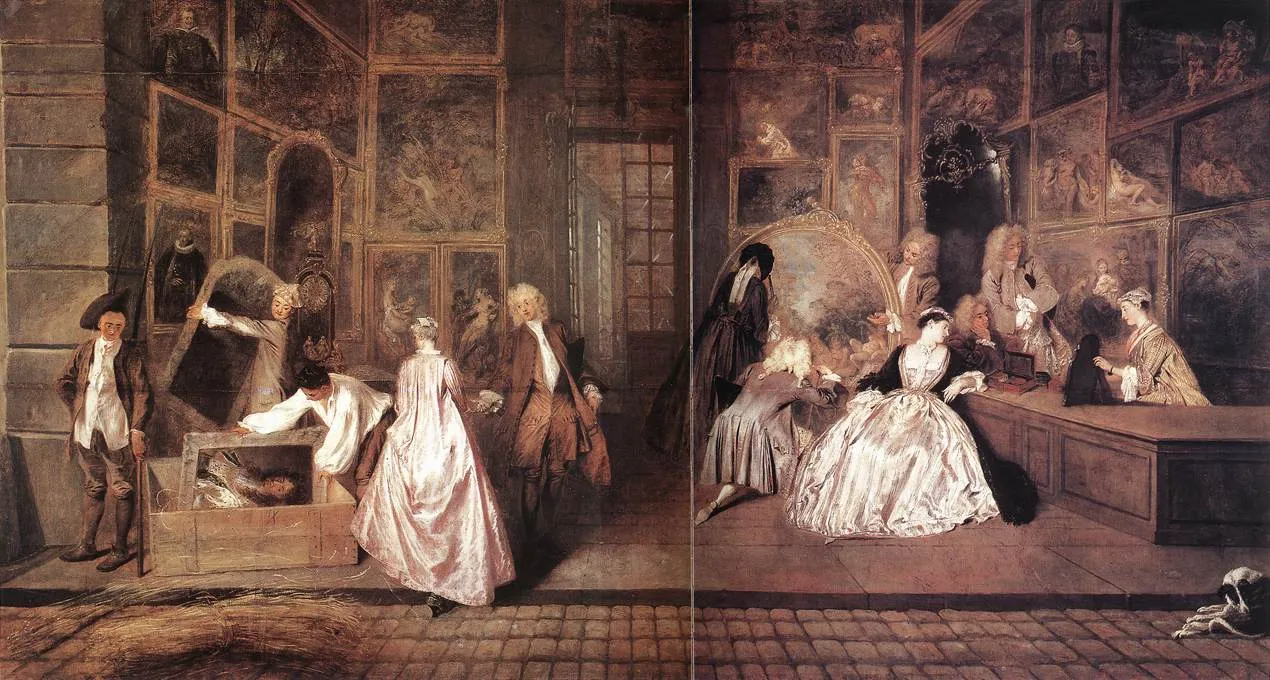
Jean-Antoine Watteau's The Shop Sign of Gersaint, dated 1720, is held at Charlottenburg Palace. Painted as a sign for a Paris art dealer's shop, it opens like a stage onto a room of paintings, customers and assistants, and it is one of the last major works Watteau completed before his death.
Where to see it
The Shop Sign of Gersaint is in the collection of Charlottenburg Palace, which is also its listed location. Opening hours, ticketing and the rooms on view can change, and works are sometimes moved for conservation or exhibitions. Check the official website of Charlottenburg Palace for current display status before you visit. The canvas measures 163 x 306 cm, so plan to step back to take in the whole composition before moving closer for details.
What to look for in person
The portrait going into the crate
Start at the left. Shop assistants lower a portrait of Louis XIV into a wooden packing case, while a man and a woman pause to watch. Louis XIV had died in 1715, and art historians widely read this moment as a quiet reference to the end of his reign and a shift in taste. Look at how ordinary the action is: straw, ropes and a workman's posture sit right beside a royal image, turning a grand subject into part of the everyday business of the shop.
The woman at the threshold
Near the centre-left, a woman in a shimmering pale pink silk dress steps up into the shop, seen from behind as a man reaches out his hand toward her. Her turned back is one of the most recognisable passages in Watteau's work. Move close enough to see how the folds of fabric are built from quick, light strokes that catch the light. The pose leads your eye from the street into the interior, linking the passers-by outside with the world of art collecting within.
Collectors studying pictures
On the right, elegantly dressed visitors gather at a counter to examine a painting, some leaning in for a close look. Above them, the walls are packed with framed pictures, hung edge to edge as dealers' shops displayed their stock. Notice too the paved street that runs along the bottom of the canvas: the shop front is open, so the viewer stands outside, as a passer-by would have done. This framing suits the painting's original purpose as a sign meant to draw customers in.
About the painting
Watteau painted The Shop Sign of Gersaint in 1720 for Edme-François Gersaint, an art dealer in Paris and a friend of the artist. Rather than a simple lettered board, Watteau produced a large, wide canvas, 163 by 306 centimetres, that shows the inside of a picture shop as if its front wall had been removed. The result is both an advertisement and a portrait of the Paris art market in the early eighteenth century. Watteau is best known for the fête galante, scenes of elegantly dressed figures in parkland settings. Here he moves those figures indoors and into a commercial setting. The customers are refined and leisurely, yet the assistants handling crates and frames remind us that art is also a trade. The painting rewards slow looking: the way groups are spaced across the long format, the contrast between the cool tones of the walls and the warm colours of the clothing, and the small exchanges of glance and gesture between figures. The work dates from the final period of Watteau's life; he died the following year, which gives the painting a special place in his career. For visitors, it offers a rare chance to see an artist depicting the very activity of looking at and buying pictures, an experience that mirrors your own as you stand in front of it. Take time to read it left to right, from the packing of the old king's portrait, across the threshold, to the collectors absorbed in examining a canvas.
Key facts
| Artist | Jean-Antoine Watteau |
|---|---|
| Date | 1720 |
| Size | 163 × 306 cm |
| Medium | oil paint, canvas |
| Collection | Charlottenburg Palace |
How to visit: Charlottenburg Palace
Berlin, Germany
Hours and prices can change. Please check the official website before you go.
More by Jean-Antoine Watteau
 Mezzetin — Metropolitan Museum of Art
 Pierrot Content — Thyssen-Bornemisza Museum
 Pierrot — Louvre Museum
 The Embarkation for Cythera — Louvre Museum
 Fêtes Vénitiennes — National Gallery