Art! Art! Art! › Works
Pierrot Content
 Jean-Antoine Watteau, 1712
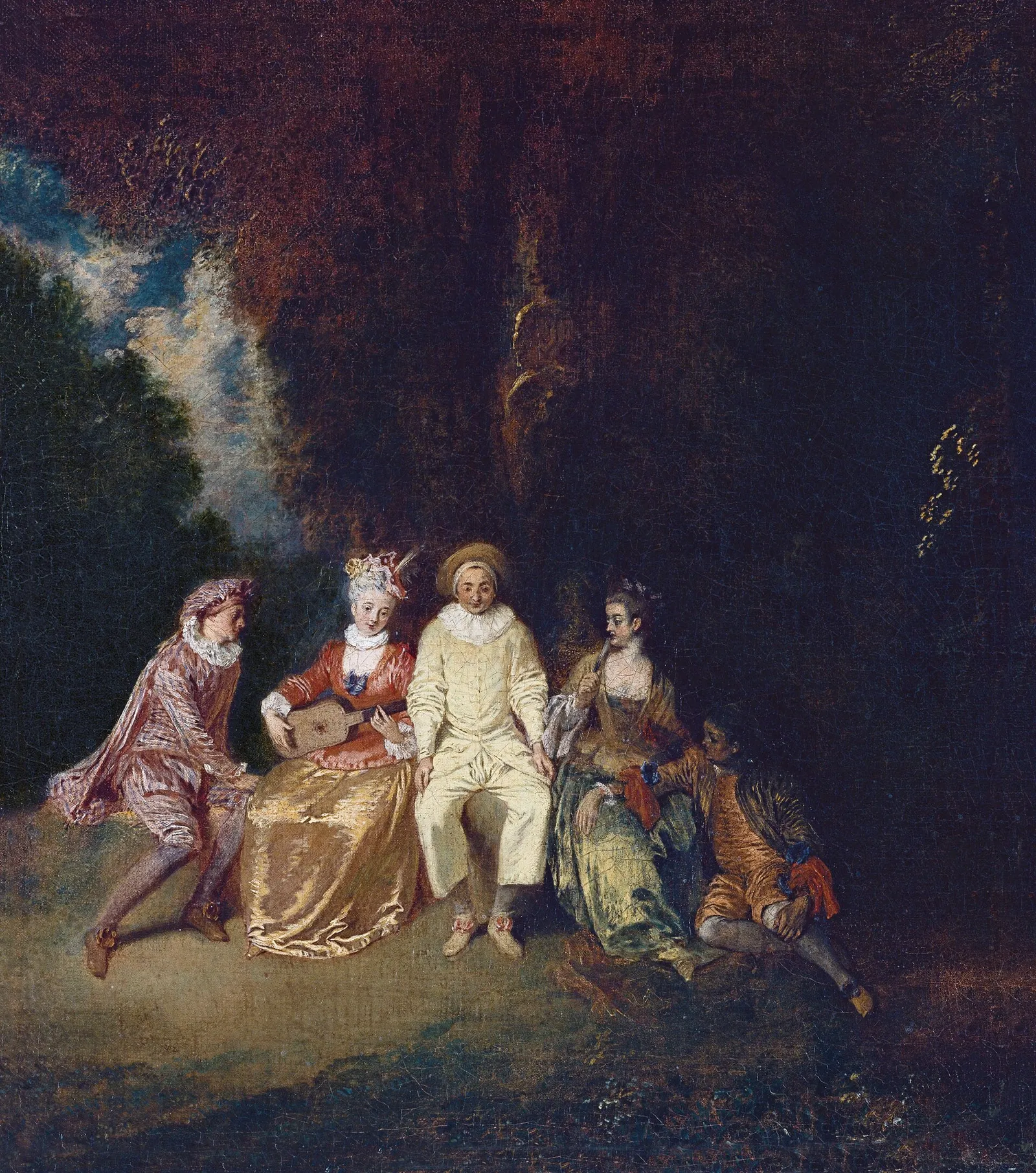
Pierrot Content is a small painting by Jean-Antoine Watteau, dated 1712 and held by the Thyssen-Bornemisza Museum. It sets the white-clad Pierrot, a stock character of Italian comedy, among companions in an open-air setting. Its intimate size rewards a slow, close look.
Where to see it
Pierrot Content is in the collection of the Thyssen-Bornemisza Museum, which is also its listed location. Works are sometimes rotated, lent or temporarily removed from display, so check the Thyssen-Bornemisza Museum's official website for current display status, opening hours and ticket information before you plan your visit.
What to look for in person
Pierrot at the centre
Start with the figure in white. Pierrot, the familiar clown of the commedia dell'arte, is the anchor of the composition, and his pale costume works as a focal point against the darker surroundings. Notice how Watteau uses the costume's broad, light-catching folds to draw your eye first to Pierrot and then outward to the people around him. Look at his posture and face, and ask yourself how 'content' he really seems. The title invites that question, and the answer you find is part of the pleasure of looking.
A small painting that asks you to step closer
The canvas measures only 35 by 31 centimetres, which is smaller than many visitors expect from a well-known name. That scale changes how you view it. Rather than taking it in from across the room, move in close, within the limits the museum allows, and study the handling of fabric, faces and foliage. Watteau's touch is often delicate, with small flicks of the brush suggesting shimmer on cloth or light through leaves. A painting this size rewards patience: give it a few minutes and details emerge.
Theatre moved outdoors
Notice the setting. Instead of a stage, Watteau places his theatrical characters in a landscape, with trees and open sky around them. This blending of stage costume and garden scene is a hallmark of his art and points toward the kind of elegant outdoor gatherings later called fêtes galantes. As you look, consider whether the figures seem to be performing or simply relaxing in costume. That ambiguity between play-acting and real life is one of the things that makes Watteau's work so distinctive to look at.
About the painting
Jean-Antoine Watteau is one of the defining painters of early eighteenth-century France. He is closely associated with two subjects that often overlap in his work: the characters of the Italian comedy, or commedia dell'arte, and refined outdoor gatherings of fashionable men and women. Pierrot Content, dated 1712, belongs to the earlier part of his short career and brings these interests together in a single small picture.
The commedia dell'arte was a popular form of theatre built around recognisable stock characters with set costumes and personalities. Pierrot, usually shown in loose white clothing, was one of the most familiar. Watteau's interest in theatrical subjects is widely connected with his time working alongside Claude Gillot, a painter known for scenes drawn from the stage. Watteau, however, tended to take such characters out of the theatre and place them in parkland or garden settings, where the line between performance and everyday leisure becomes blurred.
This approach fed into the type of painting for which Watteau became best known. In 1717 he was received into the French Royal Academy of Painting and Sculpture with a work of the kind that came to be described as a fête galante, a category associated with his name. Pierrot Content, painted several years earlier, shows ingredients of that later manner: costumed figures, a natural setting, and a mood that is gentle but hard to pin down.
For visitors, the painting's appeal lies in its scale and subtlety. At 35 by 31 centimetres, it is a picture to approach closely and study slowly, noticing the play of light on costume and the quiet exchanges between figures.
Key facts
| Artist | Jean-Antoine Watteau |
|---|---|
| Date | 1712 |
| Size | 35 × 31 cm |
| Medium | oil paint, canvas |
| Collection | Thyssen-Bornemisza Museum |
How to visit: Thyssen-Bornemisza Museum
Madrid, Spain · Museum guide
| Opening hours | Mon 12:00–16:00 (1 Sep–30 Jun, collection only, free) Tue, Wed, Thu, Fri, Sun 10:00–19:00 (1 Sep–30 Jun) Sat 10:00–23:00 (all year; 21:00–23:00 free for temporary exhibitions on level -1 and ground floor) Mon 12:00–16:00 (1 Jul–31 Aug, collection only, free) Tue–Fri 10:00–21:00 (1 Jul–31 Aug) Sun 10:00–19:00 (1 Jul–31 Aug) 24 and 31 December 10:00–15:00 (special hours) |
|---|---|
| Closed | Closed 1 January, 1 May and 25 December. Temporary exhibition hours vary (e.g. “The Freudian Universe of Dalí” is closed on Mondays). |
| Last entry | 30 minutes before closing |
| Admission | General EUR 14 (Permanent Collection, Carmen Thyssen Collection and current temporary exhibitions) Over 65s and pensioners EUR 10 (proof required) Students EUR 10 Groups (7 or more) EUR 12 per person Under 18s, unemployed, disability of 33% or more, Friends of the Museum: free Audio guide: ticket price + EUR 5.5 Paseo del Arte Pass (Thyssen + Prado + Reina Sofía) EUR 32.8 (one visit to each within 1 year) |
| Free entry | Free entry to the collection on Mondays 12:00–16:00, and to the temporary exhibitions on level -1 and the ground floor on Saturdays 21:00–23:00; no ticket required for either. “Soy de la Mutua” card holders can get up to two free same-day tickets at the ticket office. |
| Booking | No reservation is required and there is no timed entry. |
Official ticket page
Official website
View on map
Hours and prices can change. Please check the official website before you go. (Checked on: 2026-11-09)
More by Jean-Antoine Watteau
 Mezzetin — Metropolitan Museum of Art
 Pierrot — Louvre Museum
 The Embarkation for Cythera — Louvre Museum
 Fêtes Vénitiennes — National Gallery
 The Shop Sign of Gersaint