Art! Art! Art! › Works
Fêtes Vénitiennes
 Jean-Antoine Watteau, 1719
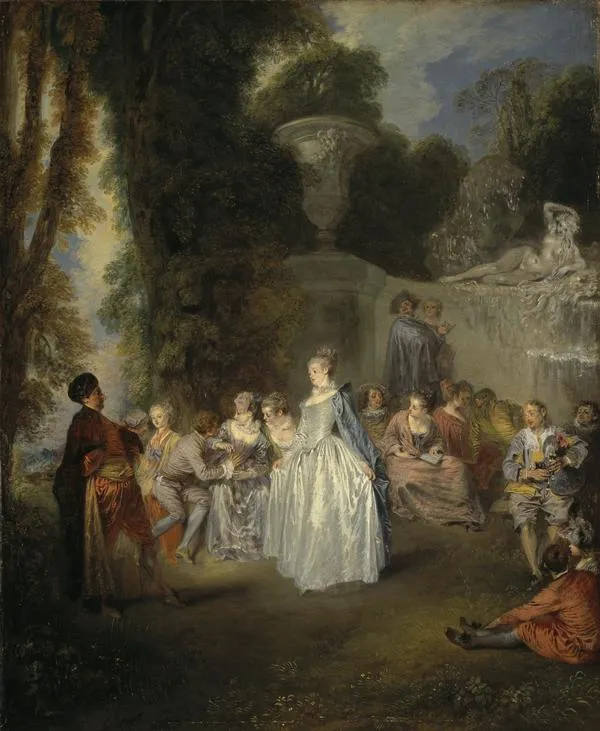
Jean-Antoine Watteau's Fêtes Vénitiennes, dated 1719, is in the collection of National Galleries Scotland and is housed at the Scottish National Gallery. At just 56 by 46 centimetres, it is a small, upright canvas that rewards close and unhurried looking. It is a fine example of the fête galante, the type of elegant outdoor gathering that Watteau made his own.
Where to see it
Fêtes Vénitiennes belongs to National Galleries Scotland and is located at the Scottish National Gallery. Works in permanent collections can be moved, rehung, lent or taken off view for conservation, so check the official National Galleries Scotland website for current display status and visitor information before you go. Because the painting measures only 56 x 46 cm, give yourself time to stand close to it. Much of its appeal lies in small passages of brushwork that are easy to miss from across a room.
What to look for in person
The dancer's shimmering dress
Start with the woman dancing near the centre. Watteau is admired above all for how he painted fabric, and here the pale silk of her gown catches the light in quick, broken strokes of colour rather than smooth blending. Step close and the dress dissolves into separate touches of paint. Step back and it shimmers again. Notice how her pose, caught mid-movement, sets the rhythm for the whole scene and draws your eye into the gathering around her.
Music and the people watching
A fête galante is as much about mood as story, and music sets that mood. Look for the seated musician playing a wind instrument, and for the onlookers grouped under the trees. Their glances, turned shoulders and quiet conversations create a sense of social theatre, where people watch and are watched. Watteau does not spell out a plot. Instead he suggests relationships through gesture and placement, leaving the viewer to sense the flirtation and reserve passing between the figures.
Garden, statue and soft light
Lift your eyes to the setting. Feathery trees frame the scene, and a pale stone sculpture of a reclining nude figure sits among the foliage, a reminder of the classical garden statuary of the period. Watteau's landscape is not a precise view of a real place but an idealised park, painted with loose, airy touches. The warm, hazy light softens edges and unifies the figures with their surroundings, giving the picture its dreamlike, slightly wistful atmosphere.
About the painting
Jean-Antoine Watteau is closely associated with the fête galante, a type of painting showing elegantly dressed men and women enjoying music, dance and conversation in parkland settings. The term itself came into use to describe his work, and it became one of the defining themes of early eighteenth-century French art. Fêtes Vénitiennes, dated 1719 on the fact sheet, comes from the late part of Watteau's short career. He died in 1721. In front of the painting, the most useful thing to keep in mind is scale. At 56 by 46 centimetres, this is a cabinet-sized work meant for close viewing, not a grand public canvas. Watteau's technique suits that intimacy: he built up shimmering surfaces with small, lively strokes, and his colour owes much to his study of Flemish and Venetian painting, especially Rubens. The picture also shows his interest in theatre. Costume, posed figures and a stage-like arrangement of performers and spectators all recall the comic theatre and opera that fascinated him. Yet the scene stays deliberately open. Nothing dramatic happens, and the meaning lies in the atmosphere of pleasure tinged with melancholy that many viewers sense in his work. For visitors, the painting is a chance to see how a quiet, small-format picture can hold attention. Look first at the overall rhythm of the figures, then move in to study individual faces, hands and folds of fabric, and finally step back again to see how the landscape and light bring everything together. The painting is held by National Galleries Scotland at the Scottish National Gallery.
Key facts
| Artist | Jean-Antoine Watteau |
|---|---|
| Date | 1719 |
| Size | 56 × 46 cm |
| Medium | oil paint, canvas |
| Collection | National Galleries Scotland |
How to visit: National Gallery
London, United Kingdom · Museum guide
| Opening hours | Mon–Thu, Sat, Sun 10:00–18:00 Fri 10:00–21:00 (Friday late) |
|---|---|
| Closed | 24–26 December and 1 January. |
| Admission | General admission (collection) free; donations invited Some exhibitions are charged (e.g. Renoir and Love, until 31 Jan 2027) |
| Free entry | General admission is always free. |
| Booking | No reservation or timed entry is required. Free timed booking gives fast-track entry. |
Building work and improvements are under way: some rooms are closed and some paintings have moved, so check the floorplans or collection search before visiting. A new Research Centre is due to open in 2028. On 17 November only, some east wing rooms and the Espresso Bar close from 16:00.
Official ticket page
Official website
View on map
Hours and prices can change. Please check the official website before you go. (Checked on: 2026-11-11)
More by Jean-Antoine Watteau
 Mezzetin — Metropolitan Museum of Art
 Pierrot Content — Thyssen-Bornemisza Museum
 Pierrot — Louvre Museum
 The Embarkation for Cythera — Louvre Museum
 The Shop Sign of Gersaint