Art! Art! Art! › Works
Pierrot
 Jean-Antoine Watteau, 1718
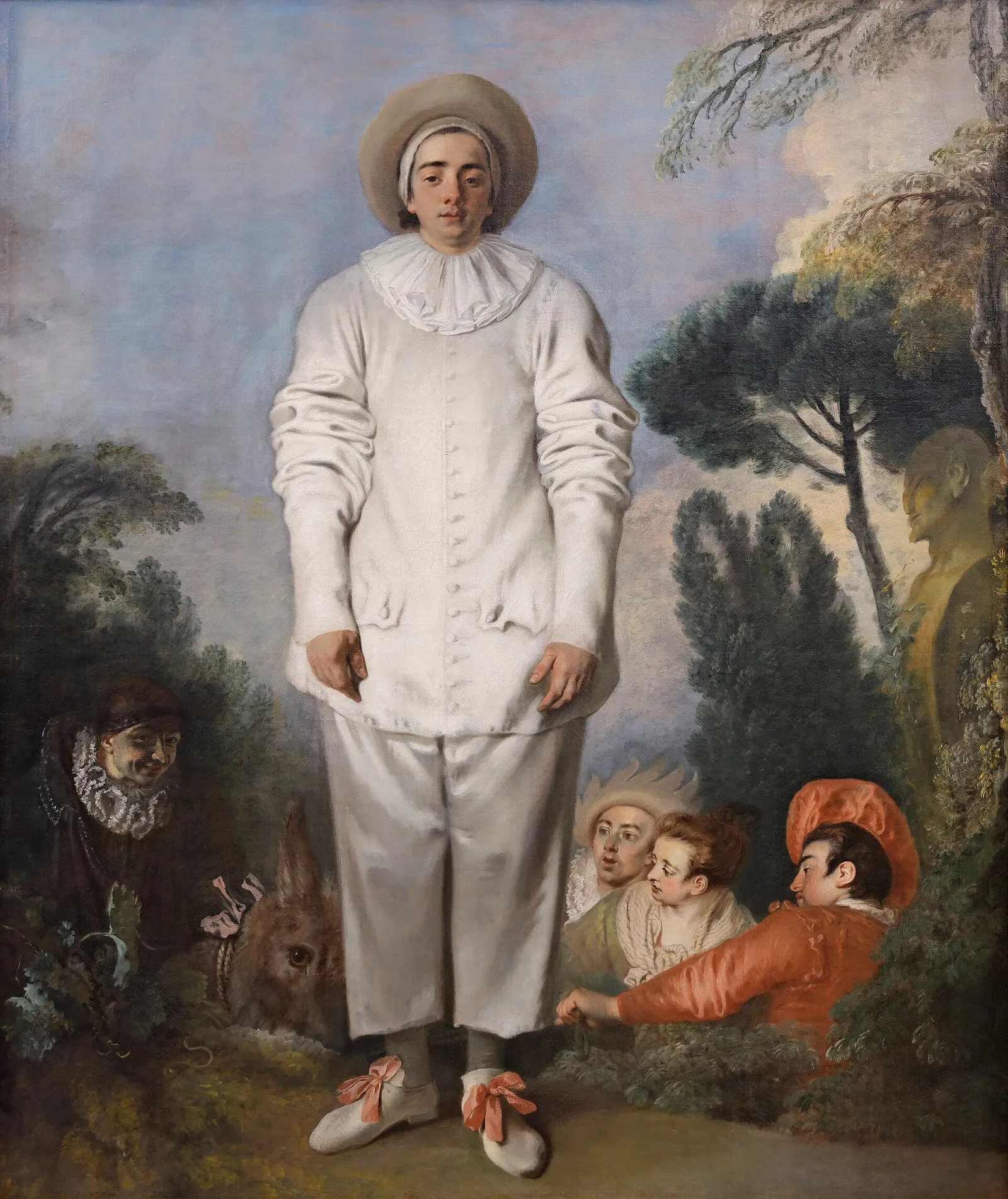
Jean-Antoine Watteau's Pierrot, dated 1718, shows a life-size actor in white standing alone and motionless before the viewer. The painting belongs to the Department of Paintings of the Louvre, and at 184.5 by 149.5 centimetres it is one of the largest canvases the artist is known for.
Where to see it
Pierrot is held by the Louvre, in the collection of its Department of Paintings. The available record lists its location as Louvre Museum storage, which may not reflect where the work is today, because records like this are not always current. Before planning a visit around this painting, check the Louvre's official website or contact the museum directly. That way you can confirm whether Pierrot is currently on view and find out where it hangs.
What to look for in person
A figure at full human scale
The canvas measures 184.5 by 149.5 centimetres, so Pierrot appears roughly life-size. Stand at a normal viewing distance and notice how he seems to share your space rather than sit inside a scene. Watteau sets the horizon low and places the figure high in the picture, so you look up at him slightly. His arms hang straight at his sides and his feet are planted firmly. This frontal, almost passive pose is unusual for a stage character, who would normally be shown in motion.
The white costume
Look closely at the costume, the traditional dress of Pierrot from the Italian comedy tradition. Watteau paints the loose white suit with a wide range of tones: cool greys, warm creams, and touches of pink and blue where light and shadow fall across the folds. Notice the ruffled collar, the oversized sleeves, and the hem of the trousers falling over ribboned shoes. The round hat frames the face like a halo. The broad white mass stands out sharply against the darker landscape and the open sky.
The actors below and the watching donkey
Lower your eyes to the strip of ground behind Pierrot's legs. Half hidden by the slope, a group of other comic actors gathers, one of them riding a donkey. Their busy, chatty poses contrast with the stillness of the central figure. Look for the donkey's eye, which seems to turn towards the viewer, echoing Pierrot's own direct gaze. Then glance to the right for a carved bust half lost among the trees. The contrast between the lively group and the isolated man in white gives the picture its quiet, puzzling mood.
About the painting
Jean-Antoine Watteau is best known for the fêtes galantes: small, delicate scenes of elegant figures gathered in parks and gardens. He was also fascinated by the theatre, especially the stock characters of the Italian comedy, who appear throughout his work. Pierrot, dated 1718, brings one of those characters forward and gives him an unexpected seriousness. Pierrot was the naive, put-upon servant of the comic stage, often the butt of the jokes. Here, rather than performing, he simply stands and looks out. His expression is hard to read: some viewers see melancholy, others embarrassment or patience. That ambiguity is part of why the picture rewards slow looking. For a long time the painting was known as Gilles, the name of a similar character from the French fairground theatre. It is now generally called Pierrot. Its large size sets it apart from most of Watteau's output, and why he painted it on this scale remains open to discussion. In front of the canvas, take time to compare the solid, sculptural presence of the central figure with the soft, feathery handling of the trees and sky. Then look at the small, animated actors below, who seem to belong to a different, noisier world. Watteau leaves the relationship between them unexplained. The painting is part of the collection of the Louvre's Department of Paintings. Its size, 184.5 by 149.5 centimetres, means that if it is on display, it can be read clearly from across a room. Coming closer will reveal the variety of brushwork in the white costume.
Key facts
| Artist | Jean-Antoine Watteau |
|---|---|
| Date | 1718 |
| Size | 184.5 × 149.5 cm |
| Medium | oil paint, canvas |
| Collection | Department of Paintings of the Louvre |
| Gallery | Room 917, Sully wing, level 2 Checked in the museum's open data on 2026-11-12 (galleries can change) Source |
How to visit: Louvre Museum
Paris, France · Museum guide
| Opening hours | Mon, Thu, Sat, Sun 09:00–18:00 Wed, Fri 09:00–21:00 (evening opening) Rooms are cleared 30 minutes before closing |
|---|---|
| Closed | Every Tuesday; 1 January, 1 May and 25 December. Other public holidays are open unless they fall on a Tuesday. |
| Last entry | 1 hour before closing |
| Admission | Adult (non-EEA visitors) EUR 32 Adult (EEA citizens and residents) EUR 22 Under 18 free (ID required) EEA citizens/residents under 26 free (photo ID; residents also need a residence permit of over 90 days) Audio guide rental EUR 6 (can be booked in advance online) Rates apply from 14 January 2026 |
| Free entry | Free for under-18s, EEA citizens/residents under 26, all visitors on the first Friday of the month after 18:00 (except July and August) and on 14 July, and disabled visitors plus one carer. Also free with proof for EEA art and art-history teachers, ICOM members, journalists, EEA job seekers and EEA residents on income support. |
| Booking | Entry is by timed slot, and booking in advance is recommended. |
The Cour Carrée entrance is currently closed. On Thursday 12 November 2026 the museum may open later and some exhibition rooms may remain closed.
Official ticket page
Official website
View on map
Hours and prices can change. Please check the official website before you go. (Checked on: 2026-11-11)
More by Jean-Antoine Watteau
 Mezzetin — Metropolitan Museum of Art
 Pierrot Content — Thyssen-Bornemisza Museum
 The Embarkation for Cythera — Louvre Museum
 Fêtes Vénitiennes — National Gallery
 The Shop Sign of Gersaint