Art! Art! Art! › Works
The Embarkation for Cythera
 Jean-Antoine Watteau, 1717
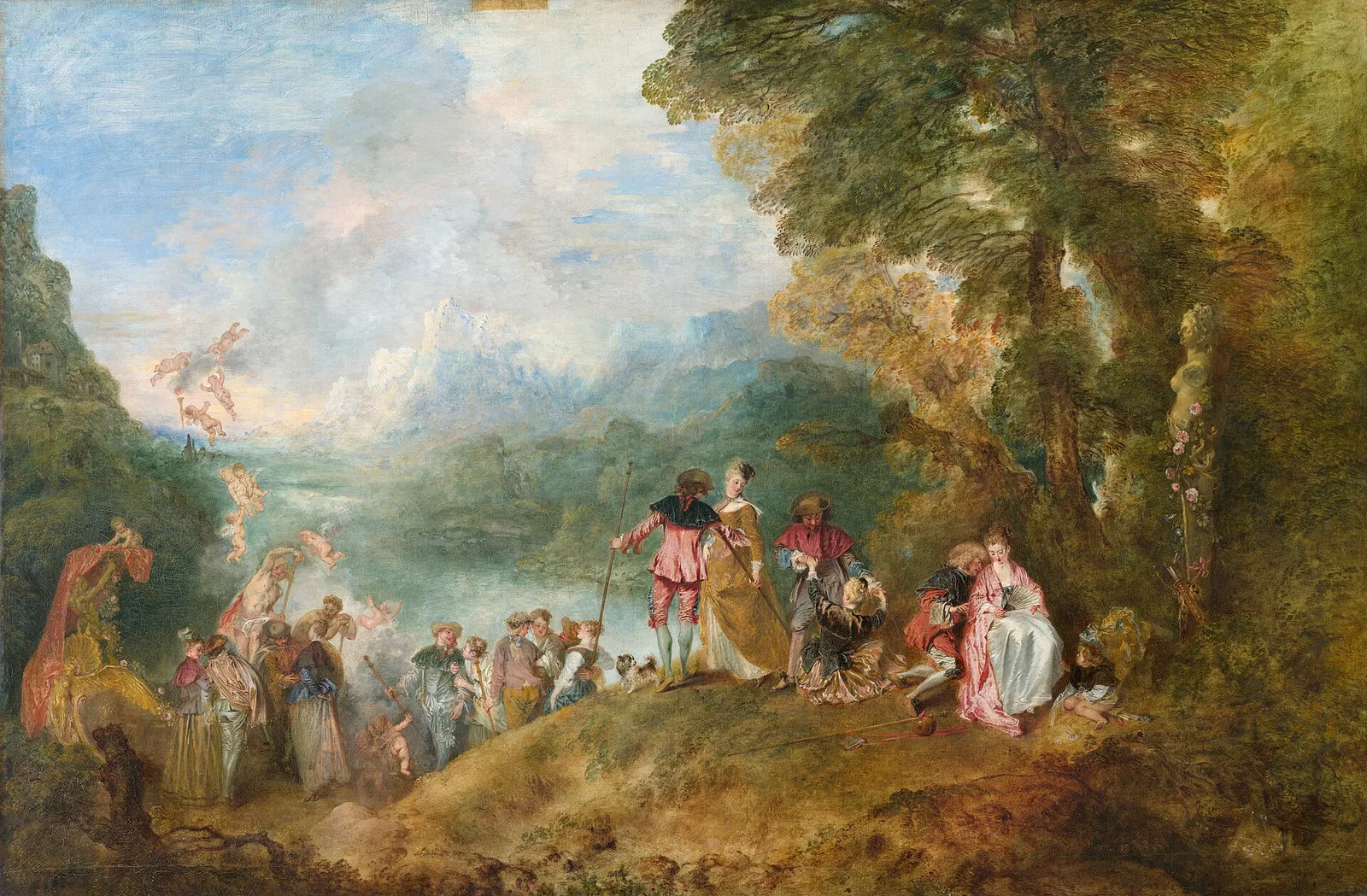
Jean-Antoine Watteau's The Embarkation for Cythera, dated 1717, belongs to the Department of Paintings of the Louvre. Elegant couples drift toward a waiting boat beneath a soft, golden sky, and the scene invites slow looking. This page explains where to find it and what to watch for once you are standing in front of it.
Where to see it
The Embarkation for Cythera is held by the Department of Paintings of the Louvre. The collection record lists its location as Room 917. Rooms are sometimes rehung, closed, or reorganized, and works can be lent or taken off view for conservation, so check the Louvre's official website for the painting's current display status before you visit. When you arrive, a museum map or the information desk can confirm the route to the gallery.
What to look for in person
Follow the couples from right to left
Start at the right edge and let your eye move left. Near the garlanded statue, a couple is still deep in conversation; next, a man helps a woman to her feet; then another pair turns to walk down the slope. Further on, groups gather by the shore and the boat. Watteau seems to tell a gradual movement through these figures, almost like frames in a sequence. Notice how gestures change from hesitation to motion, and how the line of figures curves down the hillside toward the water.
The statue of Venus and the flying cupids
On the right, look for the statue draped with roses and garlands. Cythera was the island associated with Venus, goddess of love, and the statue anchors the scene in that theme. Then look to the left, above the boat, where small winged cupids tumble through the air. These details tell you the journey is about love rather than an ordinary outing. Compare the solid, pale stone of the statue with the light, airy treatment of the cupids, and notice how both frame the human figures between them.
Silk, light and a misty distance
Step closer to study the clothing. Watteau renders shimmering silks in pinks, golds and soft blues with quick, feathery strokes, catching light on folds and sleeves. Many figures carry pilgrims' staffs and capes, a playful costume for a journey of love. Then step back and look into the background, where the landscape dissolves into a hazy, luminous distance of water and hills. That softness keeps the scene dreamlike. Notice how warm foreground colors gradually give way to cooler, paler tones as space recedes.
About the painting
Jean-Antoine Watteau painted The Embarkation for Cythera in 1717. The work is closely tied to his admission to the Royal Academy of Painting and Sculpture in Paris, for which it served as his reception piece. The Academy's existing categories did not fit the picture neatly, and it became associated with a new term: the fête galante, a scene of elegantly dressed people enjoying leisure, conversation and courtship in an idealized outdoor setting. Watteau is widely regarded as the painter who defined this type, and the genre went on to influence later French painters of the eighteenth century.
The subject draws on the idea of a voyage to Cythera, the island linked to Venus. Rather than depicting a mythological story in a heavy, formal way, Watteau treats love as a mood. The figures are contemporary in dress, but the setting is imaginary, softened by golden light and atmospheric distance. Many viewers sense a gentle melancholy beneath the charm, as if the pleasure shown is already slipping away.
For visitors, the painting rewards both distance and closeness. From afar, take in the overall rhythm of figures curving toward the shore and the sweep of landscape. Up close, look at the delicate, broken brushwork in fabrics, faces and foliage, which gives the surface its flickering quality. Spend a few minutes reading the couples one by one; the painting is less about a single moment than about a gradual unfolding of action and feeling across the canvas.
Key facts
| Artist | Jean-Antoine Watteau |
|---|---|
| Date | 1717 |
| Size | 1.29 × 1.94 cm |
| Medium | oil paint, canvas |
| Collection | Department of Paintings of the Louvre |
| Gallery | Room 917, Sully wing, level 2 Checked in the museum's open data on 2026-11-12 (galleries can change) Source |
How to visit: Louvre Museum
Paris, France · Museum guide
| Opening hours | Mon, Thu, Sat, Sun 09:00–18:00 Wed, Fri 09:00–21:00 (evening opening) Rooms are cleared 30 minutes before closing |
|---|---|
| Closed | Every Tuesday; 1 January, 1 May and 25 December. Other public holidays are open unless they fall on a Tuesday. |
| Last entry | 1 hour before closing |
| Admission | Adult (non-EEA visitors) EUR 32 Adult (EEA citizens and residents) EUR 22 Under 18 free (ID required) EEA citizens/residents under 26 free (photo ID; residents also need a residence permit of over 90 days) Audio guide rental EUR 6 (can be booked in advance online) Rates apply from 14 January 2026 |
| Free entry | Free for under-18s, EEA citizens/residents under 26, all visitors on the first Friday of the month after 18:00 (except July and August) and on 14 July, and disabled visitors plus one carer. Also free with proof for EEA art and art-history teachers, ICOM members, journalists, EEA job seekers and EEA residents on income support. |
| Booking | Entry is by timed slot, and booking in advance is recommended. |
The Cour Carrée entrance is currently closed. On Thursday 12 November 2026 the museum may open later and some exhibition rooms may remain closed.
Official ticket page
Official website
View on map
Hours and prices can change. Please check the official website before you go. (Checked on: 2026-11-11)
More by Jean-Antoine Watteau
 Mezzetin — Metropolitan Museum of Art
 Pierrot Content — Thyssen-Bornemisza Museum
 Pierrot — Louvre Museum
 Fêtes Vénitiennes — National Gallery
 The Shop Sign of Gersaint