Art! Art! Art! › Works
The Oath of the Horatii
 Jacques-Louis David, 1784
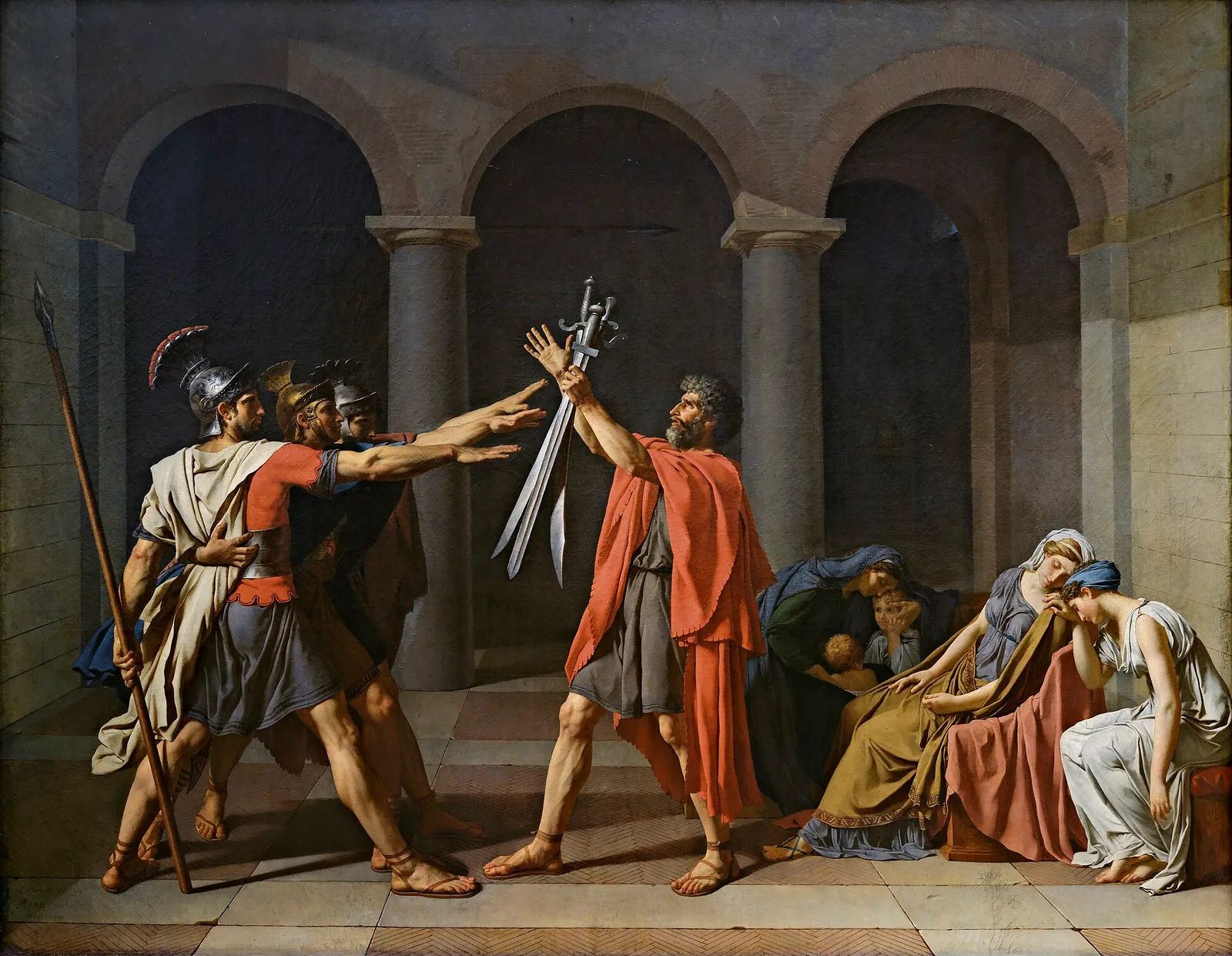
Jacques-Louis David's The Oath of the Horatii, dated 1784, belongs to the Department of Paintings of the Louvre. The large canvas shows three Roman brothers swearing to fight for their city while the women of their family collapse in grief. It is one of the key works of French Neoclassical painting.
Where to see it
The Oath of the Horatii is held by the Department of Paintings of the Louvre, and the fact sheet lists its location as Room 702. The canvas measures 330 by 425 cm, so it is easy to spot from across the room. Paintings can be moved, lent or taken off view for conservation, so check the Louvre's official website for current display status before you visit.
What to look for in person
The oath at the center
Start with the dramatic gesture at the middle of the canvas. Three brothers stand in a tight line on the left, arms stretched out in salute, while their father raises the swords they will carry into battle. Notice how the outstretched arms and the blades meet near the center, pulling your eye to a single point. The men's bodies are rigid, angular and braced, like statues. David uses this tension to make loyalty and resolve visible, turning a private family moment into a public vow.
The grieving women on the right
Then look to the right, where the mood changes completely. A group of women and children sits slumped together, their bodies curving and softening where the men's are straight and hard. In the traditional story, these women are bound by family and marriage to both sides of the coming fight, so any outcome will bring them loss. Compare the two halves of the picture: David sets public duty against private sorrow, and the contrast between the groups carries much of the painting's emotional weight.
A stage-like setting
Step back and take in the architecture. The figures stand in a shallow space in front of three arches supported by plain columns, and the groups line up roughly with those arches: brothers, father, women. The background is dark and bare, with almost no decoration, which keeps attention on the figures. This clear, ordered, almost theatrical arrangement is typical of Neoclassicism, which looked to ancient Rome for models of clarity and virtue. At 330 by 425 cm, the life-size scale makes the scene feel close and direct.
About the painting
The Oath of the Horatii illustrates a legend from early Roman history. Rome and the neighboring city of Alba Longa agreed to settle a conflict through combat between three champions from each side: the Horatii brothers for Rome and the Curiatii brothers for Alba Longa. The two families were linked by marriage and engagement, which gives the story its tragic edge. David does not show the fight itself. Instead, he chooses the moment before it, when the brothers swear to their father that they will win or die for Rome. This decision lets him focus on commitment and its cost rather than on action. The painting is dated 1784 and is a large canvas, 330 cm high and 425 cm wide. It became one of the defining images of Neoclassicism, a movement that rejected the lighter, decorative style popular earlier in the eighteenth century in favor of sober color, firm drawing and subjects drawn from ancient history and moral examples. In front of the work, notice the crisp outlines, the sculptural modeling of the bodies and the controlled light falling from the left. The composition is built from strong horizontals and verticals, with very little that distracts from the figures. Many viewers have read the picture as a statement about civic duty and self-sacrifice, ideas that gained new meaning in France in the years that followed. Today the painting is part of the Department of Paintings of the Louvre, where it is often seen alongside other large-scale French history paintings.
Key facts
| Artist | Jacques-Louis David |
|---|---|
| Date | 1784 |
| Size | 330 × 425 cm |
| Medium | oil paint, canvas |
| Collection | Department of Paintings of the Louvre |
| Gallery | Room 702, Denon wing, level 1 Checked in the museum's open data on 2026-11-12 (galleries can change) Source |
How to visit: Louvre Museum
Paris, France · Museum guide
| Opening hours | Mon, Thu, Sat, Sun 09:00–18:00 Wed, Fri 09:00–21:00 (evening opening) Rooms are cleared 30 minutes before closing |
|---|---|
| Closed | Every Tuesday; 1 January, 1 May and 25 December. Other public holidays are open unless they fall on a Tuesday. |
| Last entry | 1 hour before closing |
| Admission | Adult (non-EEA visitors) EUR 32 Adult (EEA citizens and residents) EUR 22 Under 18 free (ID required) EEA citizens/residents under 26 free (photo ID; residents also need a residence permit of over 90 days) Audio guide rental EUR 6 (can be booked in advance online) Rates apply from 14 January 2026 |
| Free entry | Free for under-18s, EEA citizens/residents under 26, all visitors on the first Friday of the month after 18:00 (except July and August) and on 14 July, and disabled visitors plus one carer. Also free with proof for EEA art and art-history teachers, ICOM members, journalists, EEA job seekers and EEA residents on income support. |
| Booking | Entry is by timed slot, and booking in advance is recommended. |
The Cour Carrée entrance is currently closed. On Thursday 12 November 2026 the museum may open later and some exhibition rooms may remain closed.
Official ticket page
Official website
View on map
Hours and prices can change. Please check the official website before you go. (Checked on: 2026-11-11)
More by Jacques-Louis David
 The Coronation of Napoleon — Louvre Museum
 The Emperor Napoleon in His Study at the Tuileries — National Gallery of Art
 The Intervention of the Sabine Women — Louvre Museum
 The Death of Socrates — Metropolitan Museum of Art
 Portrait of Madame Récamier — Louvre Museum
 Erasistratus Discovering the Cause of Antiochus' Disease
 Mars Being Disarmed by Venus