Art! Art! Art! › Works
Portrait of Madame Récamier
 Jacques-Louis David, 1800
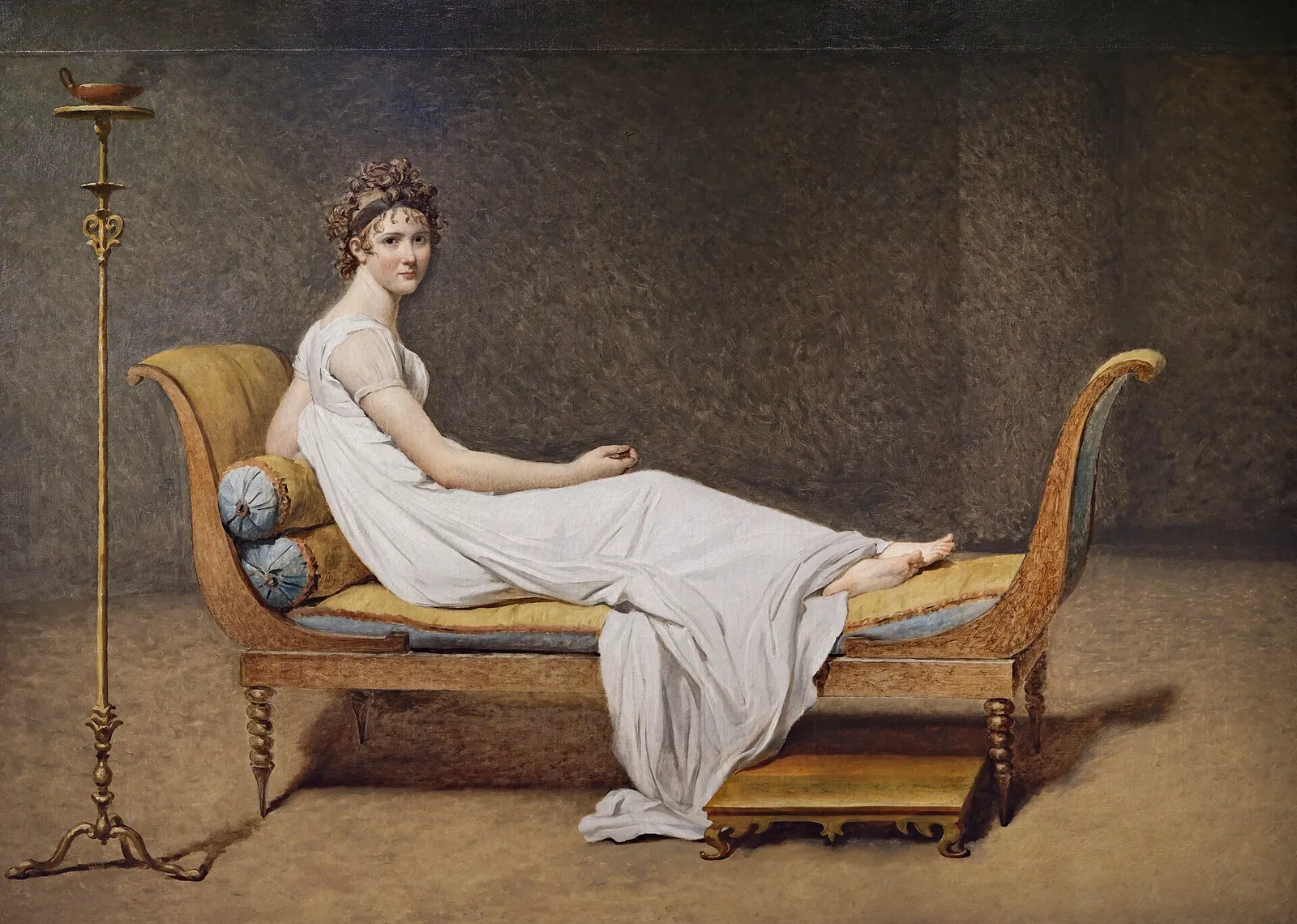
Jacques-Louis David's Portrait of Madame Récamier, dated 1800, shows one of the best-known hostesses of post-revolutionary France reclining on an antique-style couch in a bare, quiet room. The painting belongs to the Department of Paintings of the Louvre. At 174 by 244 cm, it is a large, horizontal canvas whose open space and unfinished surface reward a slow look.
Where to see it
The Portrait of Madame Récamier is held by the Department of Paintings of the Louvre, and the fact sheet gives its location as Room 702. Displays at the Louvre change because of rehangs, conservation work and loans, so check the museum's official website for the painting's current display status before you visit. Because the canvas is wide (244 cm) and almost empty above the figure, step back to take in the whole composition first, then move closer to study the brushwork and the details of the dress and furniture.
What to look for in person
The pose: turning to meet your gaze
Madame Récamier rests on a low couch, propped against cushions, with her body angled away from the viewer while her head turns back over her shoulder. The effect is both relaxed and composed: she seems to have paused rather than posed. Notice her bare feet and arms, which echo classical sculpture rather than the fashionable portraiture of the previous century. Follow the long, gently curving line from her head along her back to her feet; David uses this single sweep to hold the wide, horizontal composition together.
The white dress and antique styling
Her high-waisted white gown, bare arms and short, curled hair reflect the taste for ancient Greece and Rome that shaped fashion and design around 1800. Look at how David treats the fabric: the folds are soft and light, and the white stands out sharply against the dark, muted background. The furniture follows the same antique-inspired style, with a curved couch, a simple footstool and a tall, slender lamp. Very little colour is used beyond whites, browns and greys, which keeps attention on the sitter and the clean outlines of each object.
An unfinished painting
The portrait was never completed, and this is one of the most interesting things to look for up close. The background and floor are thinly and loosely painted, so you can see the brushwork and the underlying layers more clearly than in a finished work. Large areas of the canvas above and around the figure are left nearly empty. Rather than looking incomplete in a disappointing way, this restraint gives the room a calm, airy quality and lets you see how David built up an image, moving from broad tones toward more resolved forms.
About the painting
Jacques-Louis David was the leading painter of French Neoclassicism, an artist whose history paintings drew on ancient Greek and Roman models and whose career was closely tied to the political upheavals of his time. Alongside his large historical scenes, he painted portraits of figures from Parisian society, and the Portrait of Madame Récamier, dated 1800, is one of the most frequently reproduced of them. Juliette Récamier was famous in her day for her beauty and for the salon she hosted, where writers, politicians and society figures gathered. David presents her not with jewels or rich interiors but in a simple white dress, seated on plain antique-style furniture in an almost empty space. This spareness matches the Neoclassical ideal of clarity and restraint, and it also reflects the fashions of the period, when dress and interior design looked back to the ancient world. The work was left unfinished. Its sitter also commissioned a portrait from François Gérard, a former pupil of David, and Gérard's version is often discussed alongside this one. The painting has had a long afterlife: the type of reclining couch shown here became associated with her name, and the word récamier is still used for this kind of furniture. Standing in front of the painting, it is worth comparing the delicacy of the figure with the sketch-like handling of the surroundings, and considering how much of the work's character comes from what David chose to leave out. Today it belongs to the Department of Paintings of the Louvre.
Key facts
| Artist | Jacques-Louis David |
|---|---|
| Date | 1800 |
| Size | 174 × 244 cm |
| Medium | oil paint, canvas |
| Collection | Department of Paintings of the Louvre |
| Gallery | Room 702, Denon wing, level 1 Checked in the museum's open data on 2026-11-12 (galleries can change) Source |
How to visit: Louvre Museum
Paris, France · Museum guide
| Opening hours | Mon, Thu, Sat, Sun 09:00–18:00 Wed, Fri 09:00–21:00 (evening opening) Rooms are cleared 30 minutes before closing |
|---|---|
| Closed | Every Tuesday; 1 January, 1 May and 25 December. Other public holidays are open unless they fall on a Tuesday. |
| Last entry | 1 hour before closing |
| Admission | Adult (non-EEA visitors) EUR 32 Adult (EEA citizens and residents) EUR 22 Under 18 free (ID required) EEA citizens/residents under 26 free (photo ID; residents also need a residence permit of over 90 days) Audio guide rental EUR 6 (can be booked in advance online) Rates apply from 14 January 2026 |
| Free entry | Free for under-18s, EEA citizens/residents under 26, all visitors on the first Friday of the month after 18:00 (except July and August) and on 14 July, and disabled visitors plus one carer. Also free with proof for EEA art and art-history teachers, ICOM members, journalists, EEA job seekers and EEA residents on income support. |
| Booking | Entry is by timed slot, and booking in advance is recommended. |
The Cour Carrée entrance is currently closed. On Thursday 12 November 2026 the museum may open later and some exhibition rooms may remain closed.
Official ticket page
Official website
View on map
Hours and prices can change. Please check the official website before you go. (Checked on: 2026-11-11)
More by Jacques-Louis David
 The Coronation of Napoleon — Louvre Museum
 The Emperor Napoleon in His Study at the Tuileries — National Gallery of Art
 The Intervention of the Sabine Women — Louvre Museum
 The Death of Socrates — Metropolitan Museum of Art
 Erasistratus Discovering the Cause of Antiochus' Disease
 The Oath of the Horatii — Louvre Museum
 Mars Being Disarmed by Venus