Art! Art! Art! › Works
The Emperor Napoleon in His Study at the Tuileries
 Jacques-Louis David, 1812
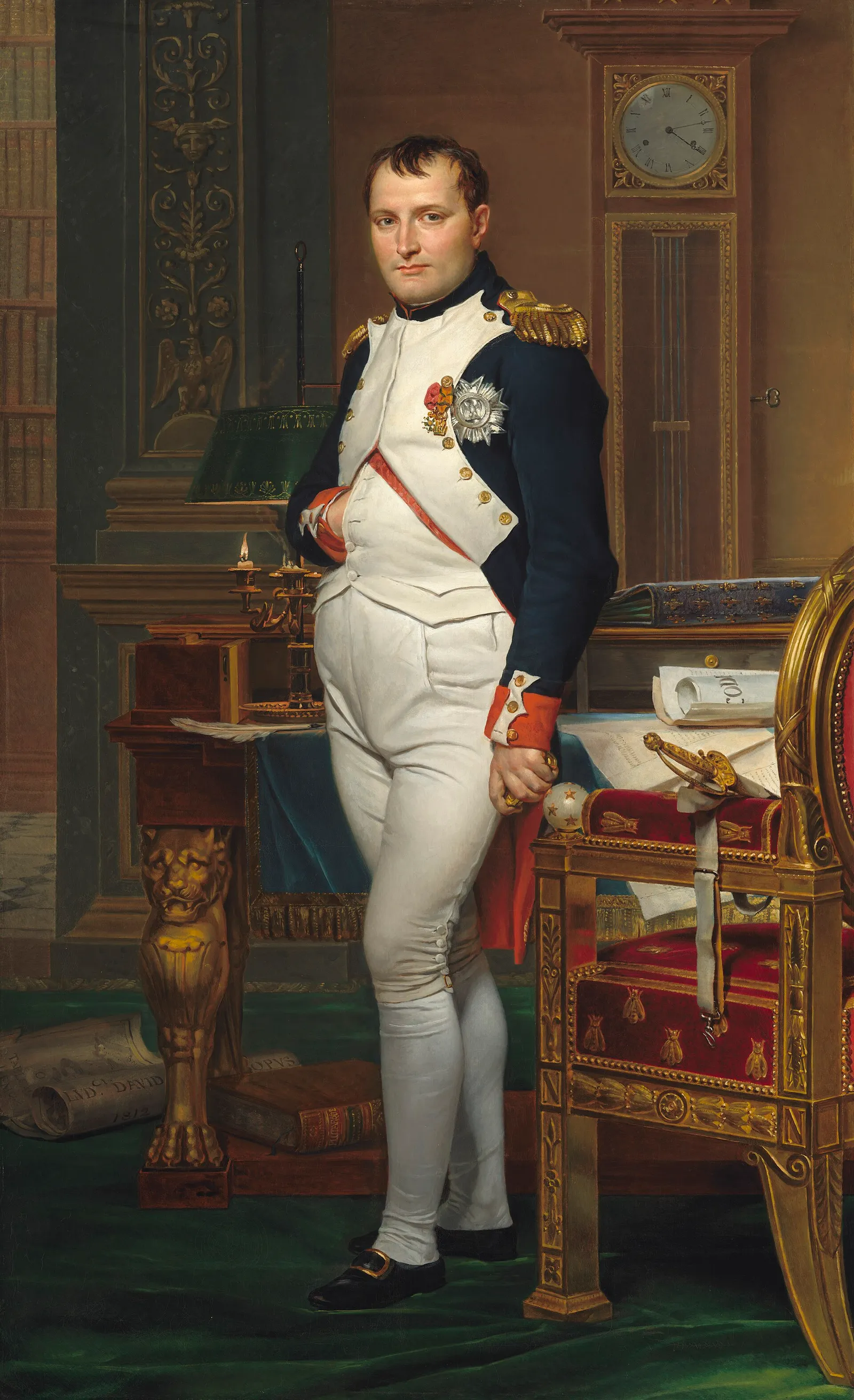
Jacques-Louis David's The Emperor Napoleon in His Study at the Tuileries, dated 1812, shows Napoleon standing in his private study rather than on a battlefield or throne. At 203.9 by 125.1 centimetres, the figure is close to life-size, and the room around him is filled with small clues that reward a slow, close look.
Where to see it
The fact sheet records the painting's collection and location as Wikidata item Q214867, which corresponds to the National Gallery of Art in Washington, D.C. Display arrangements change because of rehangings, conservation work and loans, so check the museum's official website for current display status before you plan your visit.
What to look for in person
The clock and the candles
Look at the tall clock behind Napoleon and the candles on the desk. The clock hands point to just after four, and the candles have burned low and are guttering. Together they suggest that the emperor has worked through the night and is still at his desk before dawn. This is not a scene of conquest but of labour: David presents Napoleon as a ruler who governs through long hours of administrative work. Step close enough to read the clock face, then step back to see how the light falls on the figure.
Papers on the desk
The desk is covered with papers, and the rolled document resting on it is labelled with the word CODE, a reference to the Civil Code, the body of French law associated with Napoleon's rule. Its placement matters: the legal reform sits in the foreground, close to the viewer, while the military world appears only through smaller details. Take time with the pen, the scattered sheets and the books near the desk. They build an image of Napoleon as lawgiver and statesman, which was a deliberate choice of emphasis for a portrait of a military leader.
Uniform, decorations and the sword
Napoleon wears a military uniform with decorations, including the Legion of Honour, the order he established. His sword lies on the chair beside him, set aside rather than drawn, which reinforces the theme of peaceful government over war. Notice how carefully David paints the fabrics: the gleam of the epaulettes, the white breeches and the velvet and gilt of the furniture. The hand tucked into the waistcoat is a conventional pose in portraits of the period. Look also for the artist's signature and the date, 1812, painted into the picture.
About the painting
Jacques-Louis David was the leading painter of French Neoclassicism and became closely associated with Napoleon's regime, producing major works that shaped the public image of the emperor. The Emperor Napoleon in His Study at the Tuileries, dated 1812, takes a different approach from his earlier, more heroic images. Instead of a horseman crossing the Alps or a coronation ceremony, David shows Napoleon indoors, at the Tuileries Palace in Paris, surrounded by the furniture and paperwork of daily government.
The portrait is a tall, near life-size canvas measuring 203.9 by 125.1 centimetres. That scale places the viewer almost face to face with the emperor, while the domestic setting makes the image feel more intimate than a state portrait. Yet every object carries meaning. The late hour on the clock and the nearly spent candles speak of devotion to duty; the document marked CODE points to legal reform; the sword resting on the chair suggests a ruler who is, at this moment, a civilian administrator.
The painting was not made for Napoleon himself. It was commissioned by a British admirer, a member of the Scottish Hamilton family, which is notable given that Britain and France were at war at the time.
For visitors, the work is best approached in two stages. From a distance, take in the overall composition and the confident, upright figure. Then move closer to examine the details: the clock face, the papers, the embroidery and the polished surfaces. David's precise, smooth handling of paint rewards this close inspection, and the meaning of the picture lies largely in those small, carefully chosen objects.
Key facts
| Artist | Jacques-Louis David |
|---|---|
| Date | 1812 |
| Size | 203.9 × 125.1 cm |
| Medium | oil paint, canvas |
| Collection | Q214867 |
| Gallery | West Building, Main Floor, Gallery 56 Checked in the museum's open data on 2026-11-12 (galleries can change) Source |
How to visit: National Gallery of Art
Washington, D.C., United States · Museum guide
| Opening hours | Mon–Sun 10:00–17:00 (open daily) |
|---|---|
| Closed | 25 December and 1 January |
| Admission | All visitors: free (including special exhibitions) |
| Free entry | Admission is always free. No passes or tickets are needed for the galleries, exhibitions or guided tours; some events require free registration. |
| Booking | No reservation is required and there is no timed entry. |
Hours and prices can change. Please check the official website before you go. (Checked on: 2026-11-11)
More by Jacques-Louis David
 The Coronation of Napoleon — Louvre Museum
 The Intervention of the Sabine Women — Louvre Museum
 The Death of Socrates — Metropolitan Museum of Art
 Portrait of Madame Récamier — Louvre Museum
 Erasistratus Discovering the Cause of Antiochus' Disease
 The Oath of the Horatii — Louvre Museum
 Mars Being Disarmed by Venus
Sources
- Wikidata Q1313605
- Wikipedia (en) (CC BY-SA 4.0)
- Wikipedia (ja) (CC BY-SA 4.0)
- Wikipedia (fr) (CC BY-SA 4.0)
- www.nga.gov