Art! Art! Art! › Works
The Intervention of the Sabine Women
 Jacques-Louis David, 1799
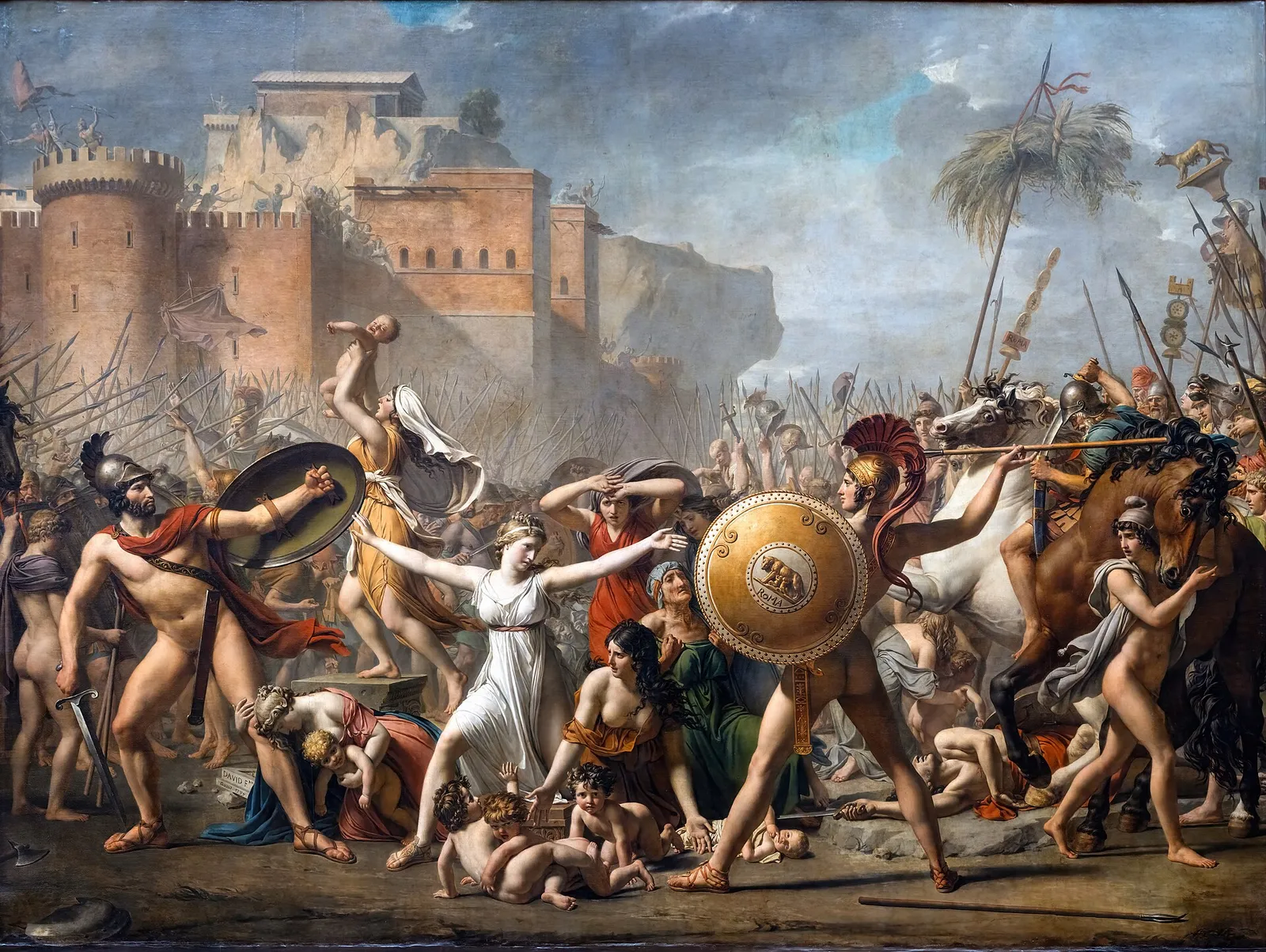
Jacques-Louis David's The Intervention of the Sabine Women, dated 1799, is held in the Department of Paintings of the Louvre. The large canvas shows a woman stepping between two armed leaders to stop a battle, and it rewards time spent reading its figures one by one.
Where to see it
The painting belongs to the Department of Paintings of the Louvre, and its recorded location is Room 702. It is a large oil on canvas, 385 cm high and 522 cm wide, so give yourself room to step back and take in the whole composition before moving closer. Paintings can be moved, lent or temporarily taken off view, so check the Louvre's official website for current display status before you visit.
What to look for in person
Hersilia at the centre
Start with the woman in the middle, arms flung wide. She is Hersilia, daughter of the Sabine leader Titus Tatius and wife of Romulus, the Roman leader. Rather than fighting, she rushes into the gap between her husband and her father, bringing her babies with her. Notice how David places her at the visual hinge of the canvas, so the eye travels from one warrior to the other through her body. Her open gesture is the picture's argument: the conflict is halted by a family tie, not by a weapon.
Two leaders, two shields
Look to either side of Hersilia. Romulus is turned away from you, seen from behind, and you can recognise him by his round shield bearing the Roman she-wolf. Opposite him, Tatius faces outward toward the viewer and holds his own shield up in defence. The contrast is worth pausing on: one man poised to strike, the other on guard, both frozen at the instant the woman intervenes. Compare the angles of their weapons and bodies to see how David builds tension and then suspends it.
The setting and the scale
Behind the crowd rises a rocky outcrop, identified as the Tarpeian Rock, which anchors the scene in early Roman legend. Let your eye move from the foreground figures to the massed soldiers and the landscape beyond to see how David layers the space. Then step back: at 385 by 522 cm, the canvas places many figures close to life size, which makes the confrontation feel immediate. Look also at the crouching figure beside Hersilia, part of the group of women and children who fill the front of the stage.
About the painting
The Intervention of the Sabine Women takes its subject from the legend of early Rome. After the Romans abducted Sabine women, the Sabines returned to fight; by then the women had become Roman wives and mothers, and David shows them stepping in to end the bloodshed. He made the work in the second half of the 1790s, conceiving it during a period of imprisonment in the Luxembourg Palace, and completed it in 1799. It is painted in oil on canvas.
David did not work alone. He relied on Delafontaine for documentary research and on studio assistants, including Jean-Pierre Franque, who was later replaced by Jérome-Martin Langlois, and the young Jean-Auguste-Dominique Ingres. Aurore de Bellegarde posed for Hersilia, and her sister Adèle sat for the crouching woman next to her.
The painting's public debut was unusual. From 21 December 1799 it was shown at the Louvre to visitors who paid an entrance fee, and some 50,000 people came, bringing in 66,000 francs. In 1819 David sold it, together with his Leonidas at Thermopylae, to the royal museums, with the lawyer Jean Pierre Delahaye acting as intermediary. The canvas first hung in the Luxembourg Palace and was transferred to the Louvre in 1826, after the artist's death. Today it belongs to the Louvre's Department of Paintings.
Key facts
| Artist | Jacques-Louis David |
|---|---|
| Date | 1799 |
| Size | 385 × 522 cm |
| Medium | oil paint, canvas |
| Collection | Department of Paintings of the Louvre |
| Gallery | Room 702, Denon wing, level 1 Checked in the museum's open data on 2026-11-12 (galleries can change) Source |
How to visit: Louvre Museum
Paris, France · Museum guide
| Opening hours | Mon, Thu, Sat, Sun 09:00–18:00 Wed, Fri 09:00–21:00 (evening opening) Rooms are cleared 30 minutes before closing |
|---|---|
| Closed | Every Tuesday; 1 January, 1 May and 25 December. Other public holidays are open unless they fall on a Tuesday. |
| Last entry | 1 hour before closing |
| Admission | Adult (non-EEA visitors) EUR 32 Adult (EEA citizens and residents) EUR 22 Under 18 free (ID required) EEA citizens/residents under 26 free (photo ID; residents also need a residence permit of over 90 days) Audio guide rental EUR 6 (can be booked in advance online) Rates apply from 14 January 2026 |
| Free entry | Free for under-18s, EEA citizens/residents under 26, all visitors on the first Friday of the month after 18:00 (except July and August) and on 14 July, and disabled visitors plus one carer. Also free with proof for EEA art and art-history teachers, ICOM members, journalists, EEA job seekers and EEA residents on income support. |
| Booking | Entry is by timed slot, and booking in advance is recommended. |
The Cour Carrée entrance is currently closed. On Thursday 12 November 2026 the museum may open later and some exhibition rooms may remain closed.
Official ticket page
Official website
View on map
Hours and prices can change. Please check the official website before you go. (Checked on: 2026-11-11)
More by Jacques-Louis David
 The Coronation of Napoleon — Louvre Museum
 The Emperor Napoleon in His Study at the Tuileries — National Gallery of Art
 The Death of Socrates — Metropolitan Museum of Art
 Portrait of Madame Récamier — Louvre Museum
 Erasistratus Discovering the Cause of Antiochus' Disease
 The Oath of the Horatii — Louvre Museum
 Mars Being Disarmed by Venus
Sources
- Wikidata Q1314013
- Wikipedia (en) (CC BY-SA 4.0)
- Wikipedia (ja) (CC BY-SA 4.0)
- Wikipedia (it) (CC BY-SA 4.0)
- Wikipedia (fr) (CC BY-SA 4.0)
- www.louvre.fr
- contact.louvre.fr