Art! Art! Art! › Works
The Death of Socrates
 Jacques-Louis David, 1787
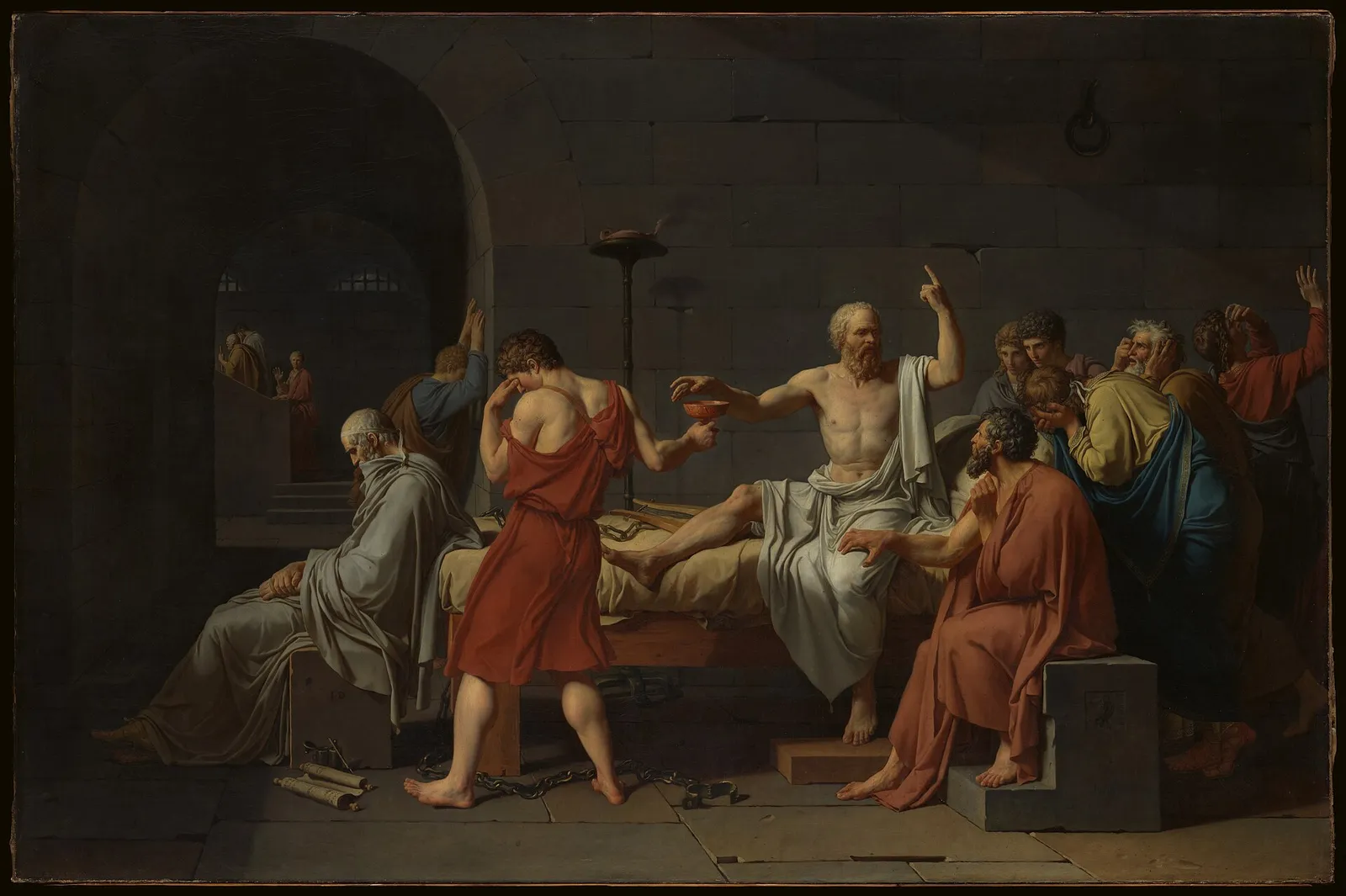
Jacques-Louis David's The Death of Socrates, dated 1787, is in the collection of the Metropolitan Museum of Art. The painting shows the Athenian philosopher calmly continuing to teach as he reaches for the cup of poison, surrounded by grieving followers. At 129.5 × 196.2 cm, it rewards slow looking at its gestures, faces and carefully staged light.
Where to see it
The Death of Socrates is held by the Metropolitan Museum of Art, which is also listed as its location. Works in large collections can be moved, rotated or lent, so check the Metropolitan Museum of Art's official website for the painting's current display status before you plan your visit.
What to look for in person
Two hands, two decisions
Start with Socrates himself, seated upright on the bed and lit more brightly than anyone else in the room. One arm is raised, a finger pointing upward as he keeps talking. The other hand reaches toward the cup of hemlock, yet his eyes do not follow it. David splits the gesture so that thought and action happen at once: the philosopher is still arguing his case while accepting his sentence. Notice how steady and muscular his body looks, an image of composure rather than of a man about to die.
A room full of grief
Let your eye move outward from the calm centre to the followers around him. Their reactions vary widely: some cover their faces, some lean against the wall, one clutches at Socrates' leg as he listens. The young man handing over the cup turns his head away, unable to watch. At the foot of the bed an older figure sits apart with his back turned, lost in thought. David uses this range of emotion to throw Socrates' control into sharper relief: the more his companions give way, the more resolute he appears.
Neoclassical staging
Step back to take in the whole composition. The figures are lined up across the shallow space almost like a carved relief, set against plain stone walls with little to distract. Contours are crisp, colours restrained, and a strong, directed light picks out bodies and drapery. These are hallmarks of the Neoclassical style David helped define. Then look through the arch on the left: in the background, small figures climb a staircase and leave the scene, a quiet secondary episode that adds depth to the room and to the story.
About the painting
The subject comes from the ancient account of the last day of Socrates, the Athenian philosopher condemned to death by his city on charges of impiety and corrupting the young. Rather than abandon his teaching or flee, he accepted the sentence and drank hemlock, spending his final hours discussing the immortality of the soul with his friends. The scene is best known through Plato's dialogue Phaedo, and David builds his picture around that moment of reasoned calm in the face of death.
Jacques-Louis David painted the work in 1787, in the years when he was establishing himself as the leading figure of French Neoclassicism. Like other history paintings of his from this period, it draws on classical antiquity to present a moral example: personal sacrifice in the name of principle, shown with clarity and restraint rather than drama for its own sake. The austere setting, sculptural figures and legible gestures were meant to be read like a lesson.
David did not aim at a strict historical record. The figure traditionally identified as Plato, seated at the foot of the bed, is shown as an old man, although Plato was young at the time of Socrates' death and, by his own account, not present. Such choices show the painter shaping the story for meaning rather than literal accuracy.
For visitors, the painting is a compact work at 129.5 × 196.2 cm, so it can be read comfortably from a few steps away. Begin with Socrates' raised hand, follow the line of grieving figures around him, and finish with the departing figures on the stairs in the background.
Key facts
| Artist | Jacques-Louis David |
|---|---|
| Date | 1787 |
| Size | 129.5 × 196.2 cm |
| Medium | oil paint, canvas |
| Collection | Metropolitan Museum of Art |
| Gallery | Gallery 634 Checked in the museum's open data on 2026-11-12 (galleries can change) Source |
How to visit: Metropolitan Museum of Art
New York City, United States · Museum guide
| Opening hours | Sun, Mon, Tue, Thu 10:00–17:00 Fri, Sat 10:00–21:00 |
|---|---|
| Closed | Wednesdays; Thanksgiving Day, 25 December, 1 January and the first Monday in May |
| Admission | Adults USD 30 Seniors (65 and over) USD 22 Visitors with a disability (in person only) USD 22 Students USD 17 Children (12 and under) free Care partners of visitors with a disability (in person only) free New York State residents; NY, NJ and CT students: pay what you wish (minimum USD 0.01). Online requires a NY State billing address; NJ/CT students in person with student ID |
| Free entry | Free for children 12 and under, Members and Patrons, and care partners of visitors with a disability. Pay what you wish for New York State residents and NY/NJ/CT students. |
| Booking | No reservation is required and there is no timed entry. |
The Cantor Roof Garden, the Modern and Contemporary Galleries, and the Ancient West Asia and Ancient Cyprus Galleries are closed for renovation.
Official ticket page
Official website
View on map
Hours and prices can change. Please check the official website before you go. (Checked on: 2026-11-09)
More by Jacques-Louis David
 The Coronation of Napoleon — Louvre Museum
 The Emperor Napoleon in His Study at the Tuileries — National Gallery of Art
 The Intervention of the Sabine Women — Louvre Museum
 Portrait of Madame Récamier — Louvre Museum
 Erasistratus Discovering the Cause of Antiochus' Disease
 The Oath of the Horatii — Louvre Museum
 Mars Being Disarmed by Venus