Art! Art! Art! › Works
The Coronation of Napoleon
 Jacques-Louis David, 1807
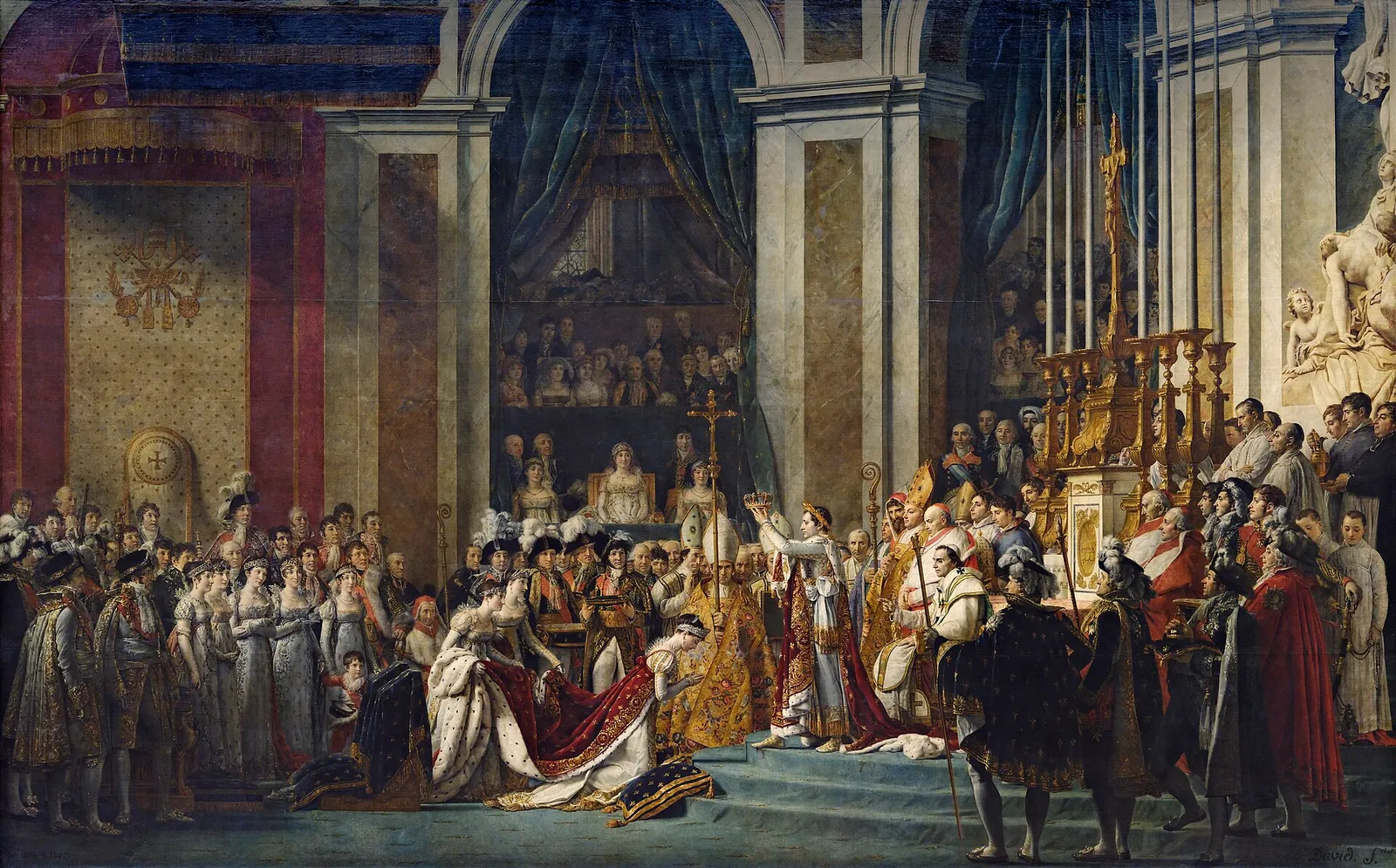
Jacques-Louis David's The Coronation of Napoleon, dated 1807, records the ceremony of 2 December 1804 in Notre-Dame Cathedral, Paris. The vast canvas belongs to the Department of Paintings of the Louvre, where it is recorded in Room 702, the Sacre Hall.
Where to see it
The Coronation of Napoleon is held by the Department of Paintings of the Louvre in Paris. The museum's record places it in Room 702, the Sacre Hall. Displays can change because of rehanging, conservation or room closures, so check the Louvre's official website for current display status before you visit. A full-size replica by David is at the Palace of Versailles, so make sure you are heading to the Louvre if you want the 1807 original.
What to look for in person
The central gesture: Napoleon crowns Josephine
Find the moment the whole composition turns on. Napoleon stands with a crown raised in both hands, about to place it on Josephine, who kneels before him. Behind him, Pope Pius VII sits with his hand lifted in blessing. David did not choose the instant Napoleon crowned himself. He chose the crowning of the empress, a gesture that reads as an act of bestowal. Follow the lines of the figures and notice how the attention of the surrounding crowd converges on this small group near the middle of the canvas.
A trace of an earlier idea
Look closely around the emperor's figure. The faint outline of an earlier composition can still be made out, in which Napoleon held the crown above his own head rather than toward Josephine. This kind of visible change, where an artist's first decision shows through later paint, rewards a slow, close look. It reminds you that the scene on view is a deliberate choice about how the event should be remembered, settled while the painting was being made, not a direct snapshot of the ceremony.
Taking in the scale
The canvas measures 621 by 979 centimetres, so plan to view it twice. First stand well back to see the whole interior of Notre-Dame, with the crowd of witnesses arranged across the width of the picture. Then walk closer and move along it from one side to the other, reading individual faces, costumes and gestures as you would in a crowded room. At this size the painting works almost like a stage set, and the figures in the foreground approach life size.
About the painting
Napoleon commissioned this painting verbally in September 1804, shortly before the coronation it would commemorate. The ceremony took place on 2 December 1804 in Notre-Dame Cathedral, and David set out to give it a permanent public image. He began work on 21 December 1805, using the former chapel of the College of Cluny near the Sorbonne as his studio, a space large enough for a canvas of this size. His student Georges Rouget assisted him. The painting is dated 1807. David regarded it as finished on 18 November 1807, although he returned to it for final touches in March 1808. It was exhibited at the Salon of 1808, which opened on 7 February, and in 1810 it was entered in the decennial prize competition. The picture stayed in David's possession until 1819, when it passed to the royal museums. They kept it in storage until 1837. King Louis-Philippe then ordered it installed in the Coronation Room of the historical museum at the Palace of Versailles. In 1889 it was moved to the Louvre, where it now belongs to the Department of Paintings. David also painted a full-size replica, commissioned by American businessmen. He began it in 1808 and finished it in 1822 while living in exile in Brussels, and it now hangs at Versailles. A visitor to both palaces can therefore see two versions of the same composition, but the Louvre canvas is the one completed in 1807.
Key facts
| Artist | Jacques-Louis David |
|---|---|
| Date | 1807 |
| Size | 621 × 979 cm |
| Medium | oil paint, canvas |
| Collection | Department of Paintings of the Louvre |
| Gallery | Room 702, Denon wing, level 1 Checked in the museum's open data on 2026-11-12 (galleries can change) Source |
How to visit: Louvre Museum
Paris, France · Museum guide
| Opening hours | Mon, Thu, Sat, Sun 09:00–18:00 Wed, Fri 09:00–21:00 (evening opening) Rooms are cleared 30 minutes before closing |
|---|---|
| Closed | Every Tuesday; 1 January, 1 May and 25 December. Other public holidays are open unless they fall on a Tuesday. |
| Last entry | 1 hour before closing |
| Admission | Adult (non-EEA visitors) EUR 32 Adult (EEA citizens and residents) EUR 22 Under 18 free (ID required) EEA citizens/residents under 26 free (photo ID; residents also need a residence permit of over 90 days) Audio guide rental EUR 6 (can be booked in advance online) Rates apply from 14 January 2026 |
| Free entry | Free for under-18s, EEA citizens/residents under 26, all visitors on the first Friday of the month after 18:00 (except July and August) and on 14 July, and disabled visitors plus one carer. Also free with proof for EEA art and art-history teachers, ICOM members, journalists, EEA job seekers and EEA residents on income support. |
| Booking | Entry is by timed slot, and booking in advance is recommended. |
The Cour Carrée entrance is currently closed. On Thursday 12 November 2026 the museum may open later and some exhibition rooms may remain closed.
Official ticket page
Official website
View on map
Hours and prices can change. Please check the official website before you go. (Checked on: 2026-11-11)
More by Jacques-Louis David
 The Emperor Napoleon in His Study at the Tuileries — National Gallery of Art
 The Intervention of the Sabine Women — Louvre Museum
 The Death of Socrates — Metropolitan Museum of Art
 Portrait of Madame Récamier — Louvre Museum
 Erasistratus Discovering the Cause of Antiochus' Disease
 The Oath of the Horatii — Louvre Museum
 Mars Being Disarmed by Venus
Sources
- Wikidata Q1231009
- Wikipedia (en) (CC BY-SA 4.0)
- Wikipedia (it) (CC BY-SA 4.0)
- Wikipedia (fr) (CC BY-SA 4.0)
- www.louvre.fr
- contact.louvre.fr