Art! Art! Art! › Works
The Little Street
 Johannes Vermeer, 1658
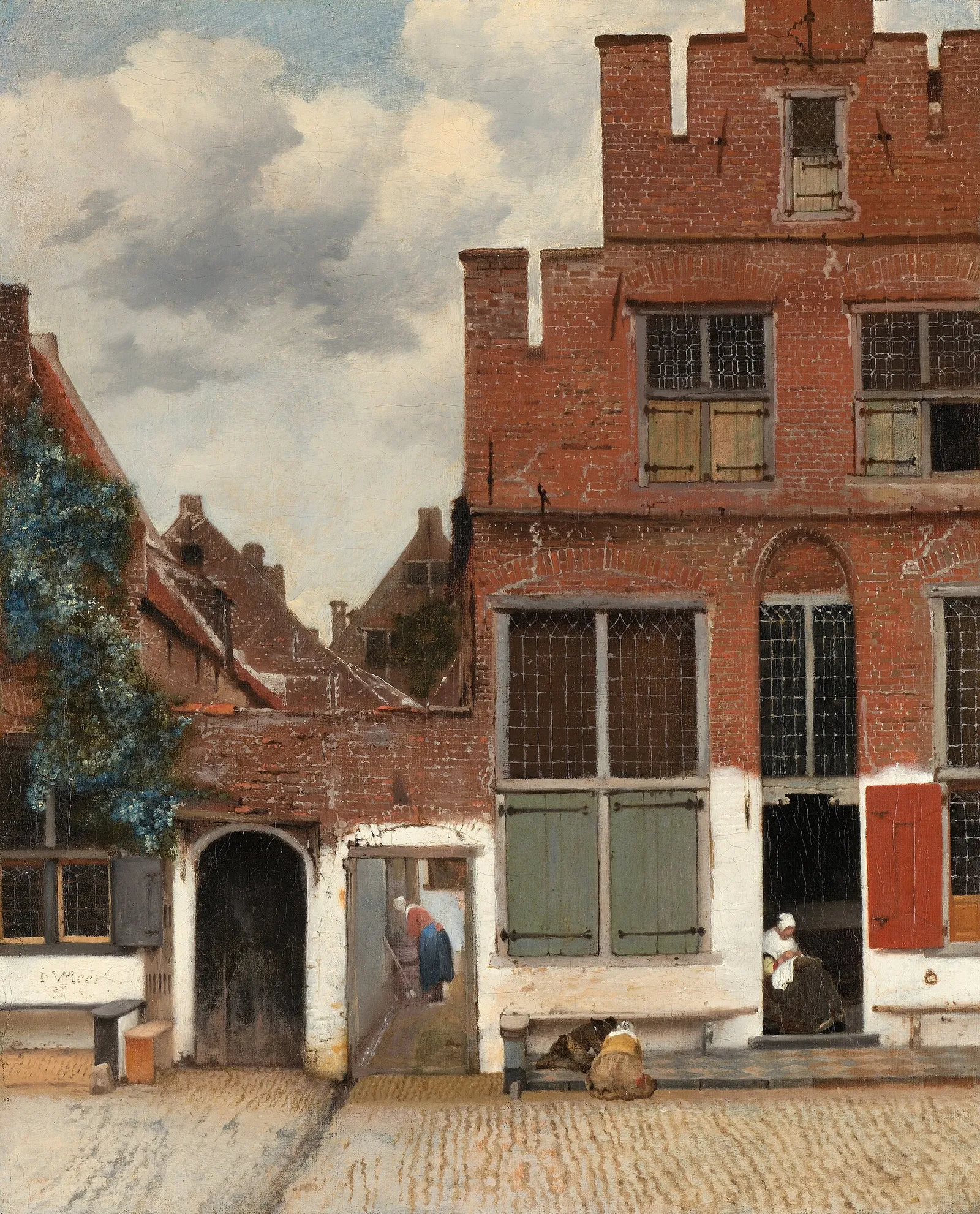
Johannes Vermeer's The Little Street, dated 1658, is in the collection of the Rijksmuseum, where it is listed in the Gallery of Honour. This small view of a brick house front and the women and children going about their day is a picture to study up close, so allow time for a slow look.
Where to see it
The Little Street belongs to the Rijksmuseum, and its listed location is the Gallery of Honour. Works can be moved, lent or temporarily taken off view, so check the Rijksmuseum's official website for current display status before you visit. The painting measures 54.3 x 44 cm, which is modest in size. Expect to stand fairly close to see its detail, and be patient if other visitors are gathered in front of it.
What to look for in person
The worn brick facade
Start with the house front that fills most of the canvas. Vermeer gives the old brickwork a tangible, weathered surface. Look for cracks, patched areas, and the whitewashed lower walls that meet the darker brick above. The texture is built up with careful, varied touches of paint, so the wall reads as something aged and lived-in rather than an idealised architectural drawing. Step back and then forward again to see how the surface shifts from an overall impression of a building to individual bricks and stains.
People at everyday tasks
Small figures give the street its quiet life. Look for the woman seated in the open doorway, absorbed in handwork. Further along, in the narrow passage to the right, a second woman bends over a barrel. Close to the pavement, two children kneel at play. None of them looks out at us, and nothing dramatic happens. Notice how each figure is framed by an opening, a doorway, a passage or the street edge, so they seem to belong to the architecture around them.
Openings, sky and small details
Vermeer crops the building at the top, so we never see the full house. That pulls attention to the lower storeys and the street. Two passageways open up depth, letting us glimpse a courtyard area beyond the facade. Look at the upper left for a patch of cloudy sky, and follow the greenery climbing the wall at the left. Shutters, window leading and the shadows in the doorways reward close viewing. The modest 54.3 x 44 cm format makes this an intimate picture that works best when seen up close.
About the painting
Johannes Vermeer, the Delft painter best known for quiet interiors, made The Little Street in 1658, according to the date in its record. The picture turns his attention outdoors, yet keeps the stillness of his indoor scenes. Rather than a grand square or church, he chose an ordinary row of houses and the people who lived and worked in them. Vermeer is generally credited with only two known townscapes. This one is the more intimate, focusing on a single facade and a few small figures rather than a broad view of the city. For visitors, this is the key to looking: the subject is not an event but a mood, made through light on old brick, open doorways and the rhythm of daily chores. Dutch painting of this period often valued domestic order and household work. The Little Street fits that interest without telling a story or pointing a moral in any obvious way. The figures are absorbed in what they are doing, and the painting asks the viewer to slow down in the same way. The canvas is small, at 54.3 cm high and 44 cm wide, so its effects depend on close attention. Look at how Vermeer separates the textures of brick, whitewash, wood and foliage, and at how the cropped composition makes the house feel near and solid. The exact street that Vermeer painted has long been discussed. Whatever its precise source, the picture is valued as a calm, closely observed image of urban domestic life. It is held by the Rijksmuseum, which lists it in the Gallery of Honour.
Key facts
| Artist | Johannes Vermeer |
|---|---|
| Date | 1658 |
| Size | 54.3 × 44 cm |
| Medium | oil paint, canvas |
| Collection | Rijksmuseum |
How to visit: Rijksmuseum
Amsterdam, Netherlands · Museum guide
| Opening hours | Mon–Sun 09:00–17:00 (every day, incl. public holidays) Gardens 09:00–18:00 (summer only) |
|---|---|
| Closed | Open every day of the year, including public holidays. |
| Admission | Adults EUR 25 (from 2027: EUR 26.50) CJP / EYCA members (half price) EUR 11.25 (from 2027: EUR 13.25) 18 and under free |
| Free entry | Free for those aged 18 and under, Friends of the Rijksmuseum, Amsterdam City Card holders, and holders of ICOM, Vereniging Rembrandt, KOG, VVAK and VriendenLoterij VIP-KAART cards. The gardens are free. |
| Booking | Advance reservation is required, with timed entry. |
Official ticket page
Official website
View on map
Hours and prices can change. Please check the official website before you go. (Checked on: 2026-11-09)
More by Johannes Vermeer
 The Concert
 The Girl with the Wine Glass
 The Lacemaker — Louvre Museum
 Girl Interrupted at her Music — The Frick Collection
 Woman with a Pearl Necklace — Gemäldegalerie Berlin
 Woman in Blue Reading a Letter — Rijksmuseum
 The Milkmaid — Rijksmuseum
 Girl with a Pearl Earring — Mauritshuis
 A Young Woman seated at a Virginal — National Gallery
 The Music Lesson
 A Young Woman Standing at a Virginal — National Gallery
 Diana and her Nymphs — Mauritshuis