Art! Art! Art! › Works
A Young Woman Standing at a Virginal
 Johannes Vermeer, 1670s
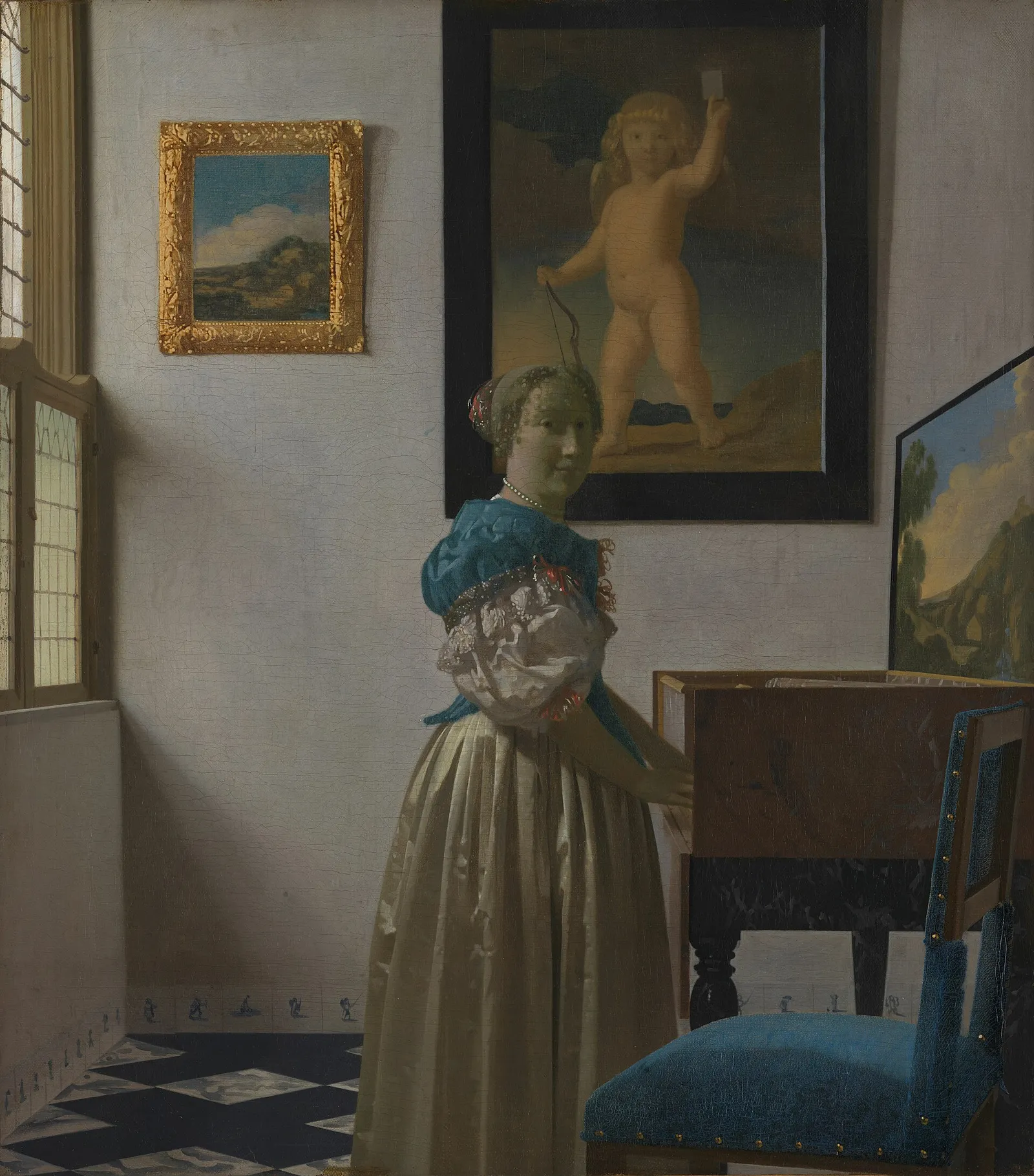
Johannes Vermeer's A Young Woman Standing at a Virginal belongs to the collection of the National Gallery. Painted in the 1670s, it shows a finely dressed woman pausing at a keyboard instrument and turning her gaze toward the viewer in a calm, light-filled room.
Where to see it
The painting is held by the National Gallery, which is also its listed location. Displays can change because of rehangs, conservation work or loans, so check the National Gallery's official website for current display status before you visit. The picture measures 51.7 x 45.2 cm, a modest size, so allow time to stand close and study the detail.
What to look for in person
The gaze that meets yours
The woman rests her hands on the keys, but she is not lost in her playing. She turns her face outward and looks straight at the viewer, making you part of the scene rather than a hidden observer. Notice how still the pose is: the moment seems suspended between music and conversation. Look closely at the satin of her dress, the way light catches its folds, and the small accents of her jewellery and ribbons. These passages show Vermeer's close attention to how different surfaces receive light.
Pictures within the picture
The back wall carries two framed paintings. On the right hangs a large image of Cupid holding up a card or letter; on the left is a landscape in an ornate gilded frame. Another landscape decorates the raised lid of the virginal itself. Vermeer often used paintings on the wall to add a layer of meaning to his interiors, and the Cupid here suggests that the scene is connected with love. Compare how he renders these images as flat, framed objects, set apart from the real space of the room.
Light, wall and floor
Daylight enters from a window at the left and falls across the woman, the instrument and the pale wall behind her. Watch how the shadows soften rather than cut sharply, and how the wall shifts gradually in tone from bright to darker areas. Along the base of the wall runs a row of blue-and-white tiles, a familiar feature of Dutch homes, and a blue upholstered chair stands in the left foreground. These carefully placed elements build an ordered, quiet space that guides the eye toward the standing figure.
About the painting
Johannes Vermeer worked in Delft and is known for a relatively small number of paintings, many of them domestic interiors in which one or two figures are absorbed in everyday activities such as reading, writing or making music. A Young Woman Standing at a Virginal dates from the 1670s, the final years of his career, as he died in 1675. Compared with some of his earlier interiors, works from this period tend to show crisper contours, cooler colour and a more deliberate, almost geometric arrangement of the room, and this painting shows those qualities clearly in its framed pictures, tiled skirting and squared-off furniture. The virginal was a small keyboard instrument common in prosperous Dutch households of the seventeenth century. In Dutch painting of the time, music-making was frequently linked with ideas of harmony and courtship, and Vermeer returned to the subject of women playing instruments several times. Here, the presence of Cupid on the back wall reinforces the association with love, while the woman's direct, composed look keeps the meaning open rather than spelling out a story. For visitors, the painting rewards slow viewing. Its size, 51.7 by 45.2 centimetres, invites you to come close, yet the composition is clear enough to read from across the room. Try looking first at the overall balance of light and dark, then at the small details: the reflections on the instrument, the edges of the frames, the pattern of the tiles and the texture of the dress. Moving between these two distances helps show how Vermeer combines careful observation with a carefully controlled design.
Key facts
| Artist | Johannes Vermeer |
|---|---|
| Date | 1670s |
| Size | 51.7 × 45.2 cm |
| Medium | oil paint, canvas |
| Collection | National Gallery |
How to visit: National Gallery
London, United Kingdom · Museum guide
| Opening hours | Mon–Thu, Sat, Sun 10:00–18:00 Fri 10:00–21:00 (Friday late) |
|---|---|
| Closed | 24–26 December and 1 January. |
| Admission | General admission (collection) free; donations invited Some exhibitions are charged (e.g. Renoir and Love, until 31 Jan 2027) |
| Free entry | General admission is always free. |
| Booking | No reservation or timed entry is required. Free timed booking gives fast-track entry. |
Building work and improvements are under way: some rooms are closed and some paintings have moved, so check the floorplans or collection search before visiting. A new Research Centre is due to open in 2028. On 17 November only, some east wing rooms and the Espresso Bar close from 16:00.
Official ticket page
Official website
View on map
Hours and prices can change. Please check the official website before you go. (Checked on: 2026-11-11)
More by Johannes Vermeer
 The Concert
 The Girl with the Wine Glass
 The Lacemaker — Louvre Museum
 Girl Interrupted at her Music — The Frick Collection
 Woman with a Pearl Necklace — Gemäldegalerie Berlin
 Woman in Blue Reading a Letter — Rijksmuseum
 The Milkmaid — Rijksmuseum
 Girl with a Pearl Earring — Mauritshuis
 A Young Woman seated at a Virginal — National Gallery
 The Music Lesson
 Diana and her Nymphs — Mauritshuis
 Girl with a Flute — National Gallery of Art