Art! Art! Art! › Works
The Girl with the Wine Glass
 Johannes Vermeer, 1659
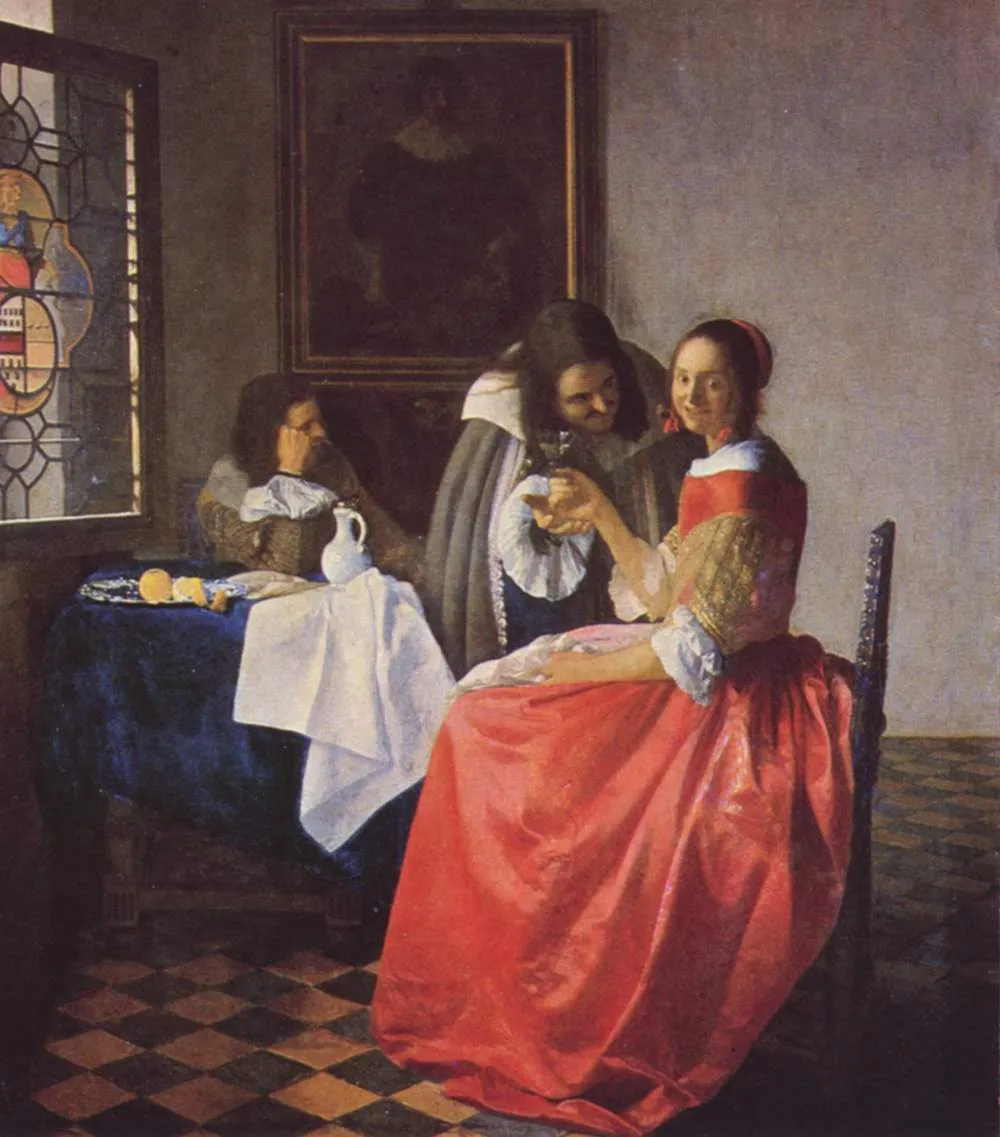
The Girl with the Wine Glass by Johannes Vermeer belongs to the Herzog Anton Ulrich Museum in Braunschweig, Germany. The museum dates this oil on canvas to about 1658/59. It shows a young woman in red, a man pressing a glass of wine on her, and a stained-glass window that quietly comments on the scene.
Where to see it
The painting is in the collection of the Herzog Anton Ulrich Museum in Braunschweig, which is also its recorded location. Paintings can be moved, lent or taken off view for conservation, so check the museum's official website for current display status before you plan your visit.
What to look for in person
The window as a quiet commentary
Start with the open casement on the left. Its stained-glass panel shows a coat of arms and a female figure holding a bridle, a traditional attribute of Temperance, the virtue of moderation. Placed beside a scene of wine and coaxing, the emblem sets restraint against indulgence and invites you to read the room as more than a pleasant gathering. Look closely at the glass as well: the painting is signed "IV Meer" there, so the artist's name sits in the same pane that frames the scene's moral tension.
Three figures, three roles
The young woman in a red dress holds a wineglass and smiles out toward you, drawing the viewer into the moment. Beside her, a man bends close, urging her to drink. Further back on the left, a second man sits at a table, apart from the exchange, near a silver dish of fruit and a white jug. When you study the faces, bear in mind that the woman's face and the seated man have been heavily altered by later overpainting, so not every detail you see there is Vermeer's original surface.
Colour and costly pigments
The painting is oil on canvas, and technical study has clarified how Vermeer built its colours. Pigment analysis by Hermann Kühn identified natural ultramarine, an expensive blue made from lapis lazuli, in the tablecloth. The bright oranges on the table contain lead-tin yellow, while the woman's glowing skirt combines madder lake with vermilion. Standing in front of the canvas, compare the deep reds of the dress with the cooler blue of the cloth and notice how these materials give the figures and still life their intensity.
About the painting
The Girl with the Wine Glass is an early interior by Johannes Vermeer, dated by the Herzog Anton Ulrich Museum to about 1658/59. The canvas, recorded at 78 by 67.5 cm, belongs to the period when Vermeer was painting scenes of social life set in well-lit rooms, often with a moral undertone carried by small details such as the Temperance figure in the window. The work's history can be followed for more than three centuries. It is probably one of the paintings offered at the auction of the Dissius collection in Amsterdam on 16 May 1696, where it fetched 73 guilders. By 1710 it was in the collection of Duke Anton Ulrich of Brunswick. That year the painter Tobias Querfurt listed it in a catalogue as "Eine lustige Gesellschaft admirable gemalet, sonderlich die Kleidung", a description that praises it as a merry company admirably painted, especially the clothing, a fitting note given the attention the red dress still attracts. Later inventories record the picture in the ducal collection again in 1744 and 1776. During the Napoleonic period it was taken to Paris and shown at the Musée Napoléon, today the Louvre, from 1807 to 1815. It is now held by the Herzog Anton Ulrich Museum in Braunschweig. Visitors should keep in mind that parts of the surface, notably the woman's face and the seated man, were altered by later overpainting, which affects how those passages read today.
Key facts
| Artist | Johannes Vermeer |
|---|---|
| Date | 1659 |
| Size | 78 × 67.5 cm |
| Medium | oil paint, canvas |
| Collection | Herzog Anton Ulrich Museum |
How to visit: Herzog Anton Ulrich Museum
Brunswick, Germany
Hours and prices can change. Please check the official website before you go.
More by Johannes Vermeer
 The Concert
 The Lacemaker — Louvre Museum
 Girl Interrupted at her Music — The Frick Collection
 Woman with a Pearl Necklace — Gemäldegalerie Berlin
 Woman in Blue Reading a Letter — Rijksmuseum
 The Milkmaid — Rijksmuseum
 Girl with a Pearl Earring — Mauritshuis
 A Young Woman seated at a Virginal — National Gallery
 The Music Lesson
 A Young Woman Standing at a Virginal — National Gallery
 Diana and her Nymphs — Mauritshuis
 Girl with a Flute — National Gallery of Art
Sources
- Wikidata Q1169874
- Wikipedia (en) (CC BY-SA 4.0)
- Wikipedia (ja) (CC BY-SA 4.0)
- Wikipedia (it) (CC BY-SA 4.0)
- Wikipedia (fr) (CC BY-SA 4.0)
- Museum website (3landesmuseen-braunschweig.de)