Art! Art! Art! › Works
Girl with a Pearl Earring
 Johannes Vermeer, 1665
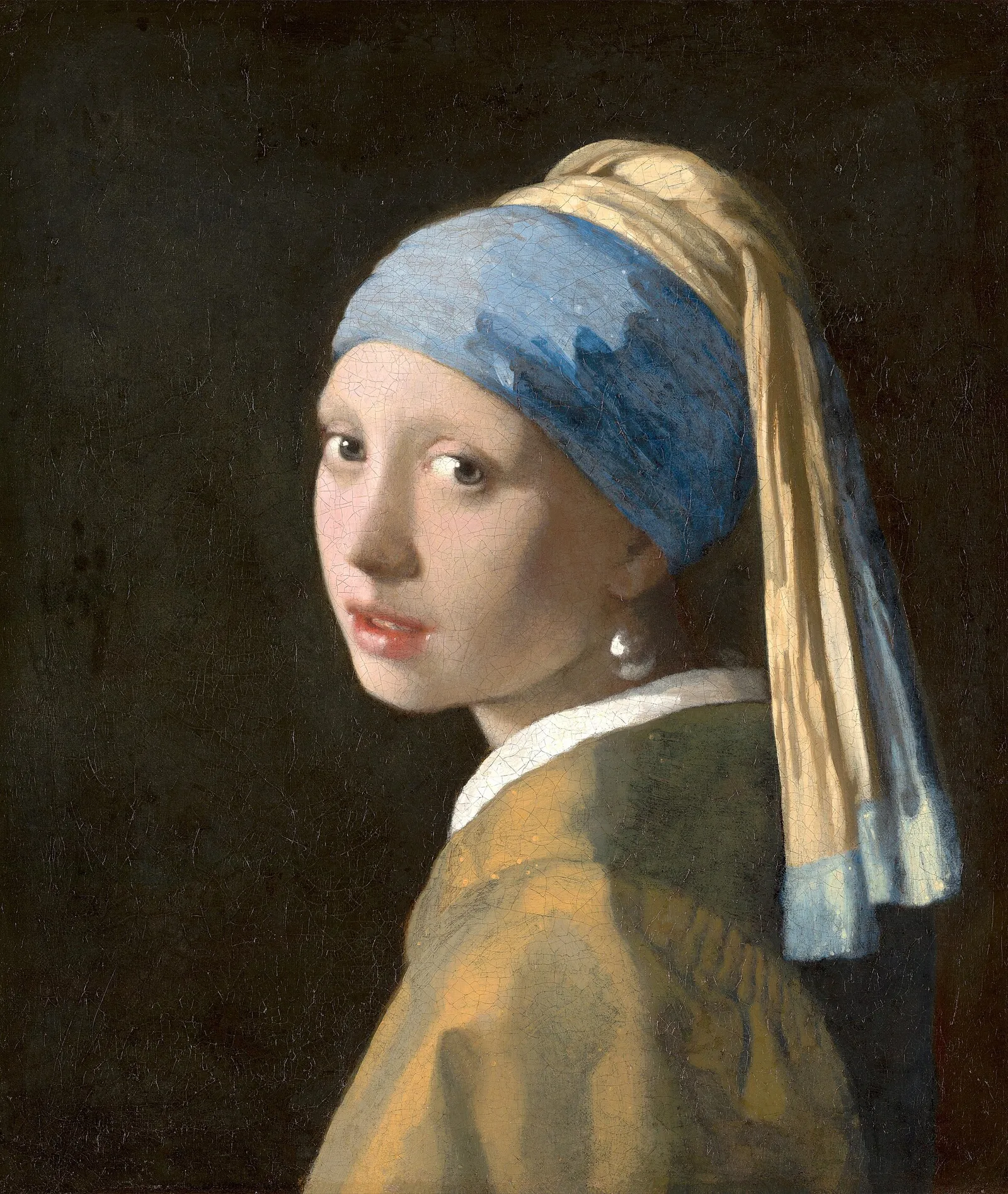
Johannes Vermeer's Girl with a Pearl Earring, dated 1665, belongs to the collection of the Mauritshuis. At just 44.5 by 39 centimetres, it is a small, intimate canvas that rewards a close, unhurried look. This guide covers where to see it and what to watch for when you stand in front of it.
Where to see it
Girl with a Pearl Earring is held by the Mauritshuis, which is listed as both its collection and its location. Because works can be moved, lent or temporarily taken off view, check the Mauritshuis's official website for current display status, opening hours and ticketing before you visit. The painting measures 44.5 cm high and 39 cm wide, so allow time to get close enough to see the brushwork, especially if the room is busy.
What to look for in person
The pearl itself
Look closely at the earring. Up close, it is made from remarkably little paint: a bright highlight near the top and a soft, pale reflection along the lower edge, which seems to pick up light from the white collar below. There is no clear hook or outline joining it to the ear; your eye fills in the rest. Step back a few paces and those few touches resolve into a solid, glowing drop hanging in shadow. Moving between near and far views is one of the most rewarding ways to experience this painting.
Blue and yellow in the headscarf
The turban-like headwrap is built from two strong colours: a blue band across the head and a yellow cloth falling behind. The blue is generally associated with ultramarine, a costly pigment made from lapis lazuli that Vermeer is known to have used. Notice how the colours shift where light strikes the folds and where they turn away into shade. The fabric is not described thread by thread; instead, broad, confident strokes suggest weight and texture. Compare the crisp highlights on top with the softer, cooler tones in the shadowed areas.
The turning glance
The girl looks back over her shoulder toward the viewer, her lips slightly parted, as if caught in a passing moment. Look at the small points of light in her eyes and on her lower lip, which give the face a sense of moisture and life. Notice also how gently the edges are handled: the outline of the cheek and nose melts into the surrounding shadow rather than being drawn with a hard line. Set against a dark, plain background, the figure seems to emerge toward you, with nothing in the setting to distract from her gaze.
About the painting
Girl with a Pearl Earring was painted by Johannes Vermeer, the Dutch artist active in Delft in the seventeenth century, and is dated 1665. It measures 44.5 cm high by 39 cm wide and is held by the Mauritshuis. Although it is often thought of as a portrait, art historians generally describe it as a tronie: a Dutch type of painting showing a head or bust of a figure, often in unusual costume or with a particular expression, rather than a commissioned likeness of a named person. The identity of the model is not known, and the exotic headwrap supports the idea that the picture was meant as a study of character, costume and light rather than a record of an individual. Vermeer is best known for quiet interior scenes in which women read, write, pour milk or play music, usually lit from a window at the left. This work is different. There is no room, no furniture and no narrative, just a single figure against darkness. That simplicity throws attention onto the things Vermeer handled with particular care: the fall of light across skin and fabric, the balance of a few strong colours, and the soft transitions between light and shadow. For visitors, the painting's modest size is worth keeping in mind. It is not a work that dominates a wall from across a room; it asks you to come close. Spend a moment at a distance to take in the pose and the glance, then move nearer to see how sparingly the highlights on the pearl, eyes and lips are applied.
Key facts
| Artist | Johannes Vermeer |
|---|---|
| Date | 1665 |
| Size | 44.5 × 39 cm |
| Medium | oil paint, canvas |
| Collection | Mauritshuis |
How to visit: Mauritshuis
The Hague, Netherlands · Museum guide
| Opening hours | Mon 13:00–18:00 Tue–Sun 10:00–18:00 Prince William V Gallery: Tue–Sun 12:00–17:00 (closed Mon) 5 Dec 2026 (Saint Nicholas), 26 Dec 2026: 10:00–18:00 (special hours) 24 Dec 2026, 31 Dec 2026: 10:00–16:00 (special hours) |
|---|---|
| Closed | Closed 25 December and 1 January (2027); otherwise open almost every day of the year. |
| Last entry | 30 minutes before closing |
| Admission | Adult (Mauritshuis) EUR 21 Adult (combo Mauritshuis + Prince William V Gallery) EUR 24 Under 19 free Student (Mauritshuis) EUR 13.5 CJP (Mauritshuis) EUR 13 Groups of 15+ adults (Mauritshuis) EUR 18.5 Mauritshuis Friends, Museum Card, Vriendenloterij VIP, Rembrandt Society, ICOM, Ooievaarspas free |
| Free entry | Free for under-19s; Mauritshuis Friends, Museum Card, Vriendenloterij VIP, Rembrandt Society, ICOM and Ooievaarspas holders; and attendants of visitors with an impairment. |
| Booking | Entry is by timed slot, and booking in advance is strongly recommended. |
Cashless museum: payment by card or smartphone only.
Official ticket page
Official website
View on map
Hours and prices can change. Please check the official website before you go. (Checked on: 2026-11-12)
More by Johannes Vermeer
 The Concert
 The Girl with the Wine Glass
 The Lacemaker — Louvre Museum
 Girl Interrupted at her Music — The Frick Collection
 Woman with a Pearl Necklace — Gemäldegalerie Berlin
 Woman in Blue Reading a Letter — Rijksmuseum
 The Milkmaid — Rijksmuseum
 A Young Woman seated at a Virginal — National Gallery
 The Music Lesson
 A Young Woman Standing at a Virginal — National Gallery
 Diana and her Nymphs — Mauritshuis
 Girl with a Flute — National Gallery of Art