Art! Art! Art! › Works
Diana and her Nymphs
 Johannes Vermeer, 1650s
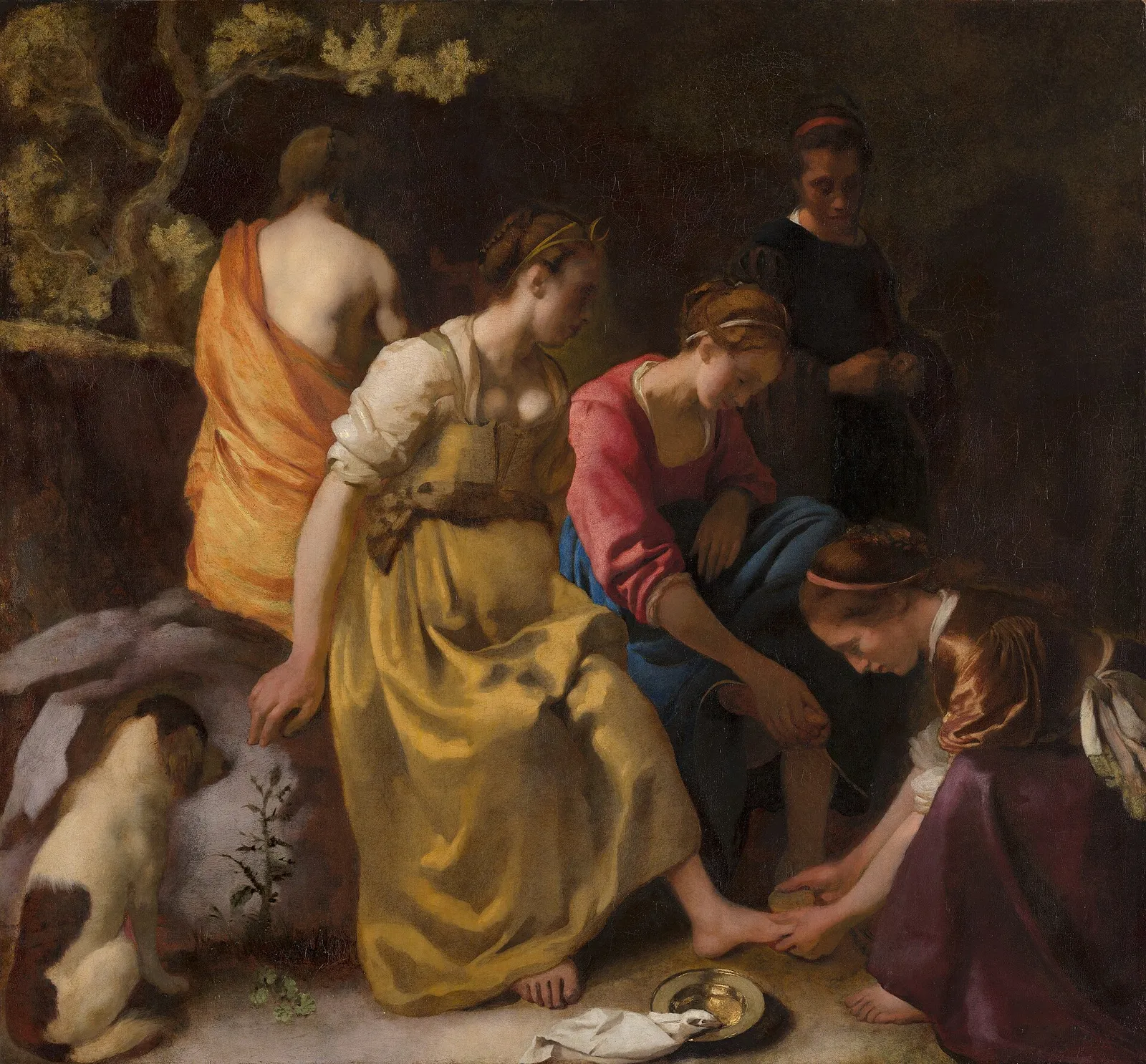
Diana and her Nymphs is an early painting by Johannes Vermeer, dated to the 1650s and held by the Mauritshuis. It shows the goddess Diana resting with her companions, a quiet mythological scene painted before Vermeer became known for his small interiors. Seeing it in person gives you a view of the artist at an exploratory stage of his career.
Where to see it
Diana and her Nymphs is in the collection of the Mauritshuis. Display arrangements can change because of rehangs, conservation or loans, so check the Mauritshuis official website for current display status, opening hours and ticket information before you plan your visit.
What to look for in person
Find the crescent moon
Start by locating Diana herself. She is seated among her companions, and the key to identifying her is the small crescent moon worn on her forehead, the traditional attribute of the goddess of the hunt and the moon. Once you have found her, notice how little else announces her status: there is no grand gesture or throne. A kneeling nymph washes her feet in a basin, and a dog, another reference to Diana as huntress, sits among the group. The identity of the scene rests on these few details.
A scene of stillness rather than action
Mythological paintings of Diana often show the hunt or dramatic episodes from her stories. Here, nothing much happens. The women are absorbed in their own thoughts or tasks, and hardly anyone meets another's gaze. Several faces are turned down or lie partly in shadow. Stand back and take in the overall mood: the scene feels hushed and inward. Many visitors find that this sense of quiet concentration connects the picture to the calm, private moments that Vermeer would later paint in his domestic interiors.
Broad handling and a warm palette
Move closer and look at the paint surface. Compared with the small, finely detailed works for which Vermeer is best known, the brushwork here is broader and the forms are modelled in larger masses of light and shade. The colours are warm and earthy, with the figures set against a darker landscape setting. The canvas is also relatively large for Vermeer, close to a metre in each direction, so give yourself room to see the composition as a whole before studying individual faces and draperies.
About the painting
Diana and her Nymphs belongs to the earliest phase of Johannes Vermeer's career, and the fact sheet dates it to the 1650s. At this time Vermeer was a young painter in the Dutch Republic, and like many artists of his generation he tried his hand at history painting: subjects drawn from mythology, the Bible and ancient literature, which were then regarded as the most ambitious category of art. Only a small number of such works by Vermeer are known, which makes this painting an important document of how he began. The canvas measures 97.8 cm in height and 104.6 cm in width, an almost square format and noticeably larger than most of the interiors he painted later. Its subject is Diana, the Roman goddess of the hunt and of the moon, shown with the nymphs who accompanied her. Rather than depicting a specific dramatic episode, Vermeer presents a moment of rest and private ritual, as one companion washes the goddess's feet. For visitors who know Vermeer mainly through his later paintings of women reading letters, pouring milk or making music in sunlit rooms, this work can be surprising. The figures are larger, the handling looser and the subject classical rather than everyday. Yet the calm, self-absorbed mood that runs through the scene is a quality many viewers recognise in his mature work. Looking at it alongside his later pictures is a useful way to think about how an artist's interests develop over time. The painting is held by the Mauritshuis. Before travelling to see it, confirm on the museum's official website that it is currently on view.
Key facts
| Artist | Johannes Vermeer |
|---|---|
| Date | 1650s |
| Size | 97.8 × 104.6 cm |
| Medium | oil paint, canvas |
| Collection | Mauritshuis |
How to visit: Mauritshuis
The Hague, Netherlands · Museum guide
| Opening hours | Mon 13:00–18:00 Tue–Sun 10:00–18:00 Prince William V Gallery: Tue–Sun 12:00–17:00 (closed Mon) 5 Dec 2026 (Saint Nicholas), 26 Dec 2026: 10:00–18:00 (special hours) 24 Dec 2026, 31 Dec 2026: 10:00–16:00 (special hours) |
|---|---|
| Closed | Closed 25 December and 1 January (2027); otherwise open almost every day of the year. |
| Last entry | 30 minutes before closing |
| Admission | Adult (Mauritshuis) EUR 21 Adult (combo Mauritshuis + Prince William V Gallery) EUR 24 Under 19 free Student (Mauritshuis) EUR 13.5 CJP (Mauritshuis) EUR 13 Groups of 15+ adults (Mauritshuis) EUR 18.5 Mauritshuis Friends, Museum Card, Vriendenloterij VIP, Rembrandt Society, ICOM, Ooievaarspas free |
| Free entry | Free for under-19s; Mauritshuis Friends, Museum Card, Vriendenloterij VIP, Rembrandt Society, ICOM and Ooievaarspas holders; and attendants of visitors with an impairment. |
| Booking | Entry is by timed slot, and booking in advance is strongly recommended. |
Cashless museum: payment by card or smartphone only.
Official ticket page
Official website
View on map
Hours and prices can change. Please check the official website before you go. (Checked on: 2026-11-12)
More by Johannes Vermeer
 The Concert
 The Girl with the Wine Glass
 The Lacemaker — Louvre Museum
 Girl Interrupted at her Music — The Frick Collection
 Woman with a Pearl Necklace — Gemäldegalerie Berlin
 Woman in Blue Reading a Letter — Rijksmuseum
 The Milkmaid — Rijksmuseum
 Girl with a Pearl Earring — Mauritshuis
 A Young Woman seated at a Virginal — National Gallery
 The Music Lesson
 A Young Woman Standing at a Virginal — National Gallery
 Girl with a Flute — National Gallery of Art