Art! Art! Art! › Works
The Lacemaker
 Johannes Vermeer, 1669
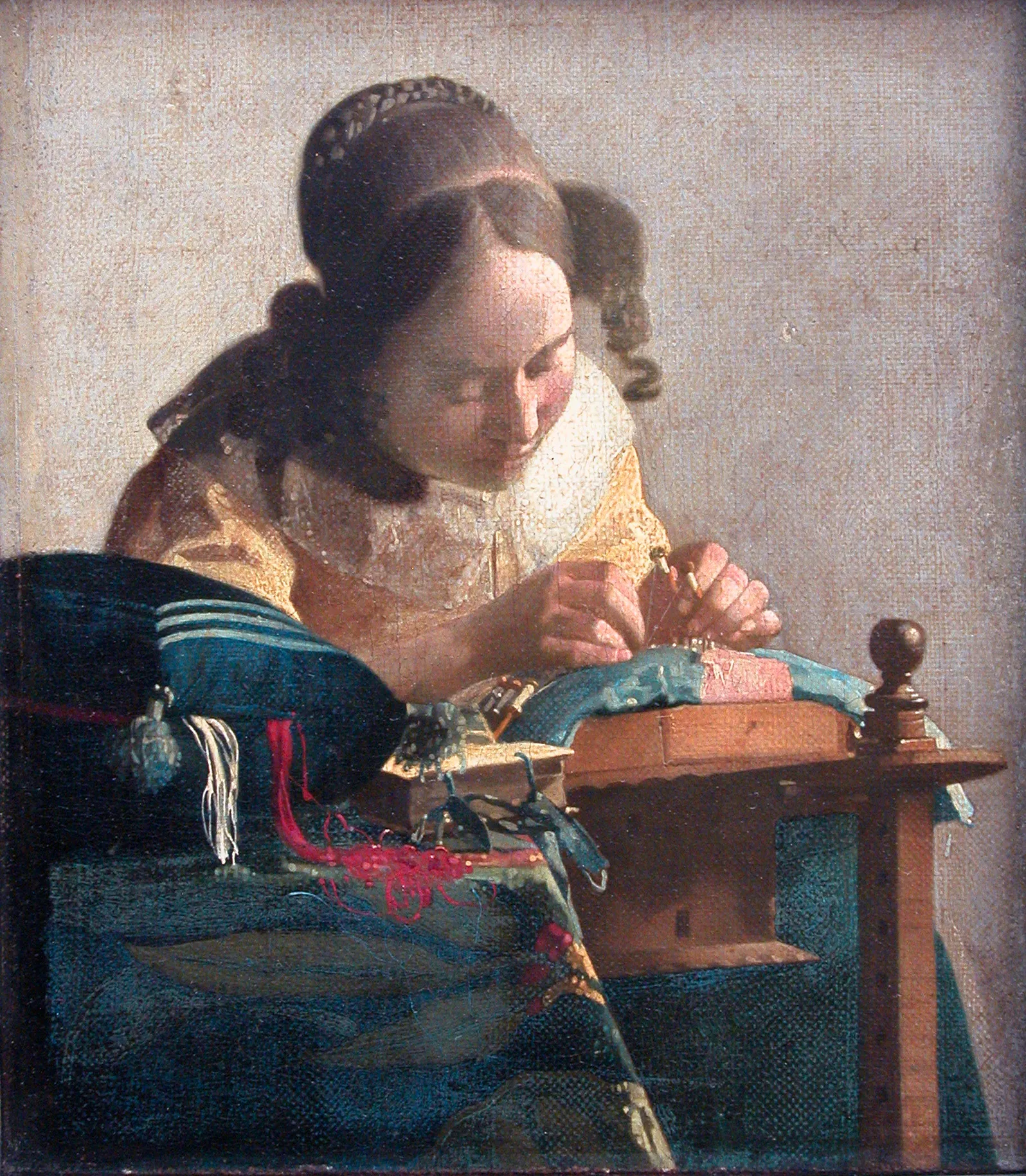
Johannes Vermeer's The Lacemaker, dated 1669, belongs to the Department of Paintings of the Louvre in Paris. At just 24.5 × 21 cm, it shows a young woman bent over her bobbin lace, so absorbed in her work that the viewer seems to be looking over her shoulder.
Where to see it
The Lacemaker is held by the Department of Paintings of the Louvre in Paris, and the museum's records place it in Room 837. Paintings can be moved, rehung or lent, so check the Louvre's official website for current display status before you visit. The picture is very small, so expect to step close to see it properly. Its inventory number, M.I. 1448, is useful when searching the Louvre's online collection.
What to look for in person
A small picture built for close looking
The painting measures only 24.5 × 21 cm, and it is often described as the smallest of Vermeer's paintings. That scale shapes the experience in the gallery: you cannot take it in from across the room. Walk right up to it and the composition starts to make sense. The young woman leans in toward her work, and you find yourself leaning in too, matching her concentration. Give it a few minutes rather than a passing glance, because much of what makes it rewarding sits in very small passages of paint.
Hands, bobbins and a single pin
Look first at the center of the picture, where the action is. The woman, dressed in a yellow bodice, holds two bobbins in her left hand while she presses a pin into the pillow on which the bobbin lace is made. Her gaze is fixed on this precise movement, and Vermeer keeps everything else simple to support it. Behind her is a plain, undecorated wall, and a small book rests on the table. Nothing competes for attention with the meeting point of her eyes, fingers and threads.
Colored threads, light from the right and the signature
At the left, look for the lace pillow with red and white threads, which add strong touches of color beside the yellow of her bodice. Then notice where the light falls from. It enters from the right, an unusual choice for Vermeer, whose interiors are more often lit from the left. Finally, search the upper right of the picture for the signature, 'IV Meer'. The letters are slightly faded, so you may need to look closely and at an angle to pick them out.
About the painting
The Lacemaker is a scene of everyday domestic work, a subject Vermeer returned to often: a single figure absorbed in a quiet task, seen at close range. The fact sheet dates the painting to 1669, and the Louvre places it in its Department of Paintings. Though small, it carries an interesting material history. It was painted in oil on canvas, and the canvas is said to come from the same bolt as that of A Young Woman Seated at the Virginals; the two pictures appear to have started out at the same size. The canvas was later transferred to an oak panel, a change reported to date from 1778. The painting's documented history begins in Amsterdam, where it appeared as lot 12 in the Dissius sale on 16 May 1696 and fetched 28 guilders. Nearly two centuries later it resurfaced in Paris at the Vis Blokhuyzen sale on 1 April 1870. It then passed through the hands of Léon Gauchez and Eugène Féral before the Louvre bought it in June of that year for 7,500 francs, recording it under inventory number M.I. 1448. With that purchase it became the first Vermeer to enter a French public collection. For visitors, that history adds a layer of interest: this modest picture of a woman at her lacework marked the beginning of Vermeer's presence in French public museums, and it remains one of the most accessible ways to see his close, attentive approach to painting in Paris.
Key facts
| Artist | Johannes Vermeer |
|---|---|
| Date | 1669 |
| Size | 24.5 × 21 cm |
| Medium | oil paint, canvas |
| Collection | Department of Paintings of the Louvre |
| Gallery | Room 837, Richelieu wing, level 2 Checked in the museum's open data on 2026-11-12 (galleries can change) Source |
How to visit: Louvre Museum
Paris, France · Museum guide
| Opening hours | Mon, Thu, Sat, Sun 09:00–18:00 Wed, Fri 09:00–21:00 (evening opening) Rooms are cleared 30 minutes before closing |
|---|---|
| Closed | Every Tuesday; 1 January, 1 May and 25 December. Other public holidays are open unless they fall on a Tuesday. |
| Last entry | 1 hour before closing |
| Admission | Adult (non-EEA visitors) EUR 32 Adult (EEA citizens and residents) EUR 22 Under 18 free (ID required) EEA citizens/residents under 26 free (photo ID; residents also need a residence permit of over 90 days) Audio guide rental EUR 6 (can be booked in advance online) Rates apply from 14 January 2026 |
| Free entry | Free for under-18s, EEA citizens/residents under 26, all visitors on the first Friday of the month after 18:00 (except July and August) and on 14 July, and disabled visitors plus one carer. Also free with proof for EEA art and art-history teachers, ICOM members, journalists, EEA job seekers and EEA residents on income support. |
| Booking | Entry is by timed slot, and booking in advance is recommended. |
The Cour Carrée entrance is currently closed. On Thursday 12 November 2026 the museum may open later and some exhibition rooms may remain closed.
Official ticket page
Official website
View on map
Hours and prices can change. Please check the official website before you go. (Checked on: 2026-11-11)
More by Johannes Vermeer
 The Concert
 The Girl with the Wine Glass
 Girl Interrupted at her Music — The Frick Collection
 Woman with a Pearl Necklace — Gemäldegalerie Berlin
 Woman in Blue Reading a Letter — Rijksmuseum
 The Milkmaid — Rijksmuseum
 Girl with a Pearl Earring — Mauritshuis
 A Young Woman seated at a Virginal — National Gallery
 The Music Lesson
 A Young Woman Standing at a Virginal — National Gallery
 Diana and her Nymphs — Mauritshuis
 Girl with a Flute — National Gallery of Art
Sources
- Wikidata Q1216387
- Wikipedia (en) (CC BY-SA 4.0)
- Wikipedia (it) (CC BY-SA 4.0)
- Wikipedia (fr) (CC BY-SA 4.0)
- www.louvre.fr
- contact.louvre.fr