Art! Art! Art! › Works
The Girlhood of Mary Virgin
 Dante Gabriel Rossetti, 1840s
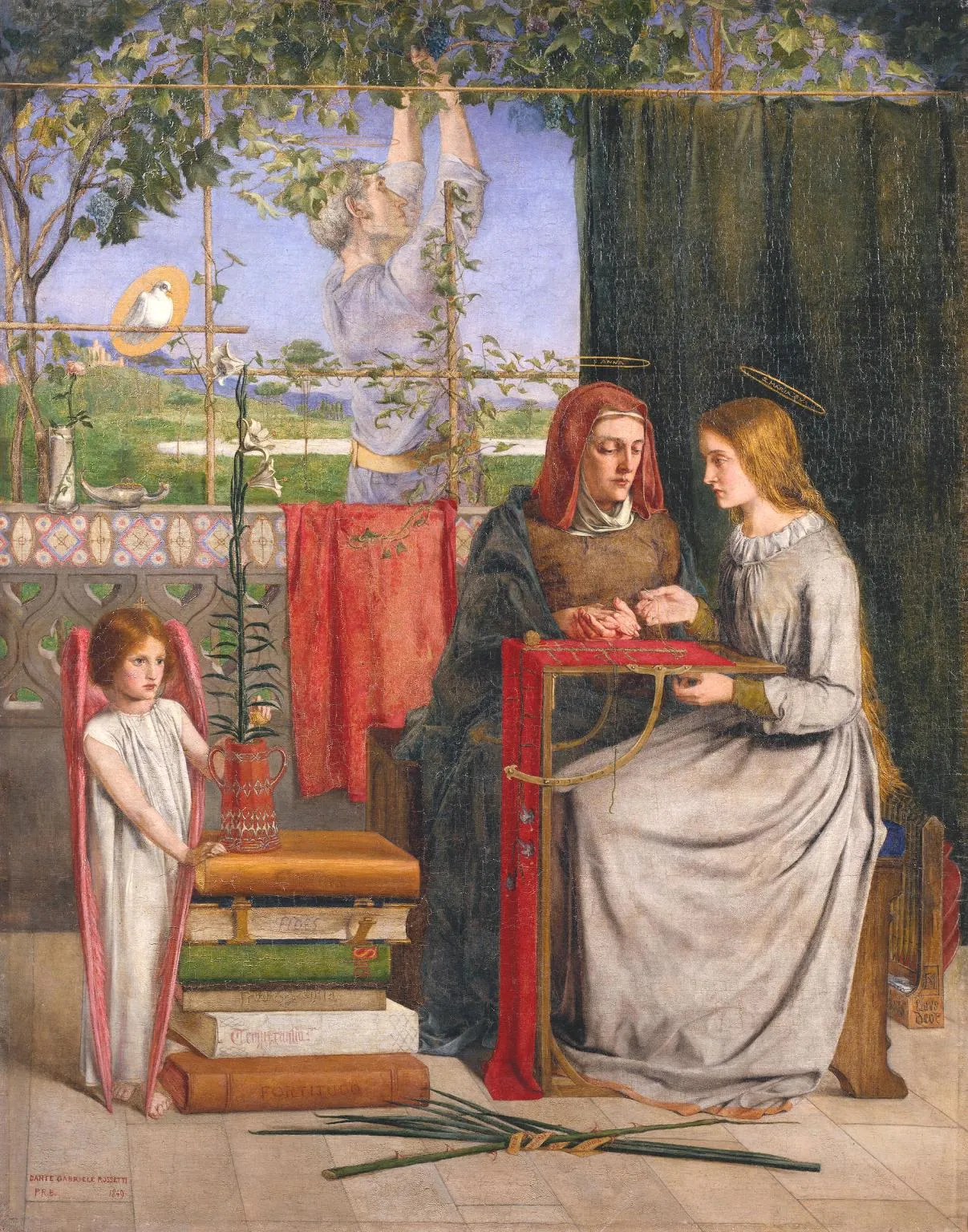
The Girlhood of Mary Virgin is an early oil painting by Dante Gabriel Rossetti, made in the 1840s and now in the Tate collection. It shows the young Virgin Mary at her embroidery beside her mother, Saint Anne, in a quiet domestic scene packed with symbolic objects. Standing in front of it is a little like reading a picture puzzle, one emblem at a time.
Where to see it
The painting is held by Tate, with its collection record listed as Tate; National Gallery. Tate runs more than one gallery, and works can move between display, storage and loan, so check Tate's official website for the painting's current display status and venue before you plan your visit. The canvas measures 83.2 cm high by 65.4 cm wide, a modest, close-viewing size, so give yourself time to stand near it and look at the small details.
What to look for in person
The embroidered lily
Start with the centre of the picture: the young Mary sits at an embroidery frame, stitching a lily from a real plant held up for her by a small child angel. The lily is a traditional emblem of purity associated with the Virgin. Look at how carefully Rossetti paints both the living flower and its stitched copy, setting the real and the represented side by side. Saint Anne sits beside her daughter, watching the work, which gives the scene the feel of a lesson taking place in an ordinary home.
Books, dove and the objects on the floor
Rossetti fills the room with symbols meant to be read slowly. On the floor, look for a stack of books whose spines are labelled with the names of virtues, and for a palm branch and a thorny briar lying nearby, objects that hint at the later suffering of Christ. A dove, the traditional sign of the Holy Spirit, perches in the background. Rather than taking these in at a glance, try identifying them one by one; the painting rewards the kind of attention you might give an illuminated manuscript.
The Pre-Raphaelite approach
This is one of the earliest works associated with the Pre-Raphaelite Brotherhood, the group Rossetti helped found with fellow young artists in the late 1840s. Notice the clear, even light, the crisp outlines and the slightly stiff, upright poses, which deliberately recall art from before the High Renaissance rather than the polished academic painting of Rossetti's day. Look also for the initials 'PRB', which Rossetti included as a signal of the group's aims. The overall effect is earnest and intimate rather than grand.
About the painting
Dante Gabriel Rossetti painted The Girlhood of Mary Virgin in the 1840s, when he was a young artist in London and one of the founders of the Pre-Raphaelite Brotherhood. The group wanted to return to what they saw as the sincerity and close observation of art made before Raphael, and this canvas is an early statement of those ideas. Instead of a dramatic biblical episode, Rossetti chose an imagined, private moment from the Virgin's childhood. Mary is shown as a serious girl at her needlework, guided by her mother, Saint Anne, while a child angel tends the lily she is copying. In the background, outside the window, a male figure, usually identified as her father, Saint Joachim, works on a vine. Almost every object in the room carries meaning: the lily for purity, the dove for the Holy Spirit, the labelled books for virtues, and the palm and thorns as quiet forewarnings of Christ's Passion. Rossetti's family were closely involved; his sister, the poet Christina Rossetti, is widely recognised as the model for Mary, and his mother as the model for Saint Anne. Rossetti was also a poet, and he wrote verses connected with the picture, reflecting his habit of joining word and image. At 83.2 by 65.4 cm, the painting is relatively small, and its impact comes from its careful detail and sense of calm concentration. For visitors interested in how the Pre-Raphaelite movement began, it offers a clear view of the young Rossetti's ambitions before his later, more sensuous style developed.
Key facts
| Artist | Dante Gabriel Rossetti |
|---|---|
| Date | 1840s |
| Size | 83.2 × 65.4 cm |
| Medium | oil paint, canvas |
| Collection | Tate / National Gallery |
How to visit: Tate Britain
London, United Kingdom · Museum guide
| Opening hours | Mon–Sun 10:00–18:00 (galleries start closing at 17:50) |
|---|---|
| Closed | 24–26 December (all Tate galleries, festive period). |
| Last entry | 17:30 |
| Admission | Collection (everyone): free, no booking needed Tate Collective (16–25) exhibition ticket: GBP 5 (free Tate Collective sign-up required) Family child ticket, ages 12–18 (exhibitions): GBP 5 Children 11 and under (exhibitions): free (up to four per parent/guardian) |
| Free entry | The collection is free for everyone. Exhibitions are free for Members, and some exhibitions are free for all (listed as FREE). Disabled visitors pay a concessionary rate; companions go free. |
| Booking | No reservation is required and there is no timed entry. |
The Millbank entrance is closed until 2027 for construction of the Clore Garden; use the Manton Entrance on Atterbury Street.
Official ticket page
Official website
View on map
Hours and prices can change. Please check the official website before you go. (Checked on: 2026-11-09)
More by Dante Gabriel Rossetti
 Ecce Ancilla Domini — Tate Britain
 Beata Beatrix — Tate Britain
 Lady Lilith — Metropolitan Museum of Art
 Proserpine — Tate Britain