Art! Art! Art! › Works
Ecce Ancilla Domini
 Dante Gabriel Rossetti, 1850
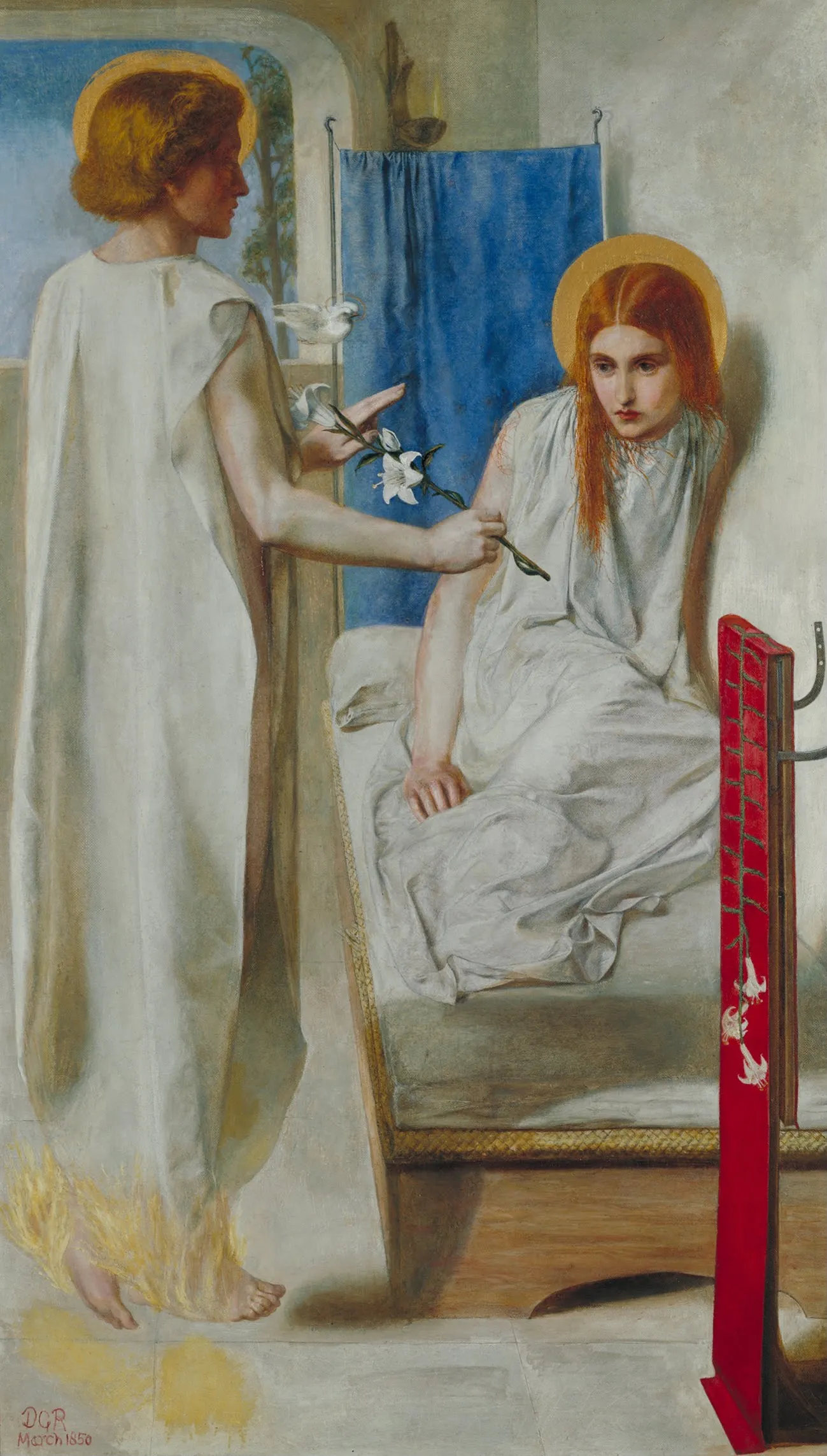
Dante Gabriel Rossetti's Ecce Ancilla Domini, dated 1850, is a small, upright painting of the Annunciation, the moment the angel Gabriel tells Mary she will bear the son of God. It is held in the Tate collection and located at Tate Britain, where its pale, almost all-white palette makes it easy to recognise across a gallery.
Where to see it
Ecce Ancilla Domini is located at Tate Britain. The fact sheet lists its collection as Tate and the National Gallery. Paintings can be moved, rehung, lent or taken off view for conservation, so check Tate's official website for the work's current display status before you plan your visit.
What to look for in person
A palette built on white
Stand back first and notice how much of the canvas is white: the walls, the bedding, Mary's shift and Gabriel's robe. Rossetti limits his other colours to a few strong accents, chiefly blue and red, so your eye is guided to the key details rather than spread across a busy scene. White carries a long association with purity in religious art, and here it fills almost the entire picture. Look closely at how many slightly different whites and creams sit side by side; the surface is far less uniform than it first appears.
A young, uneasy Mary
Rossetti breaks with the calm, regal Virgin of many earlier Annunciations. His Mary sits on a narrow bed and draws back against the wall, her body turned away and her expression wary rather than serene. She appears very young, closer to an ordinary girl woken in her room than a queen of heaven. Notice how tightly the tall, narrow format, 72.4 by 41.9 centimetres, squeezes the two figures together. The cramped space adds to the feeling of a private, unsettling encounter rather than a grand public vision.
Symbols to find
Once the overall effect has registered, look for the traditional symbols Rossetti includes. Gabriel holds a lily, the flower long linked with Mary, and he offers it towards her. A dove, the usual sign of the Holy Spirit, appears near the window. Both figures have thin halos. Rossetti also leaves out some expected conventions: his angel has no large feathered wings, and he is shown with small flames near his feet instead. Spotting what the painter keeps and what he discards is one of the pleasures of standing in front of this work.
About the painting
Dante Gabriel Rossetti painted Ecce Ancilla Domini in 1850, early in his career and soon after he helped found the Pre-Raphaelite Brotherhood with other young artists in 1848. The group wanted to move away from what they saw as the stale conventions of academic painting and look back to art made before Raphael, valuing clear colour, close observation and sincere feeling. This Annunciation is one of the clearest examples of those aims applied to a religious subject.
The Latin title means "Behold the handmaid of the Lord", Mary's reply to the angel in the Gospel of Luke. Rather than staging the scene in a grand architectural setting, Rossetti places it in a sparse, small room with a bed, a window and an embroidery stand. The result feels domestic and immediate. The figures are not idealised in the traditional way, and Mary's hesitant pose suggests a real person reacting to an overwhelming message.
The painting's simplicity was unusual for its time. Its restricted colour, flattened space and plain setting depart from the rich, crowded treatments of the subject found in much earlier art, while still keeping familiar symbols such as the lily, the dove and the halos. Early reactions to the Pre-Raphaelites were often hostile, and this work was part of that controversial early phase.
When you visit, give yourself time to look at it from two distances: from across the room to take in the striking white tonality, then close up to see the details, the different whites, and the expressions on the two faces.
Key facts
| Artist | Dante Gabriel Rossetti |
|---|---|
| Date | 1850 |
| Size | 72.4 × 41.9 cm |
| Medium | oil paint, canvas |
| Collection | Tate / National Gallery |
How to visit: Tate Britain
London, United Kingdom · Museum guide
| Opening hours | Mon–Sun 10:00–18:00 (galleries start closing at 17:50) |
|---|---|
| Closed | 24–26 December (all Tate galleries, festive period). |
| Last entry | 17:30 |
| Admission | Collection (everyone): free, no booking needed Tate Collective (16–25) exhibition ticket: GBP 5 (free Tate Collective sign-up required) Family child ticket, ages 12–18 (exhibitions): GBP 5 Children 11 and under (exhibitions): free (up to four per parent/guardian) |
| Free entry | The collection is free for everyone. Exhibitions are free for Members, and some exhibitions are free for all (listed as FREE). Disabled visitors pay a concessionary rate; companions go free. |
| Booking | No reservation is required and there is no timed entry. |
The Millbank entrance is closed until 2027 for construction of the Clore Garden; use the Manton Entrance on Atterbury Street.
Official ticket page
Official website
View on map
Hours and prices can change. Please check the official website before you go. (Checked on: 2026-11-09)
More by Dante Gabriel Rossetti
 Beata Beatrix — Tate Britain
 Lady Lilith — Metropolitan Museum of Art
 The Girlhood of Mary Virgin — Tate Britain
 Proserpine — Tate Britain