Art! Art! Art! › Works
Proserpine
 Dante Gabriel Rossetti, 1874
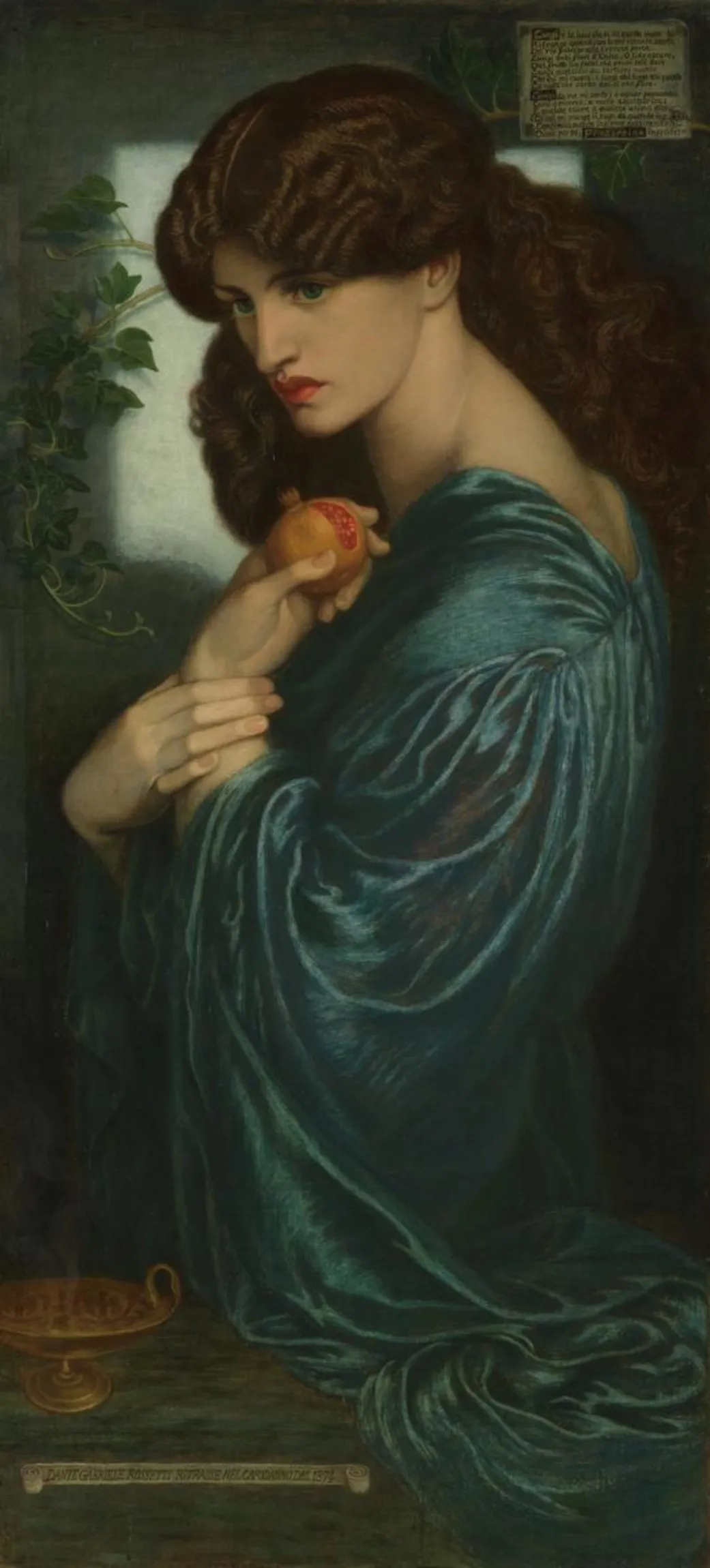
Dante Gabriel Rossetti's Proserpine, dated 1874, belongs to the collection of Tate Britain. The painting shows the goddess of Roman myth holding the pomegranate that bound her to the underworld, a single figure in a quiet, shadowed room. In front of it, you are invited to read a story through small details: a piece of fruit, a patch of light and a few lines of poetry.
Where to see it
Proserpine is in the collection of Tate Britain, and the fact sheet lists its location as Tate Britain. Paintings in a large collection can be moved, rehung, lent to other exhibitions or taken off view for conservation, so check Tate Britain's official website for the work's current display status before you plan your visit. When you find it, allow time to stand both close up and a few steps back. The canvas measures 125.1 cm high by 61 cm wide, and its tall, narrow shape is part of how the picture works.
What to look for in person
The pomegranate
Start with Proserpine's hands. She holds a split pomegranate close to her chest, its red flesh exposed where it has been bitten. In the myth, eating the seeds of this fruit in the underworld meant she had to spend part of every year there with Pluto, away from the world above. Notice how her other hand closes around her wrist, a gesture often read as hesitation or restraint. The warm red of the fruit is one of the few strong accents against her deep blue-green robe, so your eye keeps returning to it.
Light, shadow and ivy
Look past the figure to the wall behind her. A square of light falls across it from an unseen opening, generally read as a glimpse of the upper world she has lost, while she stands in the shadowy interior. Her face is half turned from this brightness. Near her is a small incense burner, an attribute suited to a goddess, with a thin curl of smoke. A branch of ivy creeps along the wall. Rossetti linked ivy with clinging memory, which fits a figure caught between two worlds.
Poem and format
Up in the top right corner, look for a painted scroll carrying lines of verse in Italian. Rossetti was a poet as well as a painter, and he wrote a sonnet on the subject of Proserpine to accompany the picture, so word and image are meant to be read together. Then step back and take in the format: at 125.1 cm high and only 61 cm wide, the tall, narrow canvas presses the figure into a confined space, echoing the sense of a woman held in a place she cannot leave.
About the painting
Dante Gabriel Rossetti was one of the founders of the Pre-Raphaelite Brotherhood, the group of young artists who set out to challenge the conventions of British academic painting around the middle of the nineteenth century. Early Pre-Raphaelite pictures are often crowded with figures and sharp detail. In his later career, Rossetti turned instead to paintings of a single woman shown at half length, surrounded by rich colour, symbolic objects and, often, lines of his own poetry. Proserpine, dated 1874 in the fact sheet, is one of the best-known examples of this later manner. The subject comes from classical myth. Proserpine, the Roman name for the Greek Persephone, was carried off by Pluto, the ruler of the underworld. Because she ate pomegranate seeds there, she was bound to return to him for part of each year, and her absences were linked to the changing seasons. Rossetti chooses the quiet moment after that choice rather than the dramatic abduction, so the picture asks you to reflect rather than to follow an action. The model was Jane Morris, wife of the designer William Morris, whose strong features, dark hair and long neck appear in many of Rossetti's later works. Rossetti worked on the composition over a number of years and produced more than one version of it. For visitors, the painting rewards slow looking: follow the line from the fruit to the light on the wall, then to the poem in the corner, and the elements come together as a single meditation on loss, memory and confinement.
Key facts
| Artist | Dante Gabriel Rossetti |
|---|---|
| Date | 1874 |
| Size | 125.1 × 61 cm |
| Medium | oil paint, canvas |
| Collection | Tate Britain |
How to visit: Tate Britain
London, United Kingdom · Museum guide
| Opening hours | Mon–Sun 10:00–18:00 (galleries start closing at 17:50) |
|---|---|
| Closed | 24–26 December (all Tate galleries, festive period). |
| Last entry | 17:30 |
| Admission | Collection (everyone): free, no booking needed Tate Collective (16–25) exhibition ticket: GBP 5 (free Tate Collective sign-up required) Family child ticket, ages 12–18 (exhibitions): GBP 5 Children 11 and under (exhibitions): free (up to four per parent/guardian) |
| Free entry | The collection is free for everyone. Exhibitions are free for Members, and some exhibitions are free for all (listed as FREE). Disabled visitors pay a concessionary rate; companions go free. |
| Booking | No reservation is required and there is no timed entry. |
The Millbank entrance is closed until 2027 for construction of the Clore Garden; use the Manton Entrance on Atterbury Street.
Official ticket page
Official website
View on map
Hours and prices can change. Please check the official website before you go. (Checked on: 2026-11-09)
More by Dante Gabriel Rossetti
 Ecce Ancilla Domini — Tate Britain
 Beata Beatrix — Tate Britain
 Lady Lilith — Metropolitan Museum of Art
 The Girlhood of Mary Virgin — Tate Britain