Art! Art! Art! › Works
Beata Beatrix
 Dante Gabriel Rossetti, 1872
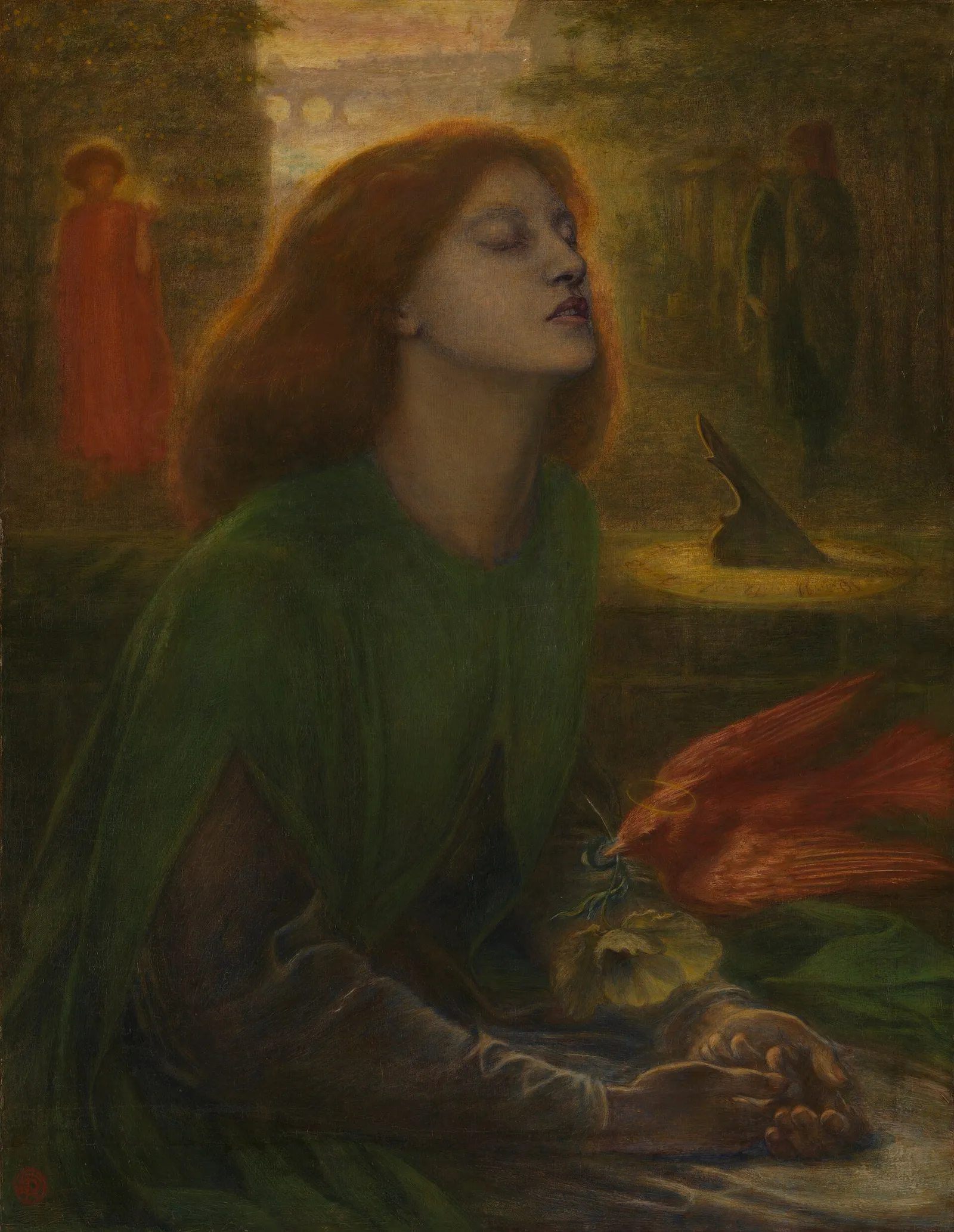
Beata Beatrix is Dante Gabriel Rossetti's image of Beatrice, the woman celebrated by the poet Dante, shown in a trance-like moment between life and death. The model was Elizabeth Siddal, Rossetti's wife, and the painting is widely understood as a memorial to her. It belongs to Tate and is located at Tate Britain.
Where to see it
Beata Beatrix is in the collection of Tate, with Tate Britain given as its location. The collection record also lists the National Gallery, which is best treated as part of the work's collection history rather than a second place to see it. Displays at Tate Britain change, and works may be rotated or lent, so check Tate's official website for the current display status before planning a visit around this painting.
What to look for in person
A face turned inward
Start with Beatrice herself. Her eyes are closed, her head tilts back, and her lips are slightly parted, as if she has stepped out of ordinary awareness. Rossetti does not show a deathbed or any physical suffering; the transition is presented as a kind of spiritual rapture. Notice how the light falls around her head and shoulders, softening the edges of her face and hair. Standing in front of the canvas, you can see how the painter keeps the features calm and still while the surrounding light and colour carry the emotion.
The dove and the poppy
Look at Beatrice's hands, resting in her lap. A red bird, usually identified as a dove, descends towards them carrying a pale poppy. The dove works as a messenger, and the poppy is a flower associated with sleep and death. Many viewers also connect it with laudanum, the opium preparation linked to Elizabeth Siddal's death, which gives this small detail a personal weight. The bird's red tone stands out against the muted greens and greys, so it is worth stepping closer to see how carefully it is placed.
Florence and the figures behind her
Behind Beatrice, the background opens onto a hazy view of a city, generally read as Florence, the home of Dante and Beatrice. Two figures stand in the middle distance: one is commonly identified as Dante, the other as a personification of Love, who in some readings holds a flickering flame. A sundial sits near Beatrice, marking the passing of time. These elements are small and softly painted, so give your eyes a moment to adjust and pick them out of the atmospheric haze.
About the painting
Beata Beatrix, dated 1872 in its collection record, draws on Dante's Vita Nuova, the early work in which the poet describes his love for Beatrice and his grief at her death. Dante Gabriel Rossetti, a founding member of the Pre-Raphaelite Brotherhood, shared his name with the Italian poet and was deeply engaged with his writings, translating them into English. Beatrice became a recurring subject for him.
What gives this painting its particular resonance is its model. Rossetti used the features of Elizabeth Siddal, his wife and long-time muse, who died from an overdose of laudanum. The painting is widely seen as Rossetti's tribute to her, fusing the literary story of Beatrice with his own loss. Rather than showing death directly, he presents Beatrice in a suspended, visionary state, which many viewers read as both mourning and transfiguration.
The picture reflects a shift in Rossetti's art away from the sharp detail of early Pre-Raphaelite painting towards softer, more atmospheric effects. Colour and light are used symbolically: the red of the bird, the glow around Beatrice and the misty city behind her all help create a dreamlike mood. The canvas is a moderate size, with listed dimensions of 66 cm by 86.4 cm, so it rewards close viewing rather than a glance across the room.
When you visit, it helps to read the painting slowly from front to back: first the face, then the hands with the dove and poppy, then the sundial, and finally the figures and the city in the distance. Each layer adds to the sense of a single moment held still.
Key facts
| Artist | Dante Gabriel Rossetti |
|---|---|
| Date | 1872 |
| Size | 66 × 86.4 cm |
| Medium | oil paint, canvas |
| Collection | Tate / Tate Britain / National Gallery |
How to visit: Tate Britain
London, United Kingdom · Museum guide
| Opening hours | Mon–Sun 10:00–18:00 (galleries start closing at 17:50) |
|---|---|
| Closed | 24–26 December (all Tate galleries, festive period). |
| Last entry | 17:30 |
| Admission | Collection (everyone): free, no booking needed Tate Collective (16–25) exhibition ticket: GBP 5 (free Tate Collective sign-up required) Family child ticket, ages 12–18 (exhibitions): GBP 5 Children 11 and under (exhibitions): free (up to four per parent/guardian) |
| Free entry | The collection is free for everyone. Exhibitions are free for Members, and some exhibitions are free for all (listed as FREE). Disabled visitors pay a concessionary rate; companions go free. |
| Booking | No reservation is required and there is no timed entry. |
The Millbank entrance is closed until 2027 for construction of the Clore Garden; use the Manton Entrance on Atterbury Street.
Official ticket page
Official website
View on map
Hours and prices can change. Please check the official website before you go. (Checked on: 2026-11-09)
More by Dante Gabriel Rossetti
 Ecce Ancilla Domini — Tate Britain
 Lady Lilith — Metropolitan Museum of Art
 The Girlhood of Mary Virgin — Tate Britain
 Proserpine — Tate Britain