Art! Art! Art! › Works
Lady Lilith
 Dante Gabriel Rossetti, 1866
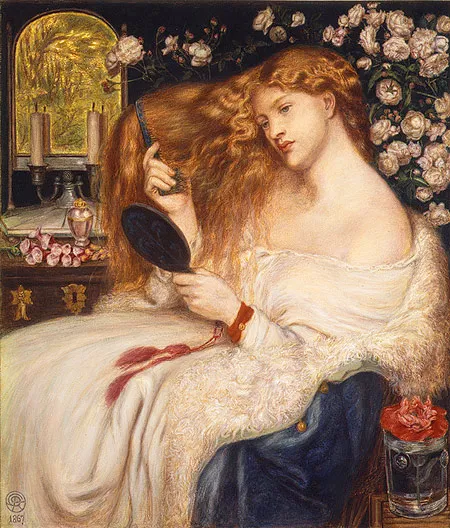
Lady Lilith is Dante Gabriel Rossetti's image of a woman absorbed in combing her long hair while she studies her own reflection. The work, dated 1866, is in the collection of the Metropolitan Museum of Art. It is a key example of the Pre-Raphaelite painter's later interest in beauty, self-regard and the allure of the femme fatale.
Where to see it
Lady Lilith is held by the Metropolitan Museum of Art, which is also listed as its location. Works on paper and paintings can be rotated off view, lent to other institutions or moved between galleries. Check the Metropolitan Museum of Art's official website for current display status before you visit. If you are making a special trip for this work, consider contacting the museum directly.
What to look for in person
The hair and the mirror
Start with the central action. Lilith draws a comb through a great mass of golden hair and gazes into a hand mirror rather than out at the viewer. Notice how her attention is turned entirely inward. In Jewish folklore Lilith was Adam's first wife, and Rossetti associated her hair with the power to ensnare. Take a moment to follow the flowing strands across the composition. They are both a decorative pattern and the main carrier of the picture's meaning.
Flowers as symbols
Look closely at the flowers around the figure. Rossetti filled the setting with blooms, and pale roses are especially prominent. Victorian viewers were used to reading flowers as coded symbols, and here they suggest sensual beauty that is tempting and possibly dangerous. Compare the cool tones of the blossoms with the warm skin and hair of the sitter. The surrounding flowers press close and enclose her, which adds to the airless, self-contained mood of the scene.
A picture paired with words
Rossetti was a poet as well as a painter, and he wrote the sonnet later titled "Body's Beauty" to accompany this subject. The poem describes Lilith as a figure whose beauty binds and destroys those drawn to her. As you look, notice how the painting avoids any explicit story. It offers a single, quiet moment of self-absorption. Text and image were meant to work together, so reading the sonnet before your visit can deepen what you see.
About the painting
Dante Gabriel Rossetti was a founding member of the Pre-Raphaelite Brotherhood, the group of young English artists who in the late 1840s rejected academic conventions in favour of intense colour, close observation and literary subjects. By the 1860s his work had moved away from the crowded medieval narratives of his early career. He turned instead to large, close-up images of single women, often surrounded by flowers, fabrics and symbolic objects. Lady Lilith, dated 1866, belongs to this phase. Rossetti took his subject from Jewish tradition, in which Lilith is described as Adam's first wife, a figure later linked with seduction and danger. He gives no setting from that story. Instead he presents a contemporary-looking woman at her toilette, combing her hair and studying her reflection. The meaning lies in the mood rather than in any narrative. Rossetti pairs physical beauty with a hint of menace, and the figure's self-absorption shuts the viewer out. The work measures 96.5 by 85.1 centimetres according to the fact sheet, a substantial size that lets the hair, skin and flowers fill much of the surface. Rossetti also wrote a sonnet on the theme, reflecting his habit of developing subjects in both poetry and paint. For visitors, the picture is best approached slowly. Notice the contrast between the lavish surface details and the stillness of the pose. Ask how the mirror, the comb and the flowers shape your sense of who this woman is. Lady Lilith offers a clear view of Rossetti's mature style and of Victorian ideas about beauty and power.
Key facts
| Artist | Dante Gabriel Rossetti |
|---|---|
| Date | 1866 |
| Size | 96.5 × 85.1 cm |
| Medium | oil paint, canvas |
| Collection | Metropolitan Museum of Art |
How to visit: Metropolitan Museum of Art
New York City, United States · Museum guide
| Opening hours | Sun, Mon, Tue, Thu 10:00–17:00 Fri, Sat 10:00–21:00 |
|---|---|
| Closed | Wednesdays; Thanksgiving Day, 25 December, 1 January and the first Monday in May |
| Admission | Adults USD 30 Seniors (65 and over) USD 22 Visitors with a disability (in person only) USD 22 Students USD 17 Children (12 and under) free Care partners of visitors with a disability (in person only) free New York State residents; NY, NJ and CT students: pay what you wish (minimum USD 0.01). Online requires a NY State billing address; NJ/CT students in person with student ID |
| Free entry | Free for children 12 and under, Members and Patrons, and care partners of visitors with a disability. Pay what you wish for New York State residents and NY/NJ/CT students. |
| Booking | No reservation is required and there is no timed entry. |
The Cantor Roof Garden, the Modern and Contemporary Galleries, and the Ancient West Asia and Ancient Cyprus Galleries are closed for renovation.
Official ticket page
Official website
View on map
Hours and prices can change. Please check the official website before you go. (Checked on: 2026-11-09)
More by Dante Gabriel Rossetti
 Ecce Ancilla Domini — Tate Britain
 Beata Beatrix — Tate Britain
 The Girlhood of Mary Virgin — Tate Britain
 Proserpine — Tate Britain