Art! Art! Art! › Works
The Geographer
 Johannes Vermeer, 1668
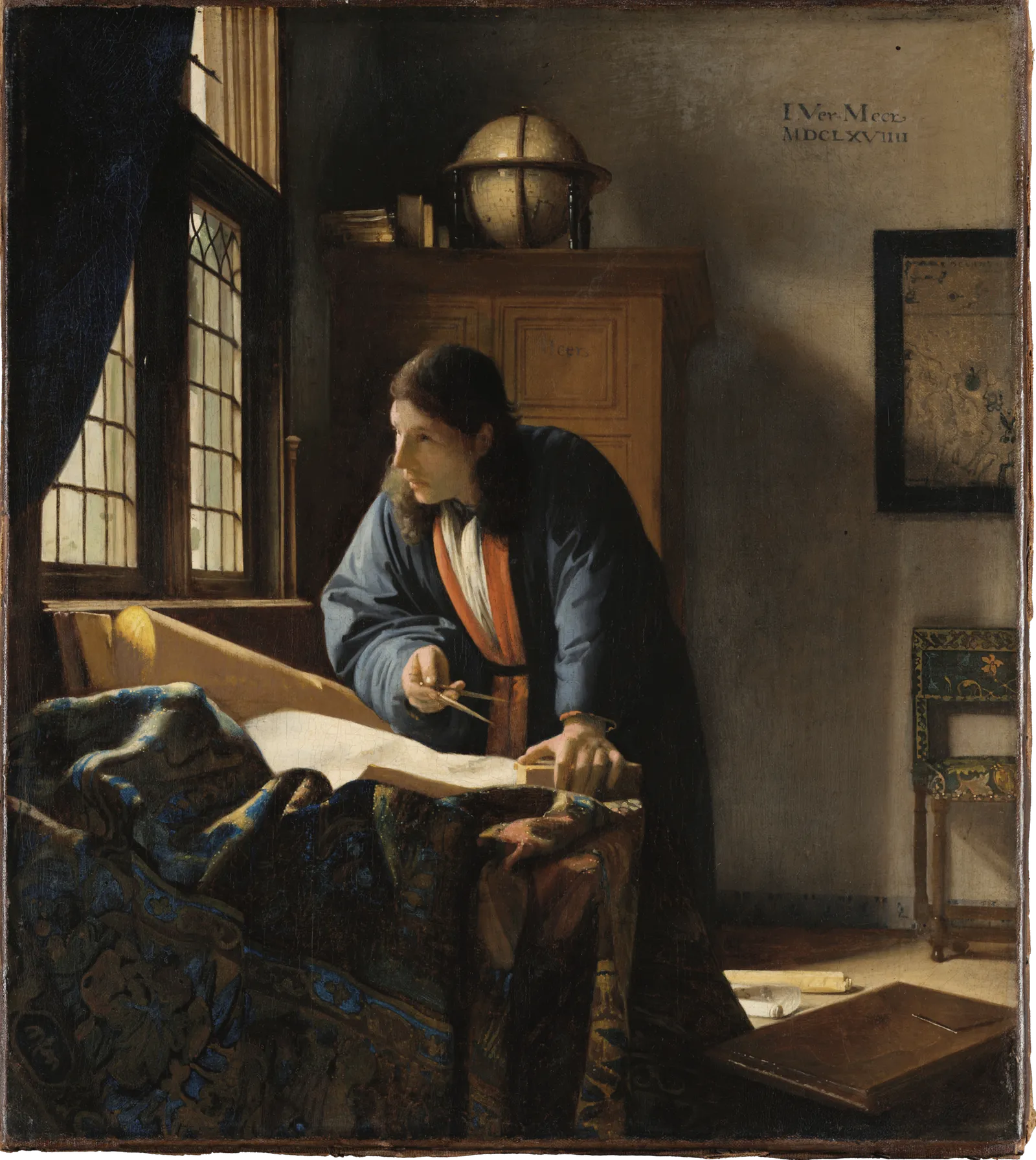
Johannes Vermeer's The Geographer, dated 1668, belongs to the collection of the Städel Museum. This modest canvas, 51.6 by 45.4 centimetres, shows a scholar pausing at his work in a quiet, light-filled room. It rewards a slow, close look.
Where to see it
The Geographer is held by the Städel Museum. Works in a permanent collection can be moved, lent or taken off view, so check the Städel Museum's official website for current display status before you visit.
What to look for in person
The pause before the next thought
Notice the moment Vermeer chose. The geographer is not caught mid-task. He has stopped with a pair of dividers in his hand and turns his gaze up toward the window, as if an idea has just come to him. One hand rests on the table and his body leans forward, so the stillness feels active rather than posed. Standing in front of the canvas, follow the line from his hand to his face to the window. That path through the picture is the real subject: thinking, made visible.
Light from the left
Like many of Vermeer's interiors, the scene is lit by daylight entering through a window on the left. Watch how the light falls unevenly. It brightens the geographer's face and robe, slides across the papers on the table, and fades into soft shadow toward the back wall. Look closely at the edges of objects, where light and shade meet. Vermeer often softened these transitions rather than outlining forms sharply. The canvas is small, so step close to see how a few touches of paint suggest a gleam or a fold.
The tools of a learned trade
The room is filled with objects that tell you who this man is. A globe sits high on a cabinet behind him, rolled charts and papers lie near his feet and on the furniture, and a map hangs on the back wall. A heavy patterned cloth covers the table in front of him. Together these details place him among the map-makers and scholars of the Dutch Republic, at a time when trade and navigation made geography a practical and prestigious field. Take time to pick out each item and see how Vermeer arranged them around the figure.
About the painting
The Geographer is a painting by Johannes Vermeer, dated 1668 and now in the collection of the Städel Museum. It measures 51.6 by 45.4 centimetres, which places it among the artist's intimate, domestic-scale works rather than large public pictures. Vermeer is known for a relatively small surviving body of work, much of it showing figures absorbed in quiet activity inside sunlit rooms, and this painting fits that pattern closely.
The subject is a single man working with maps. He wears a long, loose robe and holds a pair of dividers, an instrument used to measure distances on charts. Around him are the materials of his profession: a globe, unrolled papers, a wall map and a richly patterned table covering. The painting presents learning as something calm and contemplative, and it reflects the importance of geography and navigation in the seventeenth-century Netherlands.
The Geographer is widely regarded as a companion to another Vermeer painting, The Astronomer, which shows a similar scholar in a similar room studying a celestial globe. The two pictures share a format, mood and subject matter, and seeing one helps you understand the other.
When you visit, give yourself time. The painting is not large, and much of its effect lies in small things: the fall of light across cloth, the reflections on objects, the turn of the head toward the window. Look first from a few steps back to take in the composition, then move closer to study the surfaces. Compare the bright foreground with the dimmer corners, and notice how the window light ties the whole room together.
Key facts
| Artist | Johannes Vermeer |
|---|---|
| Date | 1668 |
| Size | 51.6 × 45.4 cm |
| Medium | oil paint, canvas |
| Collection | Städel Museum |
How to visit: Städel Museum
Frankfurt, Germany
Hours and prices can change. Please check the official website before you go.
More by Johannes Vermeer
 The Concert
 The Girl with the Wine Glass
 The Lacemaker — Louvre Museum
 Girl Interrupted at her Music — The Frick Collection
 Woman with a Pearl Necklace — Gemäldegalerie Berlin
 Woman in Blue Reading a Letter — Rijksmuseum
 The Milkmaid — Rijksmuseum
 Girl with a Pearl Earring — Mauritshuis
 A Young Woman seated at a Virginal — National Gallery
 The Music Lesson
 A Young Woman Standing at a Virginal — National Gallery
 Diana and her Nymphs — Mauritshuis