Art! Art! Art! › Works
The Astronomer
 Johannes Vermeer, 1664
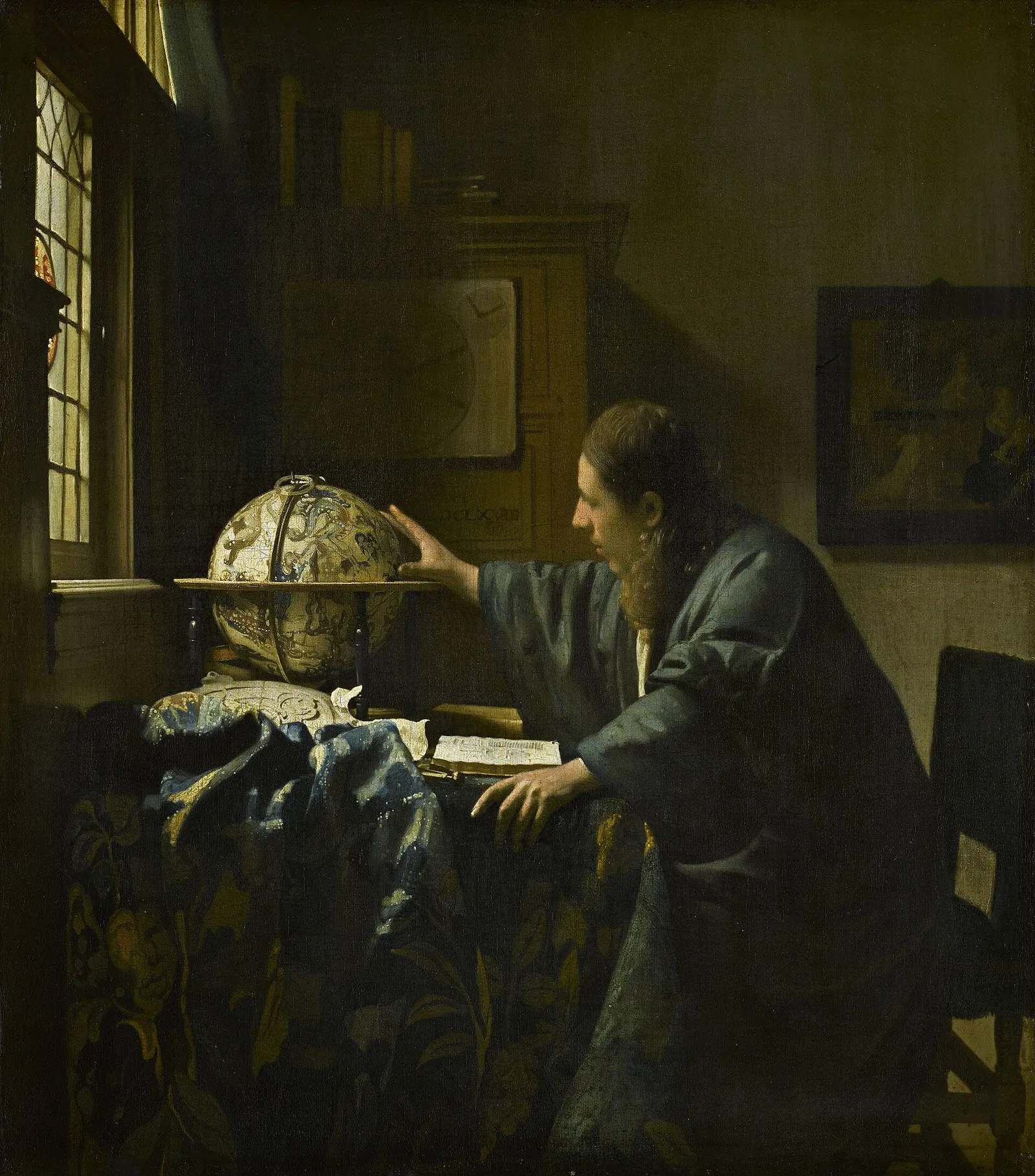
Johannes Vermeer's The Astronomer shows a scholar at his desk, one hand reaching toward a celestial globe as daylight falls across the room. The painting belongs to the Department of Paintings of the Louvre and is held at the Louvre Museum in Paris. It is a small, quiet picture that rewards slow, close looking.
Where to see it
The Astronomer is held at the Louvre Museum, in the collection of the Department of Paintings of the Louvre. Paintings can be moved, rehung, lent to other institutions or temporarily withdrawn for conservation, so check the Louvre's official website for the painting's current display status and for opening hours and ticketing before you visit. The canvas measures 50.8 cm high by 46.3 cm wide, so it is easy to miss in a busy gallery; allow time to stand close and look at the details.
What to look for in person
The hand on the globe
Start with the gesture at the centre of the picture. The astronomer leans forward from his chair and stretches one hand toward a celestial globe, the kind used to map the constellations, while his other hand rests on the table's edge. Vermeer catches a moment of thought rather than action: the man is not measuring or writing, but turning his attention to the sky as it was represented on the globe. Notice how the light from the window picks out his fingers and the curved surface of the globe at the same time.
Light from the window
As in many of Vermeer's interiors, daylight enters from a window on the left. Look at how it moves through the room: bright on the scholar's face and robe, softer on the wall behind him, and fading into shadow at the right. The leaded glass of the window itself is partly visible. Step back to see the overall fall of light, then step closer to see how Vermeer builds it from small, controlled touches of paint on the fabrics, the wood and the globe.
Objects on the table and wall
Take time over the still life on the desk. A heavy patterned cloth is pushed up into folds across the table, and an open book and scientific instruments lie among them. These objects tell you that this is a man of learning working with the tools of his field. On the back wall hangs a framed picture within the picture, and a cabinet stands beside him. Vermeer uses these surfaces, textiles, paper, metal and wood, to show his close attention to texture.
About the painting
The Astronomer is a painting by the Dutch artist Johannes Vermeer, dated 1664 on the fact sheet used for this page. It measures 50.8 cm in height and 46.3 cm in width and is part of the Department of Paintings of the Louvre, held at the Louvre Museum in Paris.
The subject is a scholar alone in a room, absorbed in study. He wears a long, loose robe and sits at a table covered with a thick patterned cloth. In front of him is a celestial globe, and nearby lie an open book and instruments associated with astronomy. The figure is caught in a moment of concentration rather than dramatic action, which is typical of Vermeer's approach: ordinary interior scenes given a sense of stillness through careful composition and light.
The painting reflects a wider interest in science, navigation and learning in the Dutch Republic of the seventeenth century, when globes, maps and instruments were prized objects. Vermeer often included maps and globes in his interiors, and here the globe becomes the focus of the whole scene.
The Astronomer is widely discussed together with Vermeer's painting The Geographer, which shows a similar scholar in a comparable room and is generally regarded as a companion piece. Seeing The Astronomer in person allows you to appreciate how Vermeer balances the dark mass of the robe and table cloth against the pale wall and the soft window light.
For visitors, the best approach is to look twice: first from a few steps back to take in the composition and the direction of light, then up close to study the rendering of fabric, paper and the globe's surface.
Key facts
| Artist | Johannes Vermeer |
|---|---|
| Date | 1664 |
| Size | 50.8 × 46.3 cm |
| Medium | oil paint, canvas |
| Collection | Department of Paintings of the Louvre |
| Gallery | Room 837, Richelieu wing, level 2 Checked in the museum's open data on 2026-11-12 (galleries can change) Source |
How to visit: Louvre Museum
Paris, France · Museum guide
| Opening hours | Mon, Thu, Sat, Sun 09:00–18:00 Wed, Fri 09:00–21:00 (evening opening) Rooms are cleared 30 minutes before closing |
|---|---|
| Closed | Every Tuesday; 1 January, 1 May and 25 December. Other public holidays are open unless they fall on a Tuesday. |
| Last entry | 1 hour before closing |
| Admission | Adult (non-EEA visitors) EUR 32 Adult (EEA citizens and residents) EUR 22 Under 18 free (ID required) EEA citizens/residents under 26 free (photo ID; residents also need a residence permit of over 90 days) Audio guide rental EUR 6 (can be booked in advance online) Rates apply from 14 January 2026 |
| Free entry | Free for under-18s, EEA citizens/residents under 26, all visitors on the first Friday of the month after 18:00 (except July and August) and on 14 July, and disabled visitors plus one carer. Also free with proof for EEA art and art-history teachers, ICOM members, journalists, EEA job seekers and EEA residents on income support. |
| Booking | Entry is by timed slot, and booking in advance is recommended. |
The Cour Carrée entrance is currently closed. On Thursday 12 November 2026 the museum may open later and some exhibition rooms may remain closed.
Official ticket page
Official website
View on map
Hours and prices can change. Please check the official website before you go. (Checked on: 2026-11-11)
More by Johannes Vermeer
 The Concert
 The Girl with the Wine Glass
 The Lacemaker — Louvre Museum
 Girl Interrupted at her Music — The Frick Collection
 Woman with a Pearl Necklace — Gemäldegalerie Berlin
 Woman in Blue Reading a Letter — Rijksmuseum
 The Milkmaid — Rijksmuseum
 Girl with a Pearl Earring — Mauritshuis
 A Young Woman seated at a Virginal — National Gallery
 The Music Lesson
 A Young Woman Standing at a Virginal — National Gallery
 Diana and her Nymphs — Mauritshuis