Art! Art! Art! › Works
The Art of Painting
 Johannes Vermeer, 1660s
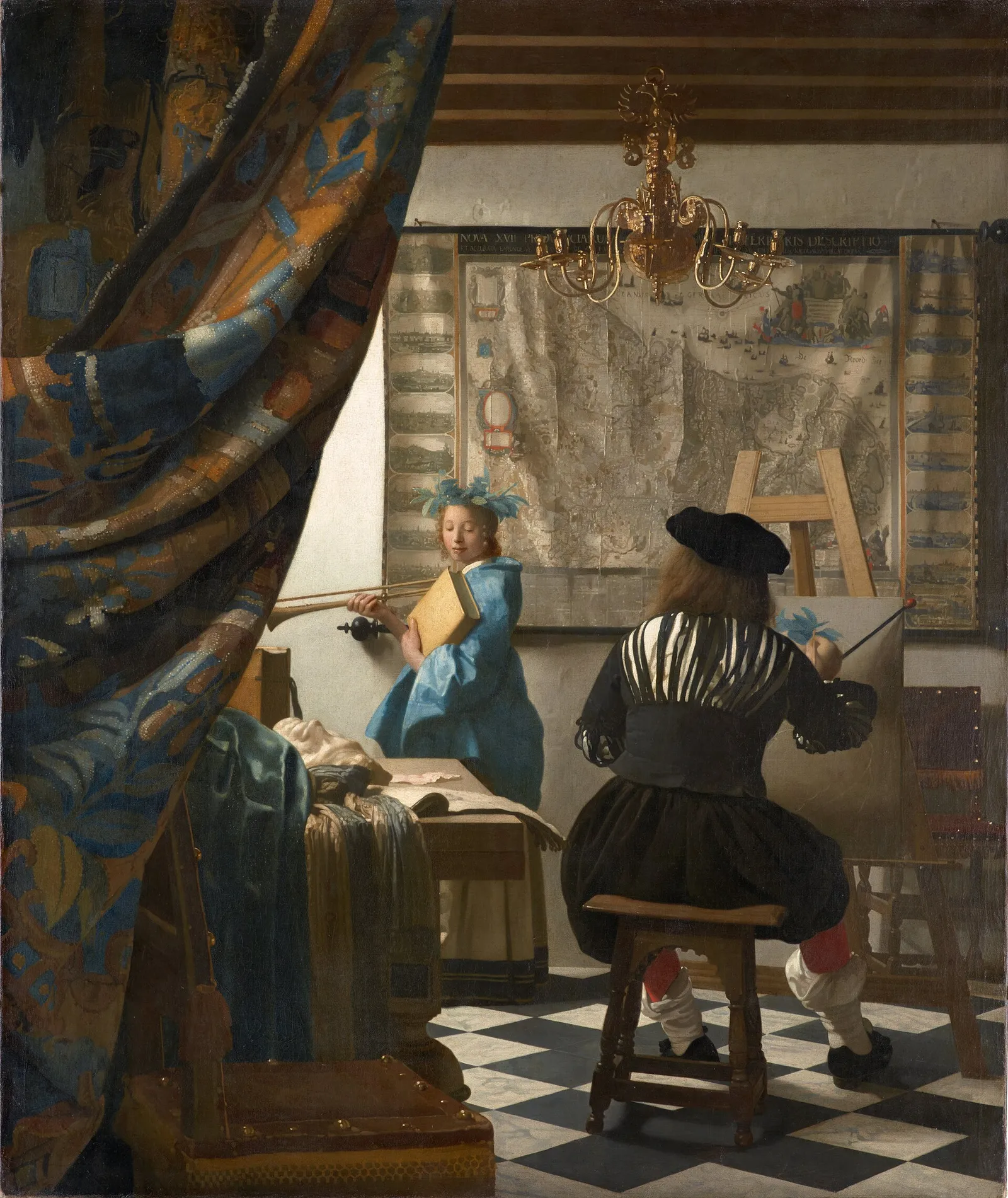
The Art of Painting by Johannes Vermeer belongs to the collection of the Kunsthistorisches Museum. Made in the 1660s and measuring 120 by 100 cm, it is one of Vermeer's larger pictures. It shows a painter, seen from behind, at work on a portrait of a young woman dressed as an allegorical figure.
Where to see it
The Art of Painting is held by the Kunsthistorisches Museum, which is listed as both its collection and its location. Display arrangements can change, so check the museum's official website for current display status, opening hours and ticket information before you visit. At 120 by 100 cm, the picture rewards two kinds of looking: a view from a few steps back to take in the whole stage-like room, and a closer look at details such as the map, the model's attributes and the painter's work in progress.
What to look for in person
A curtain drawn back like a stage
Start at the left edge. A heavy patterned tapestry hangs in the foreground and has been pulled aside, as if you have just been allowed into the room. Behind it a chair stands in the way, so the studio feels close but separate from you. Follow the black-and-white floor tiles inward and notice how they lead your eye to the easel. The light enters from the left, from a window hidden by the curtain, and falls across the model, the map and the table.
The model as Clio
The young woman wears a laurel wreath, holds a trumpet and carries a large book. Art historians widely identify her as Clio, the muse of history, following the attributes given in emblem handbooks of the period. Look at her lowered eyes and careful pose: she is clearly posing rather than caught in a moment. Then turn to the easel, where the painter has only just begun, sketching in the outline and painting the leaves of her wreath first.
The map on the back wall
The large wall map of the Netherlands fills much of the background. Look closely and you will see the folds and creases of its paper, catching the light, and small city views running along its side borders. Vermeer gives its surface as much attention as the figures. Look also along the map's lower edge near the model, where the artist's signature appears. The map is often read as a reference to the history of the Low Countries, linking it with Clio's role as muse of history.
About the painting
The Art of Painting, also known as The Allegory of Painting, is a picture about painting itself. Johannes Vermeer shows an artist in a studio, his back turned to us, dressed in a dark slashed doublet and a beret, a costume generally seen as old-fashioned for its time. He sits at his easel with a mahlstick, studying a model who poses as Clio, the muse of history, with a wreath, trumpet and book.
Rather than a record of a real working day, the scene is usually understood as an allegory: the painter brings history and fame together through his art. Objects on the table, including what appears to be a plaster mask and a large book, add to this sense of a carefully arranged statement. Unlike many of Vermeer's interiors, which show people absorbed in quiet domestic tasks, this picture presents an idea, staged with the curtain, the map and the falling light.
The painting is widely believed to have had special importance for Vermeer. It appears to have stayed with his family after his death, and his widow tried to keep it from being sold to settle debts. Its later history involved several owners before it came to the Kunsthistorisches Museum, which holds it today.
For visitors, it is worth spending time on contrasts: the soft focus of the foreground tapestry against the crisp map, the painter's half-finished work against the finished room around him, and the stillness of the whole scene. The picture was made in the 1660s and measures 120 by 100 cm.
Key facts
| Artist | Johannes Vermeer |
|---|---|
| Date | 1660s |
| Size | 120 × 100 cm |
| Medium | oil paint, canvas |
| Collection | Kunsthistorisches Museum |
How to visit: Kunsthistorisches Museum
Vienna, Austria · Museum guide
| Opening hours | Mon–Wed, Fri–Sun 10:00–18:00 Thu 10:00–21:00 (late opening) 24 December 10:00–15:00 31 December 10:00–21:00 |
|---|---|
| Closed | Open daily with no regular closing day. Rooms 24, VIII, 14 and IX are currently closed. |
| Admission | Adult (online) EUR 22 (EUR 24 on site) Reduced (online) EUR 19 (EUR 20 on site; EUR 23 with Vienna City Card) Under 19 free (registered at the entrance, no online booking needed) Combined Ticket “Habsburg Treasures” EUR 32 Masterticket EUR 37 |
| Free entry | Free for under-19s and accredited media (register 2 working days ahead). |
| Booking | Reservation is required, with timed entry. |
Official ticket page
Official website
View on map
Hours and prices can change. Please check the official website before you go. (Checked on: 2026-11-09)
More by Johannes Vermeer
 The Concert
 The Girl with the Wine Glass
 The Lacemaker — Louvre Museum
 Girl Interrupted at her Music — The Frick Collection
 Woman with a Pearl Necklace — Gemäldegalerie Berlin
 Woman in Blue Reading a Letter — Rijksmuseum
 The Milkmaid — Rijksmuseum
 Girl with a Pearl Earring — Mauritshuis
 A Young Woman seated at a Virginal — National Gallery
 The Music Lesson
 A Young Woman Standing at a Virginal — National Gallery
 Diana and her Nymphs — Mauritshuis