Art! Art! Art! › Works
Saint Praxedis
 Johannes Vermeer, 1655
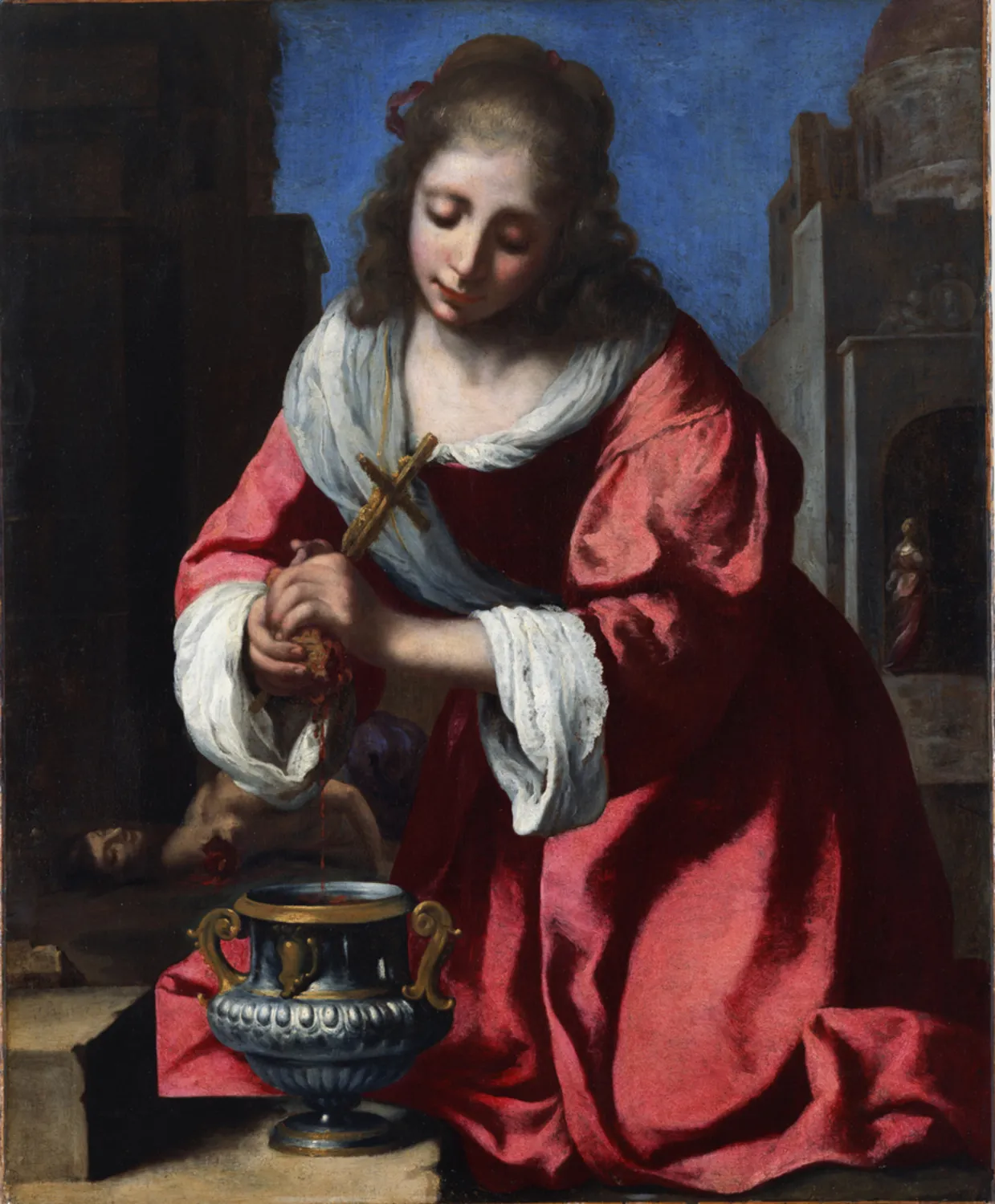
Saint Praxedis is a religious painting dated 1655 and attributed to Johannes Vermeer, recorded at the National Museum of Western Art. It shows an early Christian saint quietly tending to the remains of martyrs, which is very different from the domestic interiors Vermeer is known for. That contrast is the main reason to see it in person.
Where to see it
Saint Praxedis is recorded in the collection of the National Museum of Western Art, which is also given as its location. Display arrangements can change, so check the museum's official website for current display status before you plan your visit.
What to look for in person
The sponge and the vessel
Start with the saint's hands. Praxedis presses a sponge, and the liquid falls into a vessel at her side. In Christian tradition she collected the blood of martyrs, so this small action carries the meaning of the whole picture. Notice how calm the gesture is. There is no drama in her face or posture; the painter presents a solemn act of devotion rather than a scene of violence. Stand close enough to follow the line from her hands down to the container.
The martyrdom in the background
Look past the kneeling saint to the space behind her. The setting refers to the martyrdom whose aftermath she is attending to, and it places her act of care in a story. The background is quieter and less detailed than the foreground, which keeps your attention on Praxedis herself. Shift your eye back and forth between near and far to see how the composition moves from the event to the response. This layering is typical of religious painting made for contemplation.
Scale and surface
At 101.6 by 82.6 centimetres, this is a fairly large canvas when set beside the small interiors most visitors associate with Vermeer. Take a step back first to see the figure as a whole, then move closer to study the handling of the drapery and the fall of light across the saint's face and hands. Compare what you see with any Vermeer works you know. Asking yourself whether this looks like the same painter is a natural part of looking at this picture.
About the painting
Saint Praxedis is dated 1655, which would place it at the very start of Johannes Vermeer's known career, before the quiet domestic scenes that later made his name. It measures 101.6 by 82.6 centimetres and is recorded at the National Museum of Western Art.
The subject is Praxedis, an early Christian saint venerated in Rome. According to tradition, she cared for persecuted Christians and gathered the blood of martyrs. The painting shows her at that task, kneeling and wringing a sponge into a vessel. The mood is still and reverent rather than violent.
The work is widely understood to be based on a composition by the Florentine painter Felice Ficherelli. Copying a respected Italian model was a common way for young painters to train, and that fits with the picture's early date. It is also a reminder that Vermeer's early ambitions seem to have included religious and history painting, a more prestigious category at the time than scenes of daily life.
The attribution to Vermeer has been debated for decades. Some scholars accept it and others question it, and visitors should know that its place in his body of work is not settled. You do not need to resolve that question to enjoy the painting. Look at it as a careful and devout image in its own right, and then think about how it relates to the Delft painter who later became famous for light-filled rooms and absorbed, quiet figures.
Key facts
| Artist | Johannes Vermeer |
|---|---|
| Date | 1655 |
| Size | 101.6 × 82.6 cm |
| Medium | oil paint, canvas |
| Collection | National Museum of Western Art |
How to visit: National Museum of Western Art
Tokyo, Japan
Hours and prices can change. Please check the official website before you go.
More by Johannes Vermeer
 The Concert
 The Girl with the Wine Glass
 The Lacemaker — Louvre Museum
 Girl Interrupted at her Music — The Frick Collection
 Woman with a Pearl Necklace — Gemäldegalerie Berlin
 Woman in Blue Reading a Letter — Rijksmuseum
 The Milkmaid — Rijksmuseum
 Girl with a Pearl Earring — Mauritshuis
 A Young Woman seated at a Virginal — National Gallery
 The Music Lesson
 A Young Woman Standing at a Virginal — National Gallery
 Diana and her Nymphs — Mauritshuis