Art! Art! Art! › Works
Christ in the House of Martha and Mary
 Johannes Vermeer, 1650s
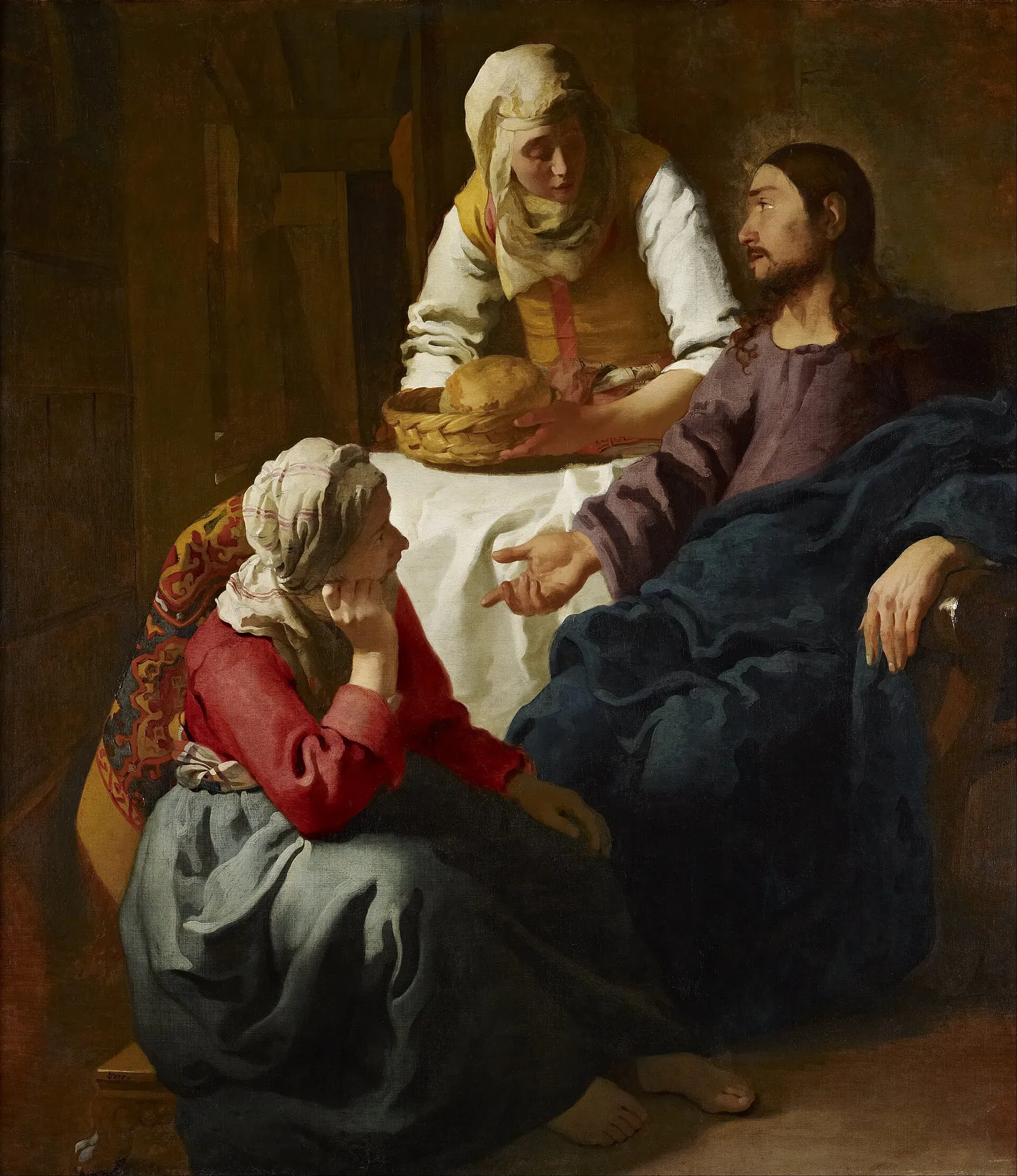
Christ in the House of Martha and Mary is an early religious painting by Johannes Vermeer, dating from the 1650s and held by the Scottish National Gallery. Measuring 158.5 by 141.5 cm, it shows a side of the artist that many visitors do not expect from the painter of quiet Dutch interiors.
Where to see it
The painting is in the collection of the Scottish National Gallery. Works can be moved, lent or taken off view for conservation, so check the Scottish National Gallery's official website for current display status, opening hours and any ticketing details before you plan your visit.
What to look for in person
Follow Christ's gesture
Start at the centre of the picture. Christ sits and turns his head toward Martha, who leans over him holding a basket of bread, while his hand points down toward Mary seated at his feet. This gesture carries the story from the Gospel of Luke, in which Martha complains that her sister leaves her to serve alone and Christ answers that Mary has chosen the better part. Trace the line from his face to his hand to Mary, and you follow the meaning of the scene in one movement.
Two sisters, two kinds of devotion
Compare the two women. Martha stands and bends forward, her attention on the work of serving; Mary sits low, resting her head on her hand, absorbed in listening. The painting places active work beside quiet contemplation, a contrast Christian tradition has long drawn from this episode. Notice how the three heads are grouped closely together, so the exchange feels like a private conversation rather than a staged event. Step back and you will see how much of the canvas the figures occupy, bringing the scene close to you.
An early Vermeer on a large scale
If you know Vermeer from his calm domestic interiors, this canvas may surprise you. Dating from the 1650s, it belongs to his early career, when he painted religious and mythological subjects. At 158.5 by 141.5 cm it is much larger than the interiors for which he is best known, and the handling is broader, with bold folds of drapery and strong blocks of colour. Look at the white tablecloth and the heavy fabrics to see how he worked with paint before developing his later, more finely detailed manner.
About the painting
Johannes Vermeer is remembered today mainly for small, carefully lit scenes of everyday life, but his earliest known works took a different path. Christ in the House of Martha and Mary, dated to the 1650s, is a history painting: a scene drawn from scripture, the kind of subject that was considered a serious ambition for a painter at the time. The story comes from the Gospel of Luke. Christ visits the home of two sisters. Martha busies herself with serving, while Mary sits at his feet to listen. When Martha asks him to tell her sister to help, Christ replies that Mary has chosen the better part. Vermeer reduces the episode to its essentials: three figures, a table, a basket of bread and a dim interior. There are few distractions, so the meaning rests on posture and gesture. For visitors, the painting is a useful way to see how Vermeer's art began. The large format, measuring 158.5 by 141.5 cm, and the broad treatment of cloth and flesh differ clearly from the compact, luminous interiors of his later years. Yet some interests that run through his career are already visible, such as figures absorbed in thought and a strong sense of light falling across fabric and faces. Give yourself time in front of it. Look first at the group as a whole, then at each figure in turn, and finally at the details of the table and the bread basket. The painting rewards slow viewing rather than a quick glance on the way to other rooms.
Key facts
| Artist | Johannes Vermeer |
|---|---|
| Date | 1650s |
| Size | 158.5 × 141.5 cm |
| Medium | oil paint, canvas |
| Collection | Scottish National Gallery |
How to visit: National Gallery
London, United Kingdom · Museum guide
| Opening hours | Mon–Thu, Sat, Sun 10:00–18:00 Fri 10:00–21:00 (Friday late) |
|---|---|
| Closed | 24–26 December and 1 January. |
| Admission | General admission (collection) free; donations invited Some exhibitions are charged (e.g. Renoir and Love, until 31 Jan 2027) |
| Free entry | General admission is always free. |
| Booking | No reservation or timed entry is required. Free timed booking gives fast-track entry. |
Building work and improvements are under way: some rooms are closed and some paintings have moved, so check the floorplans or collection search before visiting. A new Research Centre is due to open in 2028. On 17 November only, some east wing rooms and the Espresso Bar close from 16:00.
Official ticket page
Official website
View on map
Hours and prices can change. Please check the official website before you go. (Checked on: 2026-11-11)
More by Johannes Vermeer
 The Concert
 The Girl with the Wine Glass
 The Lacemaker — Louvre Museum
 Girl Interrupted at her Music — The Frick Collection
 Woman with a Pearl Necklace — Gemäldegalerie Berlin
 Woman in Blue Reading a Letter — Rijksmuseum
 The Milkmaid — Rijksmuseum
 Girl with a Pearl Earring — Mauritshuis
 A Young Woman seated at a Virginal — National Gallery
 The Music Lesson
 A Young Woman Standing at a Virginal — National Gallery
 Diana and her Nymphs — Mauritshuis