Art! Art! Art! › Works
Allegory of the Catholic Faith
 Johannes Vermeer, 1670s
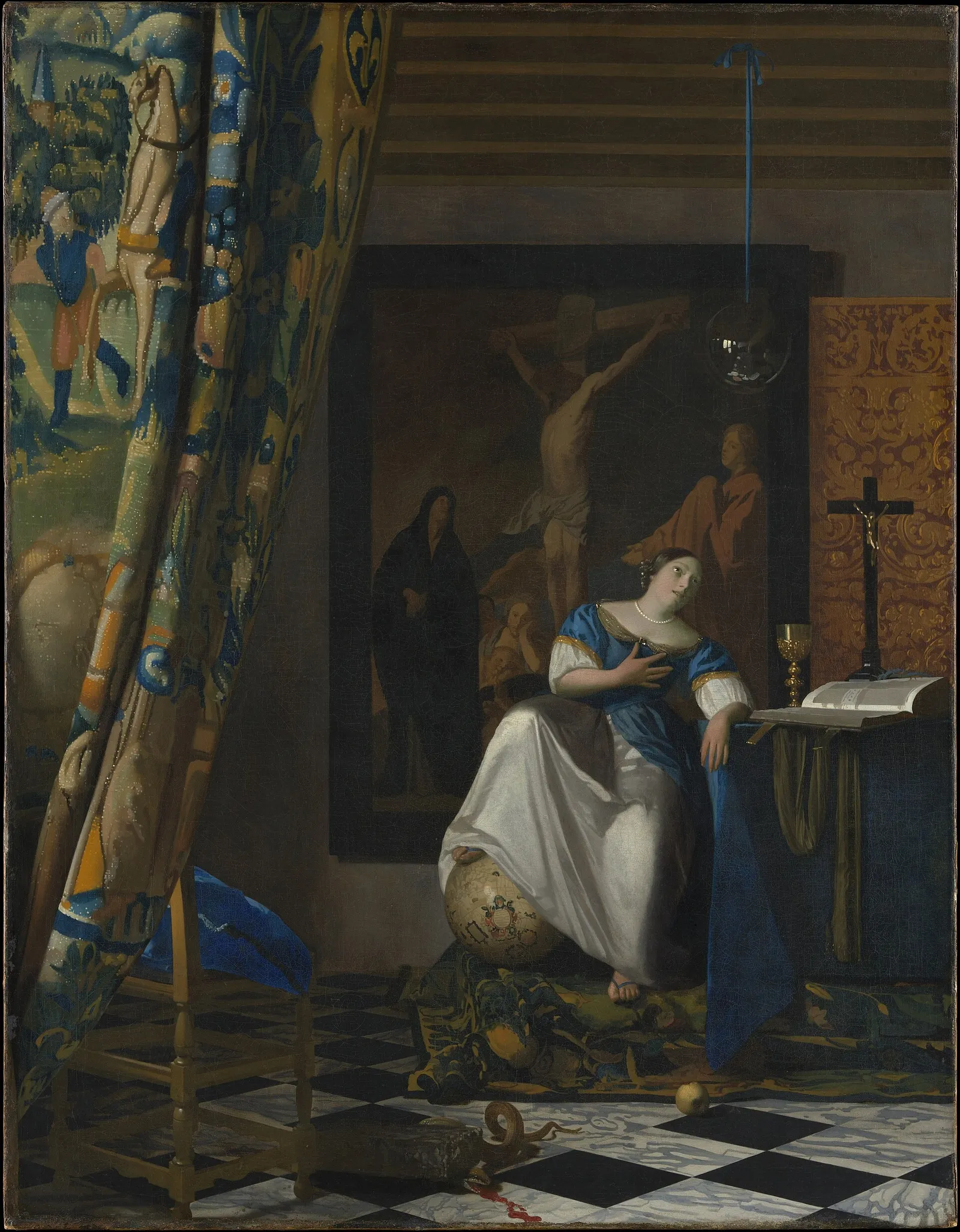
Allegory of the Catholic Faith is a late painting by Johannes Vermeer, dated to the 1670s and held by the Metropolitan Museum of Art. Unlike his quiet scenes of daily life, it is a deliberately symbolic picture, in which a single woman in a carefully staged room stands for the Catholic faith.
Where to see it
The painting is in the collection of the Metropolitan Museum of Art, which is also its listed location. Works are sometimes moved, rehung or taken off view, so check the Metropolitan Museum of Art's official website for the painting's current display status before you plan your visit.
What to look for in person
The woman and the hanging glass sphere
Start with the central figure. She sits with one hand pressed to her breast and her foot resting on a terrestrial globe, her eyes turned upward. Follow her gaze to the small glass sphere hanging from a ribbon above her, which reflects the surrounding room. Look closely at how Vermeer paints the light inside the glass and on her white and blue satin dress. The pose is theatrical by his usual standards, and that contrast with his calmer figures is part of what makes the picture worth studying in person.
The Crucifixion and the altar-like table
Behind the woman hangs a large painting of the Crucifixion, a picture within the picture that sets the religious theme for the whole room. Beneath it, the table works almost like an altar: look for the chalice, the open book and the crucifix arranged on its surface. Notice how Vermeer separates the darker, framed image on the wall from the brighter foreground, so that the painted Crucifixion reads as a backdrop while the objects on the table catch the light and draw the eye toward the seated figure.
The floor, the apple and the curtain
Lower your eyes to the black-and-white tiled floor. Near the front lie an apple and a serpent crushed beneath a heavy stone, symbols commonly read as original sin and its defeat. Then look to the left, where a richly patterned tapestry is pulled aside like a stage curtain. Vermeer used a drawn-back curtain in other interiors too, and here it frames the scene as if the viewer has been allowed to look in. Stepping back helps you see how the tiles pull the space into depth.
About the painting
Johannes Vermeer is best known for small, quiet interiors in which women read letters, pour milk or play music in soft daylight. Allegory of the Catholic Faith, dated to the 1670s, belongs to the later part of his career and takes a different approach. Instead of observing a moment from everyday life, it assembles symbols into a single statement about faith. The canvas measures 114.3 by 88.9 centimetres, relatively large for Vermeer, and the scale suits its public, declarative character.
Art historians widely agree that much of the imagery follows Cesare Ripa's Iconologia, a handbook of personifications that artists used to give abstract ideas a recognisable form. In that tradition, Faith is shown with her foot on the world, her hand on her heart, and the instruments of the Mass nearby. Vermeer translates these conventions into his own vocabulary: a tiled Dutch interior, a tapestry curtain, and carefully studied light on glass, metal and fabric.
The subject is notable in its setting. Catholic worship in the Dutch Republic was tolerated but kept out of public view, and Vermeer himself had close ties to Catholic circles through his marriage. A painting that so openly celebrates Catholic doctrine was therefore likely intended for a Catholic viewer or a private devotional context rather than for the open market.
For visitors, the picture is rewarding precisely because it is unusual. Compare its staged, emblematic quality with the stillness of Vermeer's domestic scenes, and look at how the familiar elements of his rooms are put to a new, symbolic purpose.
Key facts
| Artist | Johannes Vermeer |
|---|---|
| Date | 1670s |
| Size | 114.3 × 88.9 cm |
| Medium | oil paint, canvas |
| Collection | Metropolitan Museum of Art |
| Gallery | Gallery 614 Checked in the museum's open data on 2026-11-12 (galleries can change) Source |
How to visit: Metropolitan Museum of Art
New York City, United States · Museum guide
| Opening hours | Sun, Mon, Tue, Thu 10:00–17:00 Fri, Sat 10:00–21:00 |
|---|---|
| Closed | Wednesdays; Thanksgiving Day, 25 December, 1 January and the first Monday in May |
| Admission | Adults USD 30 Seniors (65 and over) USD 22 Visitors with a disability (in person only) USD 22 Students USD 17 Children (12 and under) free Care partners of visitors with a disability (in person only) free New York State residents; NY, NJ and CT students: pay what you wish (minimum USD 0.01). Online requires a NY State billing address; NJ/CT students in person with student ID |
| Free entry | Free for children 12 and under, Members and Patrons, and care partners of visitors with a disability. Pay what you wish for New York State residents and NY/NJ/CT students. |
| Booking | No reservation is required and there is no timed entry. |
The Cantor Roof Garden, the Modern and Contemporary Galleries, and the Ancient West Asia and Ancient Cyprus Galleries are closed for renovation.
Official ticket page
Official website
View on map
Hours and prices can change. Please check the official website before you go. (Checked on: 2026-11-09)
More by Johannes Vermeer
 The Concert
 The Girl with the Wine Glass
 The Lacemaker — Louvre Museum
 Girl Interrupted at her Music — The Frick Collection
 Woman with a Pearl Necklace — Gemäldegalerie Berlin
 Woman in Blue Reading a Letter — Rijksmuseum
 The Milkmaid — Rijksmuseum
 Girl with a Pearl Earring — Mauritshuis
 A Young Woman seated at a Virginal — National Gallery
 The Music Lesson
 A Young Woman Standing at a Virginal — National Gallery
 Diana and her Nymphs — Mauritshuis