Art! Art! Art! › Works
Young boy from Brittany
 Paul Gauguin, 1889
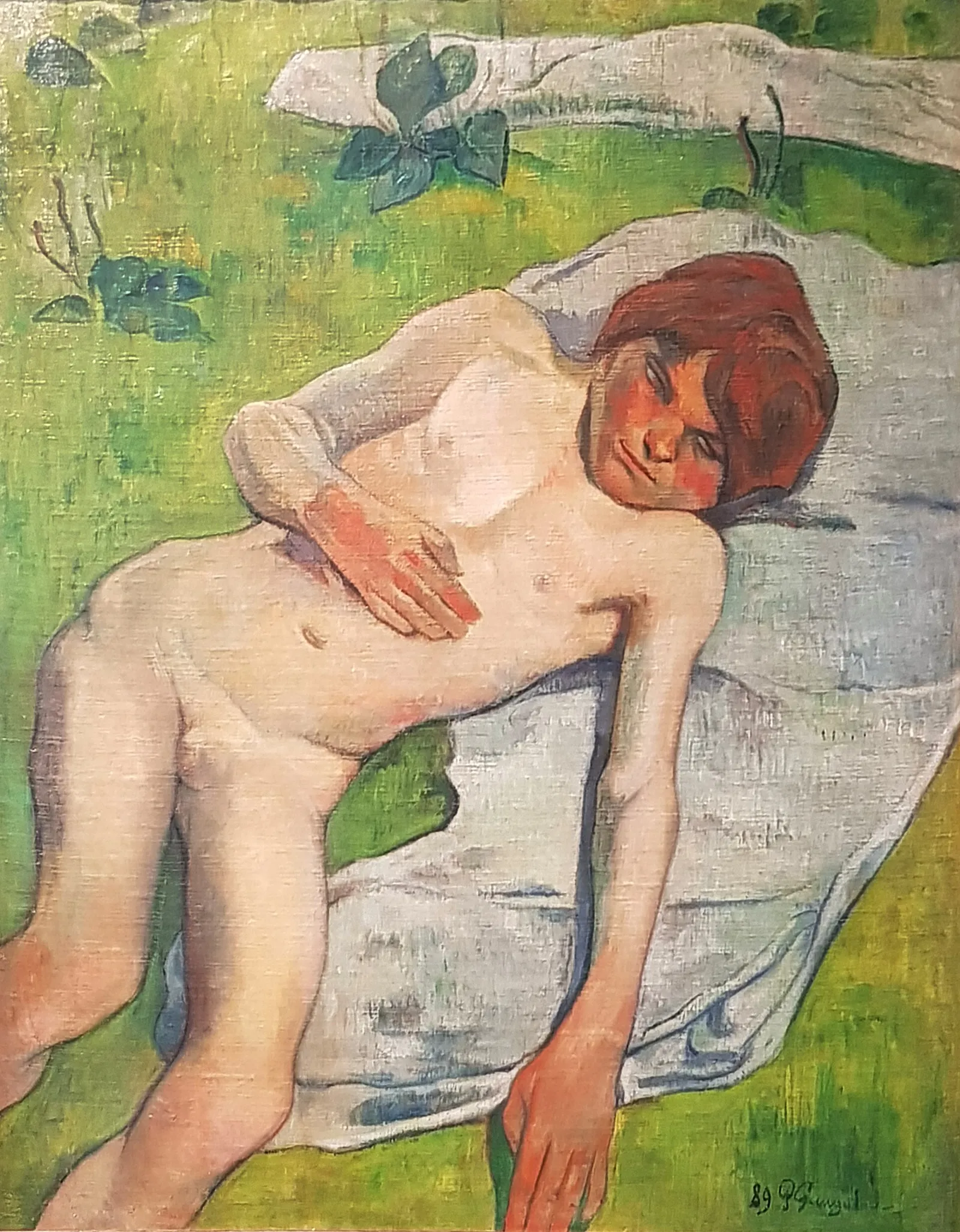
Young boy from Brittany is an 1889 painting by Paul Gauguin, held in the collection of the Wallraf–Richartz Museum. It comes from the period when Gauguin was working with Breton subjects and developing a bolder, flatter way of painting.
Where to see it
Young boy from Brittany is in the collection of the Wallraf–Richartz Museum. Works in museum collections are sometimes rotated, lent or temporarily taken off view, so check the Wallraf–Richartz Museum's official website for current display status, opening hours and visitor information before planning your trip.
What to look for in person
A Breton subject from 1889
Gauguin painted this canvas in 1889, a year he spent largely in Brittany in north-western France. He returned to the region several times in the late 1880s, drawn by its rural life, traditional dress and religious customs, which he saw as simpler and less modern than Paris. In front of the picture, consider how he presents his young sitter. The title points to a place rather than a named person, suggesting the boy stands for the region as much as for himself. Notice how much the setting and clothing contribute to that sense of place.
Colour and outline
By 1889 Gauguin had moved away from the broken, flickering brushwork of Impressionism. He was working toward a style built on flatter areas of colour and firmer contours, an approach linked to the artists around him in Brittany and often called Synthetism. Look closely at how forms are separated. Are edges reinforced by darker lines? Are shadows modelled softly, or simplified into broad zones of tone? Then step back and see how the colours work together as a pattern across the whole surface.
Scale and viewing distance
At 93 cm high and 73.5 cm wide, this is a substantial upright canvas, much larger than a quick sketch. Its size rewards two kinds of looking. From a few metres away, take in the overall design: where the figure sits within the rectangle and how much space is given to the surroundings. Then move closer to study the paint itself, including the direction and texture of the brushstrokes and places where the paint is thin enough to reveal the canvas beneath.
About the painting
Paul Gauguin (1848-1903) came to painting relatively late. He worked in finance in Paris and painted in his spare time before devoting himself fully to art in the 1880s. Early on he exhibited with the Impressionists, but by the end of the decade he was searching for something different: a way of painting that relied less on recording passing effects of light and more on simplified forms, expressive colour and imagination.
Brittany was central to that change. Gauguin first worked in the region in 1886 and returned in the following years, spending time among a circle of artists who were experimenting with bold outlines and flat colour. In late 1888 he spent a brief, turbulent period with Vincent van Gogh in Arles, then went back to Brittany. Breton people, landscapes and customs appear again and again in his work from these years, and he often treated them less as portraits of individuals than as images of a way of life.
Young boy from Brittany, dated 1889, belongs to this period. Within a few years Gauguin would leave France for Tahiti, where he developed many of the ideas he had tested in Brittany.
The painting is held by the Wallraf–Richartz Museum. When you visit, give yourself time to look at it both from a distance and up close, and to compare its handling with any other late nineteenth-century French paintings on display nearby. Before travelling, confirm on the museum's official website that the work is currently on view.
Key facts
| Artist | Paul Gauguin |
|---|---|
| Date | 1889 |
| Size | 93 × 73.5 cm |
| Medium | oil paint, canvas |
| Collection | Wallraf–Richartz Museum |
How to visit: Wallraf–Richartz Museum
Cologne, Germany
Hours and prices can change. Please check the official website before you go.
More by Paul Gauguin
 Arearea — Musée d'Orsay
 Study of a Nude
 Mahana Ma'a — Cincinnati Art Museum
 Where Do We Come From? What Are We? Where Are We Going? — Museum of Fine Arts Boston