Art! Art! Art! › Works
Mahana Ma'a
 Paul Gauguin, 1892
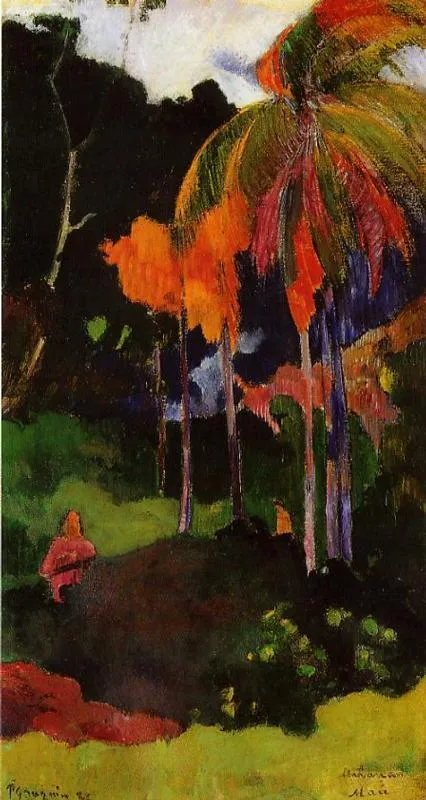
Mahana Ma'a is a painting by Paul Gauguin dated 1892, the period of his first stay in Tahiti. It is held by the Cincinnati Art Museum in Cincinnati, where its compact upright format rewards a close, unhurried look.
Where to see it
Mahana Ma'a is in the collection of the Cincinnati Art Museum, and the museum is listed as the work's location. Works are sometimes rotated, lent or taken off view for conservation, so check the Cincinnati Art Museum's official website for current display status before you visit.
What to look for in person
A tall, narrow canvas
At 55.2 cm high and 30 cm wide, the painting is almost twice as tall as it is wide. That proportion shapes how you read it: your eye tends to move up and down the surface rather than across it. Stand back first to take in the whole vertical arrangement, then step closer to see how Gauguin fits his forms into a slim space. The modest size means it is easy to overlook in a busy gallery, so allow time to stop and look properly.
Colour and flattened form
Gauguin's Tahitian paintings of the early 1890s are known for strong, often non-naturalistic colour laid down in broad areas, with simplified shapes and firm contours rather than detailed modelling. Look at how areas of colour sit next to each other and how little Gauguin relies on traditional depth. Notice where edges are outlined and where colours meet directly. These choices, central to his mature style, push the image toward pattern and decoration while still describing a place and its people.
A Tahitian-language title
Like many works from his time in Tahiti, this painting carries a title in Tahitian rather than French. Gauguin often gave his South Seas pictures such titles, and they were part of how he presented the works to audiences in Europe. When you read the label, consider how the title frames what you see. Visitors today also often reflect on how Gauguin, a European artist, represented Polynesian life, a question that has become an important part of how his work is discussed.
About the painting
Paul Gauguin (1848-1903) was a French artist who, after working in Paris and Brittany, travelled to Tahiti in 1891 in search of a life and subject matter he believed were far from European city culture. His first stay on the island lasted until 1893, and the paintings he made there are among the works most closely associated with his name. Mahana Ma'a, dated 1892, belongs to this first Tahitian period.
During these years Gauguin developed the approach often linked to Synthetism and to the wider move away from Impressionism: simplified forms, flat areas of saturated colour, and compositions that favour rhythm and pattern over strict observation. He painted the landscape around him and the Tahitian people he lived among, and he frequently gave the resulting works Tahitian titles. These paintings were intended largely for buyers and critics in France, and they did much to shape European ideas of Polynesia.
That legacy is now examined critically. Museums and scholars increasingly discuss Gauguin's work in light of colonialism and his relationships in Tahiti, alongside its undoubted influence on later modern artists. Seeing a painting such as Mahana Ma'a in person allows you to weigh both its visual inventiveness and the questions it raises.
The work measures 55.2 by 30 cm and is in the collection of the Cincinnati Art Museum. Its size makes it an intimate object, best appreciated at close range, where the handling of colour and surface can be studied directly. Check the museum's website before visiting to confirm whether it is currently on view.
Key facts
| Artist | Paul Gauguin |
|---|---|
| Date | 1892 |
| Size | 55.2 × 30 cm |
| Medium | oil paint, canvas |
| Collection | Cincinnati Art Museum |
How to visit: Cincinnati Art Museum
Cincinnati, United States · Museum guide
| Opening hours | Tue, Wed, Fri, Sat, Sun 11:00–17:00 Thu 11:00–20:00 Sat–Sun 10:00–11:00 (members only) |
|---|---|
| Closed | Closed on Mondays, and on Thursday 26 November and Friday 25 December. Open on 24 December and 31 December (closing at 17:00) and on 1 January. |
| Admission | General admission free “The Art of Charley Harper: Creatures Wild and Tame” (special exhibition) free for members; ticketed for non-members (price not published) “Nancy Rexroth: Secrets of My Power” (exhibition) free |
| Free entry | General admission is free for everyone every day. Members enter the ticketed Charley Harper exhibition free. Parking is free. |
| Booking | No reservation is required. |
Galleries 224–229 are temporarily closed. On Friday 13 November, most of the first floor, the Terrace Cafe and the REC will be closed, and the Museum Shop will close at 15:00.
Hours and prices can change. Please check the official website before you go. (Checked on: 2026-11-12)
More by Paul Gauguin
 Young boy from Brittany
 Arearea — Musée d'Orsay
 Study of a Nude
 Where Do We Come From? What Are We? Where Are We Going? — Museum of Fine Arts Boston