Art! Art! Art! › Works
Where Do We Come From? What Are We? Where Are We Going?
 Paul Gauguin, 1890s
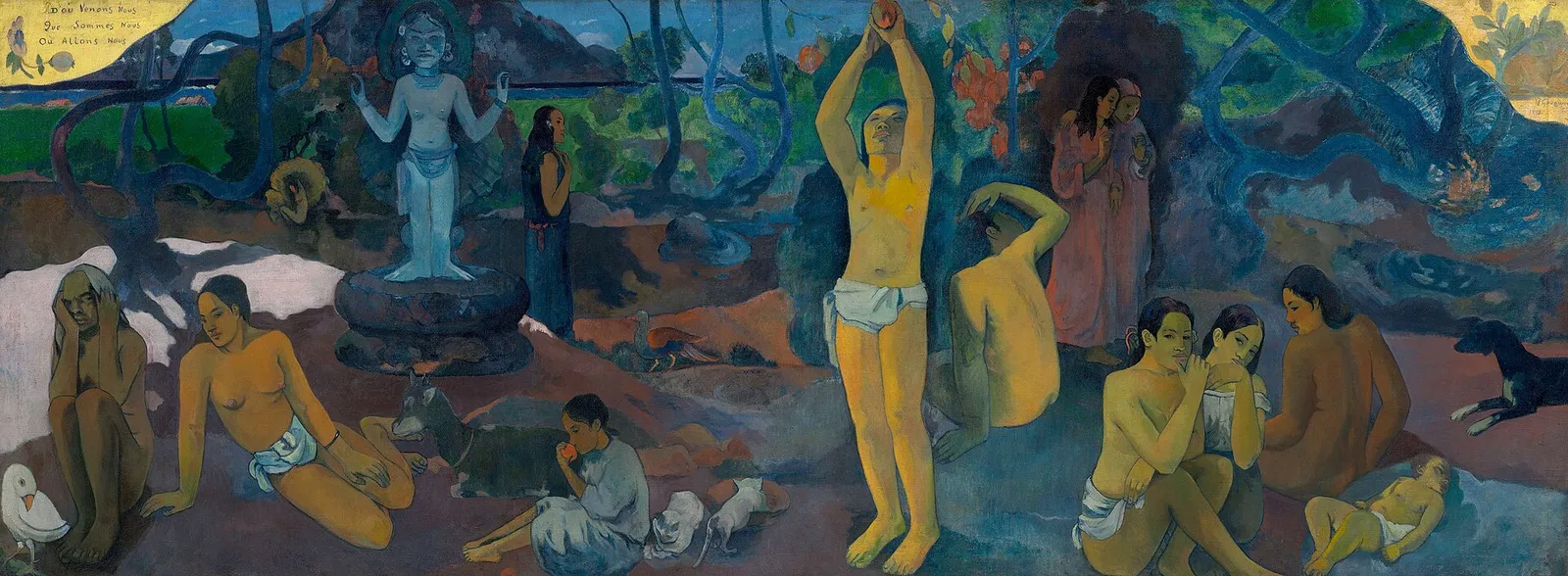
Paul Gauguin's Where Do We Come From? What Are We? Where Are We Going? belongs to the Museum of Fine Arts Boston. Painted in the 1890s and stretching 374.6 cm wide, it is a long, frieze-like canvas that asks to be read slowly, figure by figure, from one end to the other.
Where to see it
The painting is in the collection of the Museum of Fine Arts Boston, located at the Museum of Fine Arts Boston. Works on canvas can be moved, lent or rotated off view, so check the museum's official website for current display status before you plan your visit.
What to look for in person
Read it from right to left
Stand back first so you can take in the full width of the canvas, then start at the right-hand edge. There, a sleeping infant lies near a group of seated women, suggesting the beginning of life. Your eye then moves toward the centre and finally to the far left, where a hunched older woman sits with her head in her hands. Following this sequence turns the painting into a kind of journey through a human lifetime, echoing the three questions of its title.
The figure at the centre
Near the middle of the composition, a tall figure reaches upward to pick fruit from a branch. This standing figure acts as a hinge for the whole scene, dividing the groups on either side and drawing your attention vertically in a picture that is otherwise strongly horizontal. Look at how the upright pose contrasts with the seated and reclining bodies around it, and notice the fruit motif, which recurs elsewhere in the painting, including a child shown eating fruit nearby.
The inscription and the idol
Look to the upper left corner, where Gauguin painted the title in French on a yellow patch that resembles a worn fresco or label: D'ou venons-nous / Que sommes-nous / Ou allons-nous. In the background on the left stands a blue idol with raised arms, a reference to spiritual belief that sits apart from the everyday human activity in the foreground. Near the old woman, look also for a white bird holding a lizard in its claws.
About the painting
Where Do We Come From? What Are We? Where Are We Going? is a large painting by Paul Gauguin, made in the 1890s and now in the collection of the Museum of Fine Arts Boston. It measures 139.1 cm high by 374.6 cm wide, a format much wider than it is tall, which gives it the feel of a mural or a painted frieze rather than a conventional easel picture. Gauguin painted it in Tahiti, where he spent much of his later career, and it draws on the people, landscape and imagery he encountered there, combined with his own symbolic language. In front of the canvas, it helps to think of it less as a single moment and more as a sequence. Figures are arranged across a dense landscape of trees, water and flat areas of colour, each group suggesting a different stage or condition of life. Gauguin did not use traditional perspective to unify the space; instead he relied on rhythm, repeated poses and broad zones of blue, green and warm earth tones to hold the composition together. The title, written directly on the painting, frames the scene as a meditation on origins, existence and destiny rather than a narrative with a clear story. Gauguin himself regarded the work as a summation of his ideas, and it is often discussed as one of the central statements of his Tahitian period and of Symbolist painting more broadly. For visitors, its scale rewards time: view it from a distance to grasp the overall arrangement, then move closer to study individual figures, the idol and the painted inscription.
Key facts
| Artist | Paul Gauguin |
|---|---|
| Date | 1890s |
| Size | 139.1 × 374.6 cm |
| Medium | oil paint, canvas |
| Collection | Museum of Fine Arts Boston |
How to visit: Museum of Fine Arts Boston
Boston, United States · Museum guide
| Opening hours | Sat, Sun, Mon, Wed 10:00–17:00 Thu, Fri 10:00–22:00 (late opening; until 17:00 on Christmas Eve and New Year's Eve) |
|---|---|
| Closed | Closed Tuesdays, and on New Year's Day, Patriots' Day, Fourth of July, Thanksgiving and Christmas. Galleries may close temporarily without notice. |
| Last entry | 30 minutes before closing |
| Admission | Adult USD 30 Ages 7–17 USD 14 Ages 0–6 free (ticket required) Members free Phone order fee USD 6 (per order, phone orders only) |
| Free entry | Pay what you wish (USD 5 minimum) every third Thursday after 17:00 (19 Nov 2026, 17 Dec 2026; in person only). Free for Massachusetts residents on Open House days (18 Jan 2027, 31 May 2027, 18 Jun 2027; in person, no advance tickets). Also free for US active-duty military and veterans plus 5 guests, students and faculty of participating colleges, Bank of America cardholders on the first full weekend of each month, Boston students and families on the first and second Sundays (Boston Family Days), and caregivers of visitors with disabilities. |
| Booking | Booking is recommended; there is no timed entry. General admission tickets are available for dates through January 2027 (as of 9 Nov 2026). |
The Fenway Entrance is closed. Some galleries are closed until further notice: 209/209A/209B (Ancient Egypt, Nubia, Near East), 210/210A/216 (Greece and Rome), 275, 278A–C, 279 and 280 (Asia). The Arts of Japan galleries are closed while three new Japanese art spaces are added.
Official ticket page
Official website
View on map
Hours and prices can change. Please check the official website before you go. (Checked on: 2026-11-12)


